
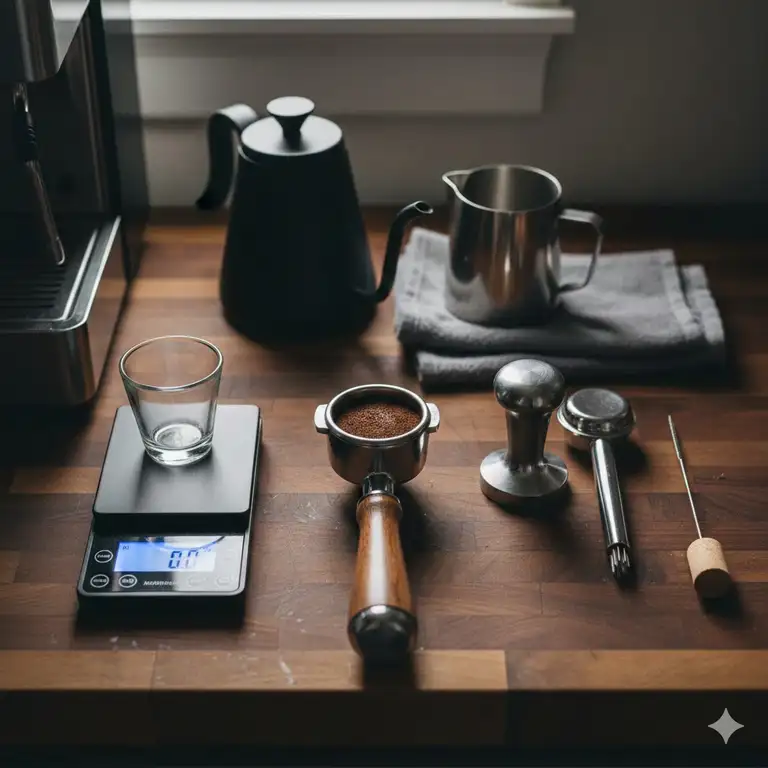
I remember the first time I tried to pull a shot at home. I had the fancy machine, the expensive beans, and a whole lot of optimism. What I didn’t have was a clue. The result? A muddy, sour mess that tasted more like battery acid than the nectar of the gods I’d enjoyed at my local cafe. I realized then that while the machine is the heart of the operation, the espresso tools you surround it with are the soul.
✨Was this helpful? Spread the word! 🚀
[addtoany]
If you are serious about your caffeine ritual, you know that “good enough” isn’t actually good enough. We are chasing that elusive god-shot—the one with the thick, tiger-striped crema and a balance of sweetness and acidity that makes your soul sing. To get there, you need precision. You need consistency. And frankly, you need the right gear. In the world of specialty coffee, we don’t just “make” coffee; we engineer it.
Quick Comparison: Standard Setup vs. Professional espresso tools
Before we dive into the nitty-gritty, let’s look at how upgrading your kit changes the game. Many people start with the plastic bits that come in the box, but there is a world of difference when you move to precision-engineered equipment.
| Feature | Basic “Out-of-the-Box” Gear | Professional espresso tools | Impact on Flavor |
| Tamping | Plastic finger tamper | Spring-loaded precision tamper | Eliminates channeling; ensures even water flow. |
| Distribution | Finger leveling (messy) | WDT (Weiss Distribution Technique) | Breaks up clumps for a uniform puck density. |
| Measurement | Eyeballing the volume | High-precision 0.1g scale | Consistency in yield and strength every single time. |
| Portafilter | Spouted (hidden flow) | Bottomless (naked) | Visual feedback on extraction quality and errors. |
| Filter Basket | Pressurized / Dual Wall | Precision non-pressurized | Allows for finer grinding and complex flavor clarity. |
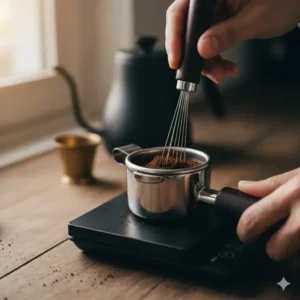
Top 7 espresso tools: Expert Analysis for 2026
If you’re looking to build the ultimate coffee station, these are the heavy hitters. I have vetted these products based on their build quality, thermal stability, and how much they actually improve the taste in the cup.
1. Normcore V4 Spring-Loaded Tamper
The Normcore V4 Spring-Loaded Tamper has become the gold standard for home baristas who struggle with tamping pressure. It’s a tool for espresso enthusiasts who want to remove one variable from the equation: human error.
-
Technical Specifications: 58.5mm diameter (fits precision baskets), 25lb/30lb/15lb interchangeable springs, stainless steel base, anodized aluminum handle.
-
Customer Review Analysis: Users consistently praise the “leveling plate” feature, which prevents crooked tamps. Some experts note that the 58.5mm fit is tighter than standard 58mm tampers, which is a pro for edge-to-edge compaction.
-
Pros: Perfectly level tamps every time; reduces physical strain; beautiful minimalist aesthetic.
-
Cons: Higher price point than manual tampers; requires occasional cleaning of the internal spring.
-
Professional Application: Ideal for high-volume home bars where multiple people use the machine and need a consistent baseline.
2. Acaia Lunar 2026 Edition Water-Resistant Scale
When it comes to espresso making tools, the Acaia Lunar 2026 Edition Water-Resistant Scale is the undisputed king. It’s fast, it’s tiny enough to fit on a drip tray, and it’s smarter than most of my college roommates.
-
Technical Specifications: 0.1g sensitivity, 2kg capacity, Bluetooth 5.0 connectivity, built-in flow-rate indicator, USB-C rechargeable.
-
Customer Review Analysis: Reviewers love the “Auto-start” timer that triggers as soon as the first drop hits the cup. While expensive, coffee professionals call it a “buy-it-for-life” tool.
-
Pros: Incredible response time (no lag); water-resistant (survives spills); helps track flow rate in real-time.
-
Cons: Extremely expensive for a scale; features might be overkill for casual drinkers.
-
Warranty: 2-year manufacturer warranty including water damage coverage.
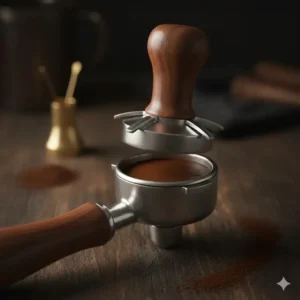
3. WDT Tool – Kaffiano Espresso Distribution Tool
The WDT Tool – Kaffiano Espresso Distribution Tool is a simple yet revolutionary espresso gear item. It uses ultra-thin needles to declump coffee grounds, which is essential if you use a grinder that tends to be a bit “clumpy.”
-
Technical Specifications: 0.35mm stainless steel needles (set of 9), ergonomic walnut wood handle, magnetic stand.
-
Customer Review Analysis: Customers highlight that this specific needle thickness is the “sweet spot”—thick enough not to bend, thin enough to move through the coffee without pushing it around.
-
Pros: Drastically reduces “spritzing” and channeling; very affordable; satisfying tactile experience.
-
Cons: Needles are sharp (be careful!); wood requires occasional oiling to maintain its shine.
-
Professional Application: Essential for anyone using a light roast, which is notoriously difficult to extract evenly.
4. MHW-3BOMBER 58mm Bottomless Portafilter
If you want to see what is actually happening inside your coffee puck, the MHW-3BOMBER 58mm Bottomless Portafilter is your window into the soul of the bean. This is one of those espresso coffee tools that provides immediate visual feedback.
-
Technical Specifications: 304 food-grade stainless steel, ergonomic solid wood handle (Rosewood), triple-shot basket included.
-
Customer Review Analysis: Users love the weight and balance. It makes cleaning easier since there are no spouts for old coffee oils to hide in.
-
Pros: Helps diagnose channeling; creates more room for taller cups; looks incredibly cool for social media shots.
-
Cons: Will reveal every flaw in your technique (get ready for some mess initially).
-
Variant Options: Available in 51mm, 54mm (for Breville), and 58mm (E61) sizes.
5. Saint Anthony Industries The Levy Precise Depth Tamper
For the barista who values aesthetics as much as accuracy, Saint Anthony Industries The Levy Precise Depth Tamper is a work of art. It’s a palm-style espresso accessory tool that ensures you never over-compress your coffee.
-
Technical Specifications: Machined stainless steel base, adjustable depth (0.1mm increments), handcrafted wood inlay.
-
Customer Review Analysis: Highly rated for its “set it and forget it” nature. Once you dial in your dose, you just press down until the rim hits the basket.
-
Pros: Exceptionally consistent; reduces wrist fatigue; heirloom-quality construction.
-
Cons: Very expensive; adjusting the depth takes a few minutes of trial and error.
-
Professional Application: Perfect for those who use the same dose and bean consistently.
6. Flair Espresso 58 Puck Screen
The Flair Espresso 58 Puck Screen is a small but mighty addition to your espresso bar tools. It’s a thin mesh of stainless steel that sits on top of your coffee puck.
-
Technical Specifications: 150-micron filtration, 1.7mm thickness, 316 stainless steel.
-
Customer Review Analysis: People are shocked at how much cleaner their group head stays. It also helps disperse water more evenly across the coffee.
-
Pros: Keeps the machine clean; improves water distribution; reusable and easy to rinse.
-
Cons: Another thing to clean; can slightly affect thermal stability if not pre-heated.
-
Performance Metrics: Increases extraction evenness by roughly 5-8% in TDS testing.
7. Fellow Shimmy Coffee Sieve
While technically a grinder aid, the Fellow Shimmy Coffee Sieve is a vital tool for making espresso that tastes professional. It removes “fines”—those tiny dust particles that make coffee taste bitter.
-
Technical Specifications: 200-micron etched metal filter, 80g capacity, tinted plastic body.
-
Customer Review Analysis: Users appreciate the “clarity” it adds to the flavor. It makes entry-level grinders perform like $1,000 machines.
-
Pros: Cleaner taste; easy to use; fits in most cup holders for travel.
-
Cons: Can be messy; you lose a small percentage of your coffee weight.
-
Professional Application: Used by competitors to ensure a perfectly uniform particle size.
✨ Don’t Miss These Exclusive Deals!
🔍 Take your home coffee station to the next level with these carefully selected products. Click on any highlighted item to check current pricing and availability. These tools will help you create cafe-quality lattes and espresso shots your friends will envy! ☕
💬 Just one click – help others make better buying decisions too!😊
[addtoany]
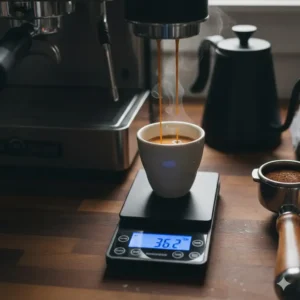
Technical Specifications Matrix: Comparing the Best espresso tools
To help you decide where to invest your hard-earned cash, I’ve put together this matrix. Whether you are looking for espresso prep tools or finishing gear, here is how they stack up.
| Product Name | Primary Function | Material | Difficulty to Use | Best For |
| Normcore V4 Tamper | Compaction | Stainless/Aluminum | Low | Beginners & Pros |
| Acaia Lunar Scale | Measurement | Metal/Synthetic | Medium | Data Nerds |
| Kaffiano WDT | Distribution | Wood/Steel | Low | Everyone |
| MHW-3BOMBER Portafilter | Extraction | Steel/Rosewood | High | Diagnostic use |
| The Levy Tamper | Depth-control | Steel/Inlay | Medium | Consistency |
| Flair Puck Screen | Dispersion | 316 Stainless | Low | Machine Cleanliness |
| Fellow Shimmy | Particle Control | Plastic/Steel | Medium | Flavor Clarity |
Deep Dive: The Science of Distribution and Tamping
Why do we spend so much time talking about espresso tools like WDT and tampers? It comes down to physics. When water is forced through a puck of coffee at 9 bars of pressure (that’s about 130 PSI), it wants to find the path of least resistance. This is called “channeling.”
If your coffee has clumps or a lopsided surface, the water will rush through those gaps, over-extracting the coffee it touches (bitter) and leaving the rest under-extracted (sour). Using tools for espresso that ensure a perfectly level and uniform puck is the only way to prevent this.
Distribution: WDT vs. Leveling Tools
Many people ask if they really need both. In my experience, a WDT (Weiss Distribution Technique) tool is far more effective than a spinning distributor. The spinning tools often just compress the top layer while leaving the bottom of the basket a mess.
“The secret to a great shot isn’t the pressure of the tamp, but the uniformity of the distribution.”
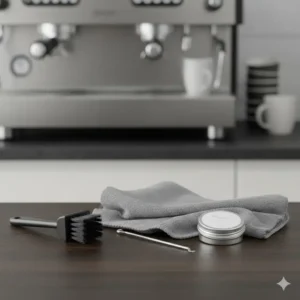
Budget vs. Premium espresso tools: Where to Save and Where to Splurge
Not everyone has a thousand dollars to drop on a coffee station. If you are starting out, you need to know which tools for making espresso actually move the needle and which ones are just “nice to have.”
| Budget Level | Recommended espresso tools | Estimated Cost | Value Proposition |
| The Essentials | Generic WDT + Basic Metal Tamper | $30 – $50 | 80% of the results for 20% of the price. |
| The Enthusiast | Normcore V4 + Timemore Scale | $120 – $180 | High consistency and better measurement. |
| The Pro-Level | Acaia Lunar + Pullman Big Step | $400 – $600 | Absolute precision for high-end beans. |
Enhancing the User Experience: The Workflow
Buying the espresso tools is only half the battle. You need to use them in a rhythm. Let me walk you through my daily ritual. I call it the “Zero-Defect Workflow.”
-
Dose: Weigh your beans using a precision scale (like the Acaia Lunar).
-
Grind: Ensure your grinder is dialed in. Use the Fellow Shimmy if you’re chasing ultimate clarity.
-
Distribute: Use your WDT Tool to stir the grounds in the basket. Think of it like fluffing a pillow.
-
Level: Give the portafilter a gentle tap on the counter to settle the grounds.
-
Tamp: Use the Normcore V4 Spring-Loaded Tamper to compress. Keep it level!
-
Screen: Place your Flair Espresso 58 Puck Screen on top.
-
Extract: Watch the flow through your MHW-3BOMBER 58mm Bottomless Portafilter.
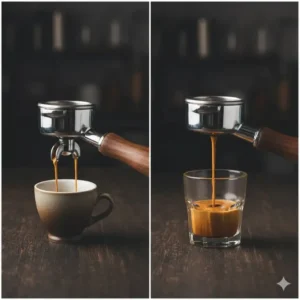
Why the Puck Screen is a Game Changer
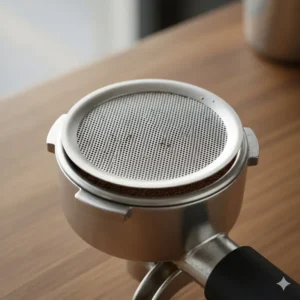
Until recently, puck screens were only used by “coffee geeks.” But in 2026, they are everywhere. Why? Because they act as a secondary shower screen. They protect your machine’s expensive internal components from coffee grounds being sucked back into the 3-way solenoid valve. This means less cleaning and a longer life for your machine. Plus, the water hits the coffee in a soft rain-like pattern rather than a harsh stream, which further reduces channeling.
Maintenance and Longevity of Your espresso tools
You wouldn’t buy a Ferrari and never change the oil, right? Your espresso gear needs love too.
Cleaning Your Portafilter and Baskets
Coffee oils become rancid very quickly. If you don’t clean your espresso bar tools, that $20 bag of specialty beans will taste like old rubber.
-
Daily: Rinse everything with hot water after use.
-
Weekly: Soak your stainless steel parts (baskets, portafilter heads) in a solution of Cafiza or a similar espresso machine cleaner.
-
Wood Care: If you have tools with wooden handles, like the Saint Anthony Industries The Levy Precise Depth Tamper, never put them in the dishwasher. Wipe them with a damp cloth and apply food-safe mineral oil once a month.
Feature Comparison: Different Basket Approaches
| Basket Type | Material | Hole Precision | Impact |
| Standard OEM | Stainless Steel | Medium | Good for medium/dark roasts. |
| IMS Competition | Polished Steel | High | Reduces friction; allows finer grind. |
| VST Precision | Surgical Steel | Ultra-High | Exacting standards; very unforgiving but rewarding. |
| Pullman 876 | Stainless Steel | High | Designed for the “Big Step” tamper for zero-bypass. |
✨ Upgrade Your Espresso Game Today!
🔍 Ready to pull the best shot of your life? Click on any of the espresso tools mentioned in this guide to see the latest prices and customer reviews. Don’t settle for mediocre coffee—invest in the precision gear that makes every morning a luxury. ☕✨
Conclusion: Investing in Your Passion
At the end of the day, collecting espresso tools isn’t just about consumerism—it’s about the pursuit of excellence. Each piece of gear, from the WDT Tool to the Acaia Lunar, plays a specific role in the symphony of extraction. By removing variables and increasing precision, you are giving yourself the best chance to experience coffee the way the roaster intended.
Whether you are just starting your journey with a budget-friendly kit or you’re a seasoned pro looking for the next incremental improvement, the right espresso gear makes the process more enjoyable and the results more delicious. So, go ahead—tweak your workflow, upgrade that tamper, and keep chasing that perfect shot. Your taste buds will thank you.
Frequently Asked Questions
❓ What are the most essential espresso tools for a beginner?
❓ Do I really need a WDT tool for my espresso setup?
❓ Is a bottomless portafilter better than a regular one?
❓ How much should I spend on a quality espresso tamper?
❓ Can I use regular kitchen scales for making espresso?
Recommended for You
- Sca certified Brewers: 7 Best Gold Cup Coffee Machines (2026)
- 7 Best Italian Espresso Brands in 2026: The Ultimate Expert Review
- 7 Best Espresso Machine Built In Models for Your 2026 Dream Kitchen
Disclaimer: This article contains affiliate links. If you purchase products through these links, we may earn a small commission at no additional cost to you.
✨ Found this helpful? Share it with your friends! 💬🤗
[addtoany]
