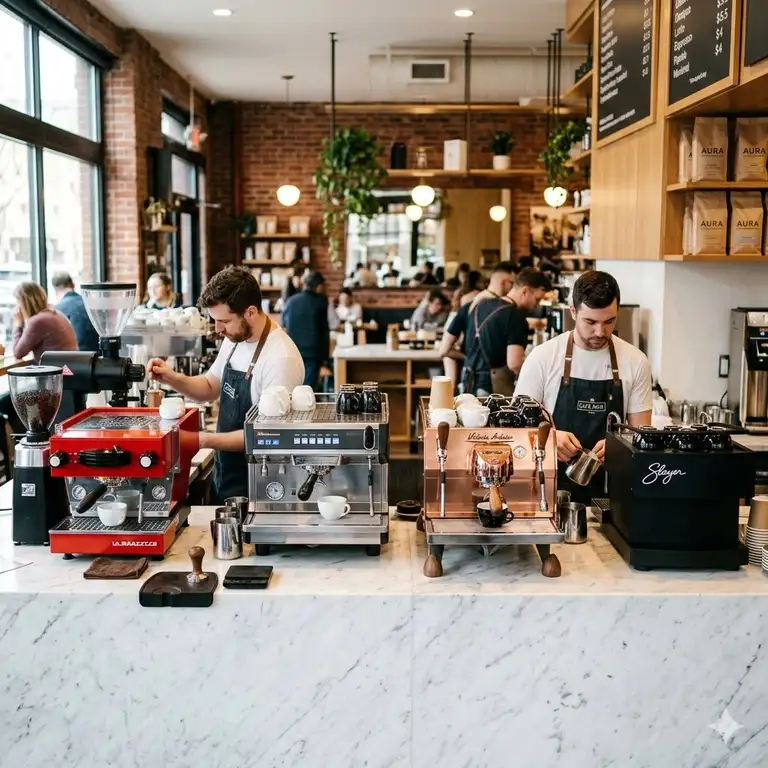
Every morning, millions of Americans walk into their favorite local café, lured by the rich, velvety aroma of roasting beans and the rhythmic hiss of a steam wand. Have you ever wondered what makes that experience possible? It isn’t just the barista’s skill or the origin of the bean; it is the heavy-duty machinery humming behind the counter. Choosing between the various commercial espresso machine brands is perhaps the most significant investment a coffee business owner will ever make. It is the heart of the operation, the literal engine that drives revenue.
✨Was this helpful? Spread the word! 🚀
Whether you are opening a high-volume shop in the middle of Manhattan or a cozy boutique bakery in a sleepy Vermont town, the equipment you choose defines your workflow, your drink quality, and your sanity. In my time consulting for specialty coffee startups, I have seen how the wrong choice can lead to mid-rush breakdowns and frustrated customers. Conversely, the right machine feels like an extension of the barista’s hands. Today, we are diving deep into the world of professional brewing to find the perfect fit for your specific needs.
Commercial Espresso Machines vs. Consumer Models: The Great Divide
Before we get into the nitty-gritty of specific brands, it is vital to understand why you cannot just take a high-end home machine and stick it in a commercial environment. While a home machine might make three or four great lattes a day, commercial espresso machine brands build equipment designed to pull three hundred shots without breaking a sweat.
Comparison: Commercial vs. Prosumer vs. Home Machines
| Feature | Home Espresso Machine | Prosumer (Light Commercial) | Commercial Espresso Machine |
| Daily Output | 1-5 Drinks | 20-50 Drinks | 100-500+ Drinks |
| Boiler Type | Single/Thermoblock | Dual Boiler / Heat Exchanger | Multi-Boiler / Large Capacity |
| Steam Power | Moderate | High | Industrial Strength |
| Plumbing | Water Tank Only | Tank or Plumbed-in | Direct Water Line Required |
| Durability | Plastic/Light Metal | Stainless Steel | Heavy-Duty Brass/Steel |
| Certification | None/UL | NSF/ANSI (Partial) | Full NSF/ANSI 4 Certification |
Quick Comparison of the Top 7 Picks
If you are in a rush and need to know which commercial espresso machine brands are dominating the market in 2026, here is a snapshot of our top contenders.
Top 7 Commercial Espresso Machines: Quick View
| Model | Brand | Best For | Boiler Type |
| La Pavoni Bar-Star 2V-B | La Pavoni | High-Volume Cafes | 14L Heat Exchanger |
| Nuova Simonelli Appia Life | Nuova Simonelli | Consistency & Ease | Heat Exchanger |
| Breville Oracle Touch | Breville | Offices/Self-Service | Dual Boiler |
| Rocket Espresso Appartamento | Rocket | Small Boutiques/Kiosks | Heat Exchanger |
| Gaggia La Decisa | Gaggia | Traditional Italian Style | Dual Boiler |
| Casadio Undici A1 | Casadio | Budget Reliability | Heat Exchanger |
| Diletta Bello+ | Diletta | Low-Volume Specialty | Dual Boiler/PID |
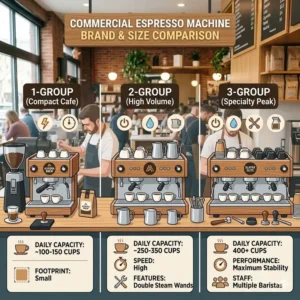
Top 7 commercial espresso machine brands: Expert Analysis
Now, let’s get into the heart of the matter. I have analyzed these machines based on their build quality, thermal stability, and ease of maintenance—three pillars that every business owner must prioritize.
1. La Pavoni Bar-Star 2V-B (2-Group)
When you talk about heritage commercial espresso machine brands, La Pavoni is usually the first name mentioned. The La Pavoni Bar-Star 2V-B is a workhorse designed for the most demanding environments. It features a massive 14-liter copper boiler, which provides incredible steam pressure that never seems to quit, even during the morning rush.
-
Technical Specifications:
-
Boiler Capacity: 14 Liters (Copper)
-
Groups: 2
-
Wattage: 4370W
-
Voltage: 230V
-
Dimensions: 30″ x 22″ x 21″
-
Control: Volumetric (Programmable dosing)
-
-
Customer Review Analysis: Users frequently praise the “thermal inertia” of this machine. One shop owner noted that they could steam two large pitchers of milk simultaneously while pulling shots without any drop in pressure. However, some beginners find the manual overrides a bit intimidating.
-
Professional Applications: Ideal for large-scale coffee shops, hotels, and restaurants with high turnover.
-
Warranty: 1-year parts and labor through authorized distributors.
Pros ✅
-
Massive steam capacity for back-to-back drinks.
-
Chrome-plated brass groups for superior heat retention.
-
Four-position power switch for energy-saving modes.
Cons ❌
-
Requires a 30-amp circuit, which may need electrical upgrades.
-
Large footprint takes up significant counter space.
2. Nuova Simonelli Appia Life (1-Group)
Nuova Simonelli is a staple in the World Barista Championships, and the Nuova Simonelli Appia Life brings that world-class technology to a more compact scale. This is one of the most reliable commercial espresso machine brands for those who want consistent results without a steep learning curve.
-
Technical Specifications:
-
Boiler Capacity: 5 Liters
-
Groups: 1
-
Technology: SIS (Soft Infusion System)
-
Steam Wands: Cool-touch technology
-
Material: Lead-free brass and stainless steel
-
-
Customer Review Analysis: Baristas love the “Soft Infusion System,” which compensates for imperfect tamping. It’s often described as a “forgiving” machine. Feedback suggests it is surprisingly quiet compared to older models.
-
Professional Applications: Perfect for mobile coffee carts, small bakeries, and high-end offices.
-
Warranty: 2-year warranty on major components.
Pros ✅
-
SIS technology ensures crema-rich shots every time.
-
Ergonomic “Push & Pull” steam levers reduce wrist strain.
-
Energy-efficient insulation reduces operating costs.
Cons ❌
-
Single group might struggle with lines longer than 5 people.
-
Plastic side panels feel less premium than all-metal alternatives.
3. Breville Oracle Touch
While often categorized as “high-end home,” the Breville Oracle Touch is frequently used as a light commercial solution for offices or self-service lounges. Among commercial espresso machine brands, Breville excels at automation. If you don’t have a trained barista, this is your best friend.
-
Technical Specifications:
-
Boiler: Dual Stainless Steel
-
Grinder: Integrated conical burr grinder
-
Tamping: Automatic grind and tamp
-
Touchscreen: Swipe and select menu
-
PID Control: Digital temperature control
-
-
Customer Review Analysis: Customers rave about the “automated milk texturing.” It can produce latte-art quality microfoam at the touch of a button. Some purists dislike the lack of manual control, but for office settings, it is unparalleled.
-
Professional Applications: Executive boardrooms, boutique hair salons, and high-end car dealerships.
-
Warranty: 2-year limited warranty.
Pros ✅
-
Requires zero barista training to operate.
-
Extremely fast heat-up time.
-
Compact and sleek aesthetic.
Cons ❌
-
Not suitable for heavy-duty cafe use (limited daily cycles).
-
Integrated grinder is a single point of failure.
4. Rocket Espresso Appartamento
For those who prioritize style and “vibe” as much as the coffee, the Rocket Espresso Appartamento is a legend. Rocket is one of the commercial espresso machine brands that focuses on the “prosumer” bridge, but the Appartamento’s commercial-grade E61 group head makes it a favorite for small boutique pop-ups.
-
Technical Specifications:
-
Boiler: 1.8L Heat Exchanger
-
Group Head: E61 heavy brass
-
Pump: Vibratory (Quiet-tuned)
-
Water Source: 2.5L Reservoir (Can be adapted)
-
Finish: Stainless steel with copper or white circular inserts
-
-
Customer Review Analysis: “A piece of art on the counter,” says one reviewer. Users love the manual control offered by the E61 lever. A few users mentioned that it takes about 20 minutes to fully heat up, so it’s not a “turn on and go” machine.
-
Professional Applications: Design studios, small retail boutiques, and low-volume “hidden” cafes.
-
Warranty: 1-year parts and labor.
Pros ✅
-
Iconic design that attracts customers’ eyes.
-
Excellent thermal stability due to the E61 group.
-
Small footprint fits anywhere.
Cons ❌
-
Manual operation requires a skilled hand.
-
No volumetric programming (must stop shot manually).
5. Gaggia La Decisa
Gaggia is arguably the grandfather of all commercial espresso machine brands. The Gaggia La Decisa is their modern answer to the mid-sized cafe market. It balances traditional Italian brewing philosophy with modern touchscreen convenience.
-
Technical Specifications:
-
Boiler: 13L (on 2-group models)
-
Display: LED-backlit keyboard and touchscreen
-
Wattage: 3450W
-
Energy: Smart eco-mode
-
Groups: Available in 2 or 3 groups
-
-
Customer Review Analysis: Reliable and “unfussy.” Owners appreciate the easy access for technicians, which keeps maintenance costs low. The steam power is noted as being particularly “dry,” which is great for velvet-textured milk.
-
Professional Applications: Mid-sized cafes, busy breakfast spots, and diners.
-
Warranty: 1-year commercial warranty.
Pros ✅
-
Highly intuitive interface for staff.
-
Tall-cup version available for 16oz+ lattes.
-
Very competitive pricing for a full-sized 2-group.
Cons ❌
-
Exterior styling is a bit “corporate” compared to Rocket or La Pavoni.
-
Menu navigation can be slightly laggy during peak use.
6. Casadio Undici A1
Owned by the Gruppo Cimbali (one of the largest commercial espresso machine brands in the world), Casadio offers the “Undici” line. The Casadio Undici A1 is a compact, automatic machine that is built like a tank and priced for the startup entrepreneur.
-
Technical Specifications:
-
Boiler: 5 Liters
-
Pump: Built-in volumetric pump
-
Nozzles: 1 multi-directional steam wand, 1 hot water wand
-
Body: Steel and aluminum
-
System: Fixed-nozzle thermosyphon system
-
-
Customer Review Analysis: Frequently cited as the “best value” in the commercial space. It doesn’t have the bells and whistles of a touchscreen, but it works day in and day out. “It’s the Toyota Corolla of espresso machines,” says one tech.
-
Professional Applications: Gas stations, small kiosks, and catering businesses.
-
Warranty: 1-year parts.
Pros ✅
-
Incredible durability for the price point.
-
Compact A1 model fits on very narrow counters.
-
Simple mechanical buttons are easy to replace.
Cons ❌
-
Lack of advanced PID control for specific temperature surfing.
-
Single steam wand can slow down service during rushes.
7. Diletta Bello+
A newer entry in the specialty market, the Diletta Bello+ is making waves among commercial espresso machine brands for bringing high-end features to a manageable size. It’s a dual-boiler machine that offers the precision of a professional lab in a package that fits on a standard kitchen counter.
-
Technical Specifications:
-
Boiler: 0.5L Brew / 1.5L Steam (Dual)
-
Control: PID Temperature Control
-
Timer: Built-in shot timer
-
Pump: Vibratory (High performance)
-
Frame: Stainless steel
-
-
Customer Review Analysis: Users love the PID display which doubles as a shot timer. It allows for “micro-adjustments” that help pull the best flavors out of light-roast beans. Some find the vibratory pump a bit loud compared to rotary pumps.
-
Professional Applications: Specialty coffee testing labs, low-volume “slow bars,” and high-end catering.
-
Warranty: 2-year manufacturer warranty.
Pros ✅
-
Precise temperature control for different roast profiles.
-
Shot timer helps baristas maintain consistency.
-
Beautifully polished stainless steel finish.
Cons ❌
-
Small brew boiler may struggle with rapid back-to-back shots.
-
Vibratory pump isn’t as robust as a rotary pump for 24/7 use.
✨ Don’t Miss These Exclusive Deals!
🔍 Take your kitchen or cafe to the next level with these carefully selected products. Click on any highlighted item to check current pricing and availability. These tools will help you create world-class espresso that your customers will love! ✨
💬 Just one click – help others make better buying decisions too!😊
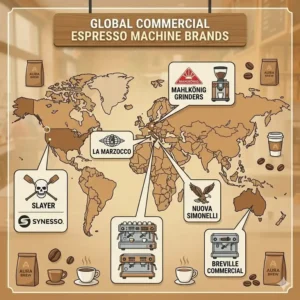
Detailed Product Comparison: Feature Matrix
| Model | Group Heads | PID Control | Auto-Tamp | Water Connection | Ideal Traffic |
| La Pavoni Bar-Star | 2 | No (HX) | No | Plumbed | High |
| Nuova Simonelli Appia | 1 | No (SIS) | No | Plumbed | Medium |
| Breville Oracle Touch | 1 | Yes | Yes | Reservoir | Office |
| Rocket Appartamento | 1 | No | No | Reservoir | Low |
| Gaggia La Decisa | 2 | Optional | No | Plumbed | High |
| Casadio Undici A1 | 1 | No | No | Plumbed | Medium |
| Diletta Bello+ | 1 | Yes | No | Reservoir | Low |
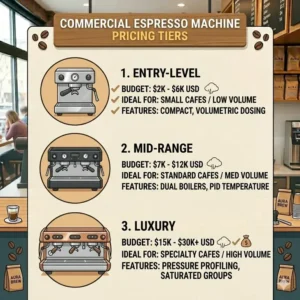
Budget vs. Premium Analysis
| Category | Budget (<$2,500) | Mid-Range ($2,500-$6,000) | Premium ($6,000+) |
| Focus | Functionality/Value | Balance of Power/Size | Maximum Output/Tech |
| Best Brand Pick | Casadio | Nuova Simonelli | La Pavoni |
| Longevity | 5-7 Years | 8-12 Years | 15+ Years |
| Maintenance | Low frequency | Moderate | Professional Required |
Performance Metrics: Steaming Power & Recovery
| Model | Steam Pitcher (12oz) Time | Recovery Time Between Shots | Max Daily Cups |
| La Pavoni Bar-Star | 8 Seconds | Instant | 500+ |
| Nuova Simonelli Appia | 12 Seconds | 5 Seconds | 150 |
| Breville Oracle Touch | 25 Seconds (Auto) | 15 Seconds | 50 |
| Rocket Appartamento | 18 Seconds | 20 Seconds | 40 |
| Gaggia La Decisa | 10 Seconds | Instant | 400 |
| Casadio Undici A1 | 15 Seconds | 10 Seconds | 100 |
| Diletta Bello+ | 20 Seconds | 15 Seconds | 30 |
The Technical Core: What Makes These Brands Tick?
When you are looking at commercial espresso machine brands, you are really looking at a collection of engineering choices. Furthermore, these choices impact everything from the flavor of your espresso to your monthly electricity bill.
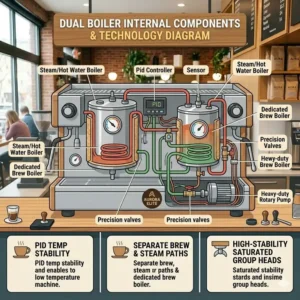
Heat Exchanger (HX) vs. Dual Boiler
This is the age-old debate in the coffee world. A Heat Exchanger machine uses one large boiler to keep water at steaming temperature. A pipe runs through that boiler, flash-heating the brew water on its way to the group head.
-
Pros: Lower cost, great steam power, smaller footprint.
-
Cons: “Temperature surfing” may be required; you often have to flush the group to cool it down.
On the other hand, a Dual Boiler machine (like the Diletta or Breville) has two dedicated tanks. One is set precisely to brew temperature ($195^{\circ}F$ to $205^{\circ}F$) and the other to steam temperature.
-
Pros: Maximum precision, no flushing required, incredible consistency.
-
Cons: Higher price point, more components to maintain, larger energy draw.
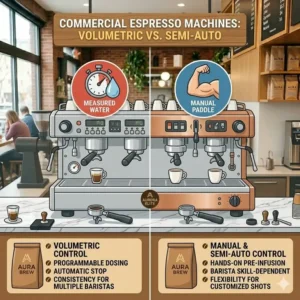
Volumetric vs. Manual Dosing
Many commercial espresso machine brands offer both options.
-
Volumetric machines have a flow meter. You press a button, and the machine stops exactly at 36g (or whatever you program). This is vital for consistency when you have multiple staff members.
-
Manual/Semi-Automatic machines require the barista to start and stop the shot. Consequently, this requires more focus but allows for “on-the-fly” adjustments.
Comparison: Manual vs. Automatic Workflow
| Metric | Manual (Semiautomatic) | Volumetric (Automatic) | Super-Automatic |
| Barista Skill Req. | High | Moderate | Low |
| Drink Quality | Potentially Highest | Very Consistent | Good/Standard |
| Speed of Service | Slower | Faster | Fastest |
| Maintenance | Low | Moderate | High |
How to Choose the Right Brand for Your Business
I often tell my clients that choosing among commercial espresso machine brands is like choosing a car. You don’t buy a Ferrari to haul lumber, and you don’t buy a pickup truck for a Formula 1 race.
Step 1: Analyze Your Volume
Be honest with yourself. If you expect to serve 200 people in a two-hour window, you must have a multi-group, plumbed-in machine with a large boiler like the La Pavoni Bar-Star. If you are a jewelry store that wants to offer a latte to customers while they browse, a Breville Oracle Touch is more than enough.
Step 2: Consider Your Power Supply
Commercial machines aren’t “plug and play” into a standard 110V wall outlet. Most require 220V/240V and a 20 to 30 amp circuit. Additionally, you will need a direct water line and a drain. If you are in a historical building where you cannot drill holes or upgrade the panel, you might be restricted to “prosumer” models with water reservoirs like the Rocket Espresso Appartamento.
Step 3: Local Support
This is the secret that most blog posts won’t tell you. Before you buy, call the local espresso machine technician in your city. Ask them, “Which brands do you carry parts for?” If you buy a beautiful Italian machine but the only person who can fix it is three states away, you will be in trouble when a gasket blows on a Saturday morning. Commercial espresso machine brands like Nuova Simonelli and La Pavoni have huge technician networks in the USA.
Benefit Comparison: Investing in Quality
| Benefit | Cheap/Used Machine | High-End Brand (New) |
| Customer Retention | Risk of inconsistent taste | High due to quality |
| Repair Costs | High and frequent | Low (Warranty periods) |
| Resale Value | Poor | High (70-80% MSRP) |
| Employee Morale | Frustrated with breaks | Proud to use “Pro” gear |
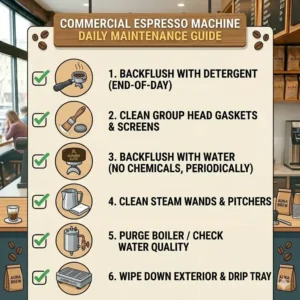
Maintenance: The Key to Longevity
You wouldn’t buy a car and never change the oil, right? Commercial espresso machine brands require a daily, weekly, and quarterly schedule to keep the coffee tasting sweet and the machine running smoothly.
The Daily Routine
-
Backflushing: Using a blind filter and detergent to clean the group heads.
-
Steam Wand Cleaning: Purging and wiping after every single use (milk is a machine killer!).
-
Portafilter Soak: Keeping the baskets free of bitter coffee oils.
The Water Problem
In my experience, 90% of all commercial machine failures are caused by water scale. Calcium and magnesium build up inside the copper pipes and eventually choke the machine to death. You must invest in a high-quality water filtration system. Sites like NCAUSA.org provide great resources on the chemistry of coffee water.
Estimated Maintenance Costs (Annual)
| Item | Estimated Cost |
| Cleaning Supplies (Detergent/Brushes) | $150 |
| Water Filter Cartridges | $300 – $500 |
| Gasket/Screen Replacement | $100 |
| Professional PM (Preventative Maint.) | $400 – $800 |
| Total | **$950 – $1,550** |
✨ Don’t Miss These Exclusive Deals! 🔍
Take your coffee game to the next level with these carefully selected products. Click on any highlighted item to check current pricing and availability. These tools will help you create flavors your customers will love! ☕
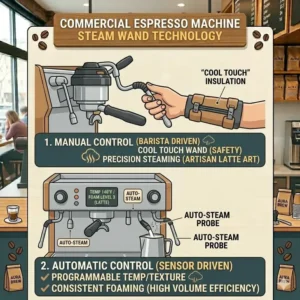
Conclusion: Crafting Your Legacy
Choosing the right partner from the many commercial espresso machine brands available today is about more than just numbers on a spec sheet. It is about how you want your business to feel. Do you want the manual, tactile experience of a Rocket? Or the high-tech, consistent automation of a Nuova Simonelli?
Ultimately, your machine is a silent partner. When it is working well, you don’t even think about it—you just focus on the customer in front of you and the latte art in the cup. Take the time to research your local support, measure your counter space, and dream about those perfect shots. Your future customers are waiting for that first sip.
Frequently Asked Questions
✅ Nuova Simonelli and La Marzocco are widely considered the gold standards for reliability. For those on a tighter budget, Casadio and Gaggia offer excellent longevity with lower upfront costs, provided you maintain a regular cleaning schedule…
✅ A 1-group machine is sufficient for low-volume settings (under 50 drinks per day). However, for a standard cafe, a 2-group machine is recommended to allow two baristas to work or to steam milk while a shot pulls…
✅ Technically yes, but practically no. Home machines lack NSF certification required by health departments and will likely fail under the stress of back-to-back orders. Commercial espresso machine brands are built for constant heat and pressure…
✅ Expect to spend between $3,000 and $15,000. Entry-level commercial units start around $3k, while high-performance multi-boiler systems used in specialty shops often range from $8,000 to $20,000 depending on features and group count…
✅ Tap water contains minerals that cause scale buildup, which is the leading cause of machine failure. Proper filtration ensures the coffee tastes better and protects your multi-thousand-dollar investment from costly internal damage and heating element failure… ❓ What are the most reliable commercial espresso machine brands for a startup cafe?
❓ Do I need a 1-group or 2-group commercial espresso machine?
❓ Can I use a home espresso machine in my coffee shop?
❓ How much should I budget for a commercial espresso machine?
❓ Why is water filtration so important for commercial espresso brands?
Recommended for You:
- Sca certified Brewers: 7 Best Gold Cup Coffee Machines (2026)
- 7 Best Espresso Machine Built In Models for Your 2026 Dream Kitchen
- 7 Best Commercial Coffee Maker Reviews: Boost Your 2026 Business Now!
Disclaimer: This article contains affiliate links. If you purchase products through these links, we may earn a small commission at no additional cost to you.
✨ Found this helpful? Share it with your friends! 💬🤗