
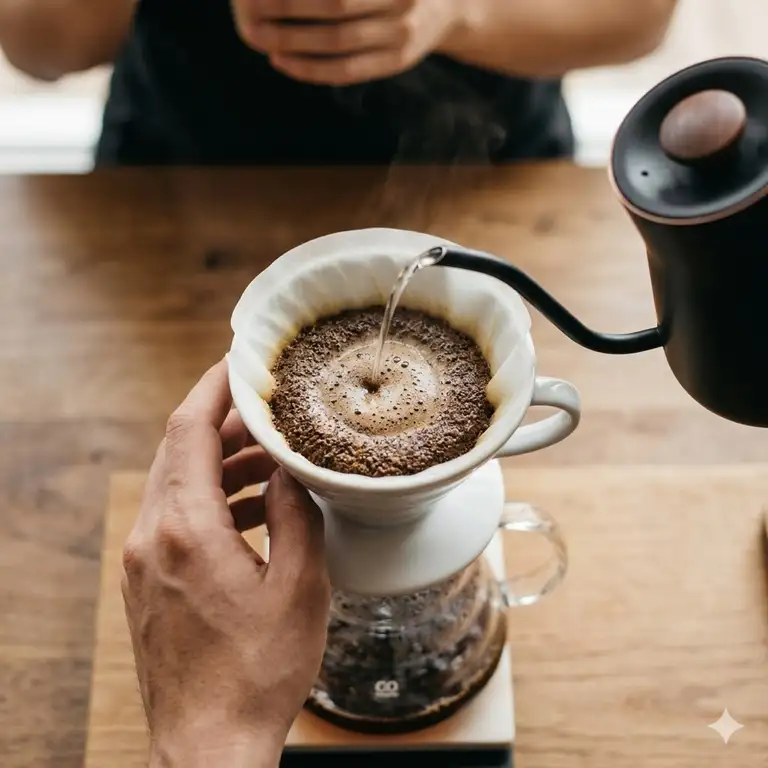
What is hand brew coffee? Hand brew coffee is a manual method of preparing coffee that involves pouring hot water over ground beans held in a filter, allowing for precise control over variables like temperature, flow rate, and steep time. Unlike automated machines, this “slow coffee” movement prioritizes the craft and sensory experience of the extraction process.
In the fast-paced digital landscape of 2026, the ritual of hand brew coffee has become more than just a caffeine delivery system; it is a morning meditation for millions of Americans. While high-tech super-automatics exist, there is an undeniable soul in the manual pour. By engaging directly with the grounds, you unlock nuanced flavor profiles—floral notes in Ethiopian beans or the crisp acidity of a Colombian roast—that often get lost in the muddy extraction of a standard drip machine. My journey into manual brewing started years ago with a simple plastic dripper, and I’ve found that the tactile feedback of the water hitting the bloom is something no app-controlled device can truly replicate. Whether you are a seasoned barista or a curious beginner, mastering this art allows you to tailor every single gram of flavor to your specific palate.
Quick Comparison Table: The Top Hand Brew Methods
| Method | Best For | Difficulty | Flavor Profile | Material Options |
| Hario V60 | Precision junkies | High | Bright & Clean | Ceramic, Glass, Metal |
| Chemex | Aesthetic & Clarity | Medium | Crisp & Tea-like | Borosilicate Glass |
| Kalita Wave | Consistency | Low | Balanced & Sweet | Steel, Ceramic, Glass |
| AeroPress | Travel & Speed | Low | Full-bodied | BPA-free Plastic |
| Fellow Stagg [X] | Heat Retention | Medium | Consistent & Rich | Double-wall Stainless |
Looking at the comparison above, the Hario V60 offers the highest ceiling for flavor clarity but requires a steady hand, making it the enthusiast’s choice. In contrast, the Kalita Wave‘s flat-bottom design is significantly more forgiving for those who haven’t yet mastered their pouring technique. If portability is your main concern, the AeroPress remains the reigning champion for durability and ease of use in 2026.
💬 Just one click — help others make better buying decisions too! 😊
[addtoany]
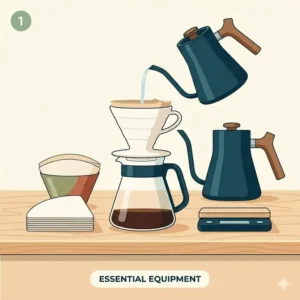
The Best Hand Brew Coffee Equipment: Expert Analysis 2026
1. The Standard-Bearer: Hario V60 Ceramic Coffee Dripper
The Hario V60 Ceramic Coffee Dripper (Size 02) remains the gold standard for manual extraction. Its 60-degree angle and internal spiral ribs aren’t just for show; they are engineered to keep the filter paper from sticking to the walls, allowing for optimal air release and a consistent draw-down.
In my experience, the ceramic version is superior to the plastic one for home use because of its thermal mass. If you pre-heat it properly with a quick rinse of hot water, it holds the slurry temperature steady throughout the three-minute brew. This prevents the “sour” under-extraction that often happens when the water cools too quickly. What most buyers overlook is the importance of the large single hole at the bottom—it means the flow rate is entirely dependent on your pour, giving you total control but also requiring a gooseneck kettle for precision.
-
Key Specs: 60° conical shape, spiral ribs, high-fire ceramic.
-
Customer Feedback: Users consistently praise the clarity of the cup, though some find the learning curve steep for beginners.
-
Expert Verdict: Best for the “flavor chaser” who enjoys experimenting with grind sizes and pour techniques.
-
Pros:
-
Unmatched flavor clarity
-
Beautiful, durable ceramic build
-
Extensive community support and recipes
-
-
Cons:
-
Fragile if dropped
-
Requires a precise gooseneck kettle
-
-
Price Range: Around $20–$30.
2. The Design Icon: Chemex Classic Series 6-Cup
The Chemex Classic Series 6-Cup is as much a piece of art as it is a brewer. It utilizes a non-porous borosilicate glass that doesn’t absorb odors or chemical residues. The real secret to the Chemex, however, is its proprietary bonded paper filters, which are 20-30% thicker than standard filters.
The thicker paper removes almost all of the coffee oils and fine sediment, resulting in what I call “the cleanest cup of coffee on earth.” It’s incredibly tea-like and bright. From a practical standpoint, this is the best brewer for entertaining. While most hand brew coffee drippers make one cup at a time, the 6-cup Chemex allows you to serve a small group without losing quality. The wood neck collar and leather tie are iconic, but remember to remove them before washing to prevent the wood from warping over time.
-
Key Specs: 30 oz capacity, borosilicate glass, wood collar.
-
Customer Feedback: Owners love the aesthetics and the lack of sediment, though some complain about the cost of the specific filters.
-
Expert Verdict: Perfect for the host who values design and a crisp, sediment-free brew.
-
Pros:
-
Elegant timeless design
-
Large batch capacity for manual brew
-
Extremely clean flavor profile
-
-
Cons:
-
Glass is thin and requires careful handling
-
Filters are more expensive than standard ones
-
-
Price Range: $45–$55 range.
3. The Consistency King: Kalita Wave 185 Stainless Steel
If the V60 is a manual transmission car, the Kalita Wave 185 Stainless Steel is a high-end automatic. The defining feature is its flat-bottomed bed with three small extraction holes. This design creates a “water pillar” that helps regulate the flow, making it much more forgiving if your pour is a bit shaky or inconsistent.
What I love about the stainless steel Wave is its indestructibility. Unlike the ceramic V60 or the glass Chemex, you can throw this in a backpack or knock it off a counter without a second thought. The “wave” filters also play a role by keeping the coffee away from the walls of the dripper, which helps maintain a stable temperature. For someone who wants the ritual of hand brew coffee without the stress of “perfect” technique, this is the definitive choice in 2026.
-
Key Specs: 18-8 Stainless steel, flat-bottom geometry, three-hole design.
-
Customer Feedback: Reviewers frequently mention that it is the easiest pour-over to get right on the first try.
-
Expert Verdict: Ideal for daily drinkers who want a balanced cup without overthinking the physics.
-
Pros:
-
Nearly indestructible build
-
Highly consistent extraction
-
Great for travel
-
-
Cons:
-
Filters can be harder to find in local stores
-
Slightly less “bright” than the V60
-
-
Price Range: Around $30–$40.
4. The Versatile Workhorse: AeroPress Clear
The AeroPress Clear is a 2026 favorite because it uses a new, glass-like Tritan™ plastic that is shatterproof and BPA-free. While not a traditional “pour-over,” it is a staple of the hand brew coffee world because of its versatility. It uses a combination of immersion and pressure to extract coffee in under two minutes.
The spec sheet says it makes “espresso style” coffee, but what that really means is you get a concentrated shot that can be diluted with water (for an Americano) or milk. In my professional opinion, the AeroPress is the best tool for learning about extraction. You can change the steep time, the pressure, and the temperature to see exactly how it affects the bitterness. It’s the ultimate “scientist’s” coffee maker. Plus, the clean-up takes roughly five seconds—you just “pop” the puck into the bin.
-
Key Specs: Tritan™ construction, 10 oz capacity, includes 100 filters.
-
Customer Feedback: Users adore its portability and the fact that it’s almost impossible to brew a “bad” cup.
-
Expert Verdict: Best for travelers, campers, and office workers who need a quick, great cup.
-
Pros:
-
Fastest brew time
-
Extreme durability
-
Easy to clean
-
-
Cons:
-
Small capacity (mostly single cup)
-
Can feel less “premium” than glass/ceramic
-
-
Price Range: $50 range.
5. The Professional Tool: Fellow Stagg [X] Pour-Over Set
For those willing to spend a bit more for engineering, the Fellow Stagg [X] Pour-Over Set is a masterpiece. It features a vacuum-insulated, double-wall stainless steel body. This is a game-changer for temperature stability. Most drippers lose significant heat to the air during a three-minute pour, but the Stagg [X] keeps the slurry piping hot.
The steep interior slope also increases the height of the coffee bed, which forces the water to interact with more grounds as it passes through. This results in a very rich, high-extraction cup. What the marketing won’t tell you is that because of the high heat and vertical flow, you usually need to grind slightly coarser than you would for a V60 to avoid over-extraction. It’s a precision instrument that rewards those who pay attention to the details.
-
Key Specs: Double-wall vacuum insulation, stainless steel, built-in ratio aid.
-
Customer Feedback: High praise for the temperature retention and the sleek, modern aesthetic.
-
Expert Verdict: The best choice for the “pro-sumer” who wants the highest possible extraction levels.
-
Pros:
-
Superior heat retention
-
Modern, minimalist design
-
Consistently high extraction
-
-
Cons:
-
Higher price point
-
Requires specific tall filters
-
-
Price Range: $80–$100 range.
✨ Don’t Miss These Exclusive Deals!
🔍 Take your hand brew coffee to the next level with these carefully selected products. Click on any highlighted item to check current pricing and availability. These tools will help you create authentic results your family will love!
The Science of the Pour: A Practical Usage Guide
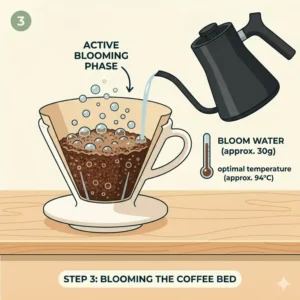
Mastering hand brew coffee isn’t just about the gear; it’s about the dance of water and coffee. Many beginners make the mistake of just dumping water in and waiting. To get the most out of your beans, you need to understand the “The Bloom.” When hot water first hits the grounds, you’ll see bubbles forming—this is the release of carbon dioxide (degassing). If you don’t allow 30-45 seconds for this “bloom,” the gas will actually repel the water, leading to uneven extraction and a weak, sour cup.
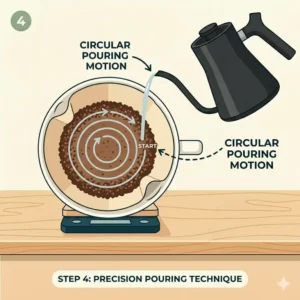
Once the bloom is finished, your pouring technique should be a slow, spiral motion starting from the center and moving outward, but never touching the very edges of the filter. If you pour on the edges, the water will “bypass” the coffee and go straight down the side of the dripper, resulting in a thin, watery brew. Aim for a total brew time of 3 to 4 minutes. If it’s taking longer than 5 minutes, your grind is too fine; if it’s finishing in 2 minutes, your grind is too coarse. This constant feedback loop is what makes hand brew coffee so engaging—you are the pilot of your morning caffeine.
Finding Your Ritual: Hand Brew Scenarios for Real Life
Choosing the right hand brew coffee setup depends entirely on your lifestyle. I’ve categorized three common personas to help you find your match:
-
The WFH Perfectionist: If you have a dedicated coffee corner and 10 minutes to spare in the morning, go for the Hario V60. Pair it with a high-quality burr grinder and a gooseneck kettle. The ritual of measuring and pouring will act as a mental bridge between “sleep mode” and “work mode.”
-
The Weekend Brunch Host: If you love having friends over for Sunday morning bagels, the Chemex is your best friend. It looks stunning on a dining table and produces enough coffee for 3-4 people at once. The clean flavor also pairs beautifully with heavy breakfast foods like pancakes or eggs benedict.
-
The Outdoor Adventurer: For those who spend their Saturdays hiking or camping, the AeroPress or the Kalita Wave (Steel) are essential. They don’t break, they are easy to pack, and they work perfectly even if your water temperature isn’t perfectly controlled by a thermometer.
By matching the brewer to your environment, you ensure that the process remains a joy rather than a chore.
How to Choose Your First Hand Brew Setup
Selecting your first piece of gear for hand brew coffee can feel overwhelming, but focusing on these three criteria will simplify the process:
-
Material Matters: If you are prone to dropping things, avoid glass and ceramic. Stainless steel or high-grade plastic (like Tritan) is your friend. However, if you care about heat retention above all else, ceramic and insulated metal are the clear winners.
-
Filter Availability: Some brewers, like the Chemex or the Fellow Stagg, require proprietary filters. Before you buy the dripper, make sure you are comfortable with the recurring cost and availability of these filters. Standard #2 or #4 filters are much easier to find at local grocery stores.
-
Required Accessories: A V60 is almost impossible to use well without a gooseneck kettle. If you don’t want to invest in a new kettle, look for a “flow-restricted” dripper like the Kalita Wave or an immersion method like the AeroPress, which can be used with a standard kitchen kettle.
Common Pitfalls: Why Your Hand Brew Coffee Tastes Bitter
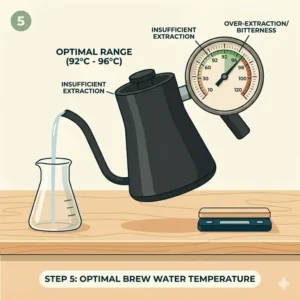
If your hand brew coffee tastes like burnt rubber or leaves a dry, “sandpaper” feeling on your tongue, you are likely over-extracting. This happens when the water pulls too much from the coffee beans. The most common culprit is water temperature. In 2026, many people still believe coffee needs boiling water. In reality, water at 212°F (100°C) is often too hot for light and medium roasts. Aim for 195°F to 205°F (90°C to 96°C) for the best results.
Another major mistake is the “agitation” during the pour. If you pour too aggressively, you stir up the grounds too much, which can lead to bitterness. You want a gentle, consistent stream. Think of it like painting a delicate picture rather than hosing down a driveway. Lastly, always check your water quality. Coffee is 98% water; if your tap water tastes like chlorine, your hand brew coffee will too. Using a simple charcoal filter pitcher can transform a mediocre cup into a professional-grade experience.
Pour-Over vs. Immersion: Interpreting the Extraction
Understanding the difference between pour-over and immersion is vital for any hand brew coffee enthusiast. Pour-over (like the V60 or Chemex) is a “percolation” method. Fresh water is constantly passing through the coffee grounds and out the bottom. This process is highly efficient at pulling out the bright, acidic, and floral notes of the coffee. It’s why pour-over is the preferred method for high-end specialty beans that have complex flavor profiles.
Immersion (like the French Press or the AeroPress), on the other hand, involves the coffee grounds sitting in the water for the entire duration of the brew. This creates a much more uniform extraction and a fuller, heavier body. While you lose some of the delicate top notes, you gain a rich, chocolatey sweetness. In my analysis, if you prefer a “strong” cup that can stand up to a splash of cream, immersion is the way to go. If you drink your coffee black and want to taste the “origin” of the bean, pour-over is superior.
The Role of Water Chemistry in Manual Brewing
In the world of hand brew coffee, water isn’t just a solvent—it’s an ingredient. According to the Specialty Coffee Association (SCA), the ideal water for brewing should have a certain mineral content to help extract the flavors. If your water is “too soft” (distilled or reverse osmosis without minerals), the coffee will often taste flat and overly acidic because there aren’t enough minerals to grab onto the flavor compounds.
Conversely, if your water is “too hard” (high in calcium and magnesium), it can make the coffee taste dull and chalky. In 2026, many serious hobbyists are using mineral packets that you add to distilled water to create the “perfect” brewing water. While this might seem extreme for a beginner, it shows how deep the rabbit hole goes. For a more practical approach, just ensure you aren’t using water that has been sitting in your kettle for days—fresh, filtered water is the foundation of every great cup.
Grind Size Dynamics: The Key to Consistent Hand Brews
Your grinder is arguably more important than your brewer when it comes to hand brew coffee. You want a burr grinder, not a blade grinder. Blade grinders “smash” the beans into inconsistent shards—some like dust (fines) and some like pebbles (boulders). During the brew, the dust over-extracts and becomes bitter, while the pebbles under-extract and stay sour. The result is a muddy, confusing cup.
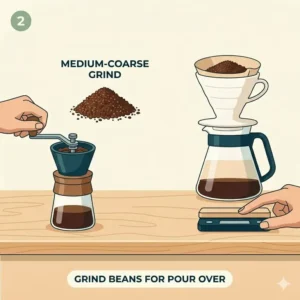
A burr grinder provides a uniform grind size, which is the secret to consistency. For most hand brew methods, you are looking for a “medium-coarse” setting, roughly the texture of Kosher salt. If your coffee is too weak, move one “click” finer. If it’s too bitter, move one “click” coarser. This level of granularity is what separates a casual drinker from a hand brew coffee pro. Even a budget-friendly manual burr grinder is a massive upgrade over the best blade grinder on the market.
Long-Term Value: Why Investing in a Quality Dripper Pays Off
When you look at the total cost of ownership, hand brew coffee is incredibly economical compared to pod-based systems or high-end espresso machines. A high-quality ceramic dripper like the V60 costs around $25 and can literally last a lifetime if you don’t drop it. There are no pumps to fail, no heating elements to burn out, and no complex electronics to go obsolete.
From a sustainability perspective, manual brewing is also the clear winner. Most hand brew filters are compostable, and the brewers themselves are usually made of recyclable materials like glass, steel, or ceramic. When you compare this to the millions of plastic pods that end up in landfills every year, the “slow coffee” movement isn’t just about flavor—it’s about a more responsible way to consume our favorite beverage. The long-term ROI is found in both your wallet and your environmental footprint.
Features That Actually Matter vs. Marketing Hype
In 2026, the market is flooded with “innovative” coffee gear, but as an expert, I can tell you that many of these features are pure hype. For instance, some drippers claim “diamond-patterned” internal walls for “enhanced turbulence.” In reality, as long as there are some ribs to keep the paper off the wall, the specific pattern makes a negligible difference in the final cup.
What does matter? Thermal stability and flow regulation. A dripper that is too thin will lose heat to the air, causing your brew temperature to crash. A dripper with a hole that is too small will clog if you use a fine grind. Focus on the geometry (conical vs. flat-bottom) and the material (metal, glass, ceramic) rather than flashy marketing terms. Simplicity is often the hallmark of the best hand brew coffee equipment. The more “features” a manual dripper has, the more variables you have to control, which can actually make it harder to brew a consistent cup.
Maintenance and Longevity for Manual Brewers
One of the biggest advantages of hand brew coffee gear is the ease of maintenance. Unlike a drip machine that requires descaling every few months, manual drippers just need a quick rinse. However, there are a few pro tips for longevity. If you use a glass Chemex, be wary of “thermal shock.” Never take a cold Chemex and pour boiling water into it, or place a hot Chemex on a cold stone countertop—it can crack.
For stainless steel drippers like the Kalita Wave, coffee oils can build up over time, creating a “rancid” smell. Every few weeks, soak your dripper in a mixture of hot water and a coffee equipment cleaner (or simple unscented oxygen bleach) to strip away those oils. For ceramic brewers, avoid using abrasive scrubbers that can scratch the glaze. A soft sponge and mild soap are all you need to keep your gear looking and tasting like new for years to come.
✨ Ready to start your journey?
🔍 Check out our top-rated hand brew coffee gear on Amazon today and transform your morning routine. Whether you’re at home or on the go, the perfect cup is just a pour away!

Conclusion
The world of hand brew coffee is a journey of discovery. It’s about taking a few minutes out of your day to slow down and engage with the process of creation. By selecting the right gear—whether it’s the precise Hario V60, the elegant Chemex, or the indestructible Kalita Wave—and mastering the fundamentals of grind size and water temperature, you can achieve a level of coffee quality that far surpasses anything from a pod or a standard machine. Remember, the “best” cup of coffee is the one that tastes best to you. Don’t be afraid to experiment, tweak your ratios, and find the ritual that fits your 2026 lifestyle. Happy brewing!
FAQs
❓ What is the best grind size for hand brew coffee?
✅ For most pour-over methods, aim for a medium-coarse grind, similar to the texture of Kosher salt. If using an AeroPress, you can go slightly finer, like table salt, since the brew time is much shorter…
❓ Can I use regular grocery store filters for a Chemex?
✅ Technically yes, but it won’t taste like a “Chemex” brew. The proprietary thick bonded filters are what provide the signature clarity and sediment removal that define this specific hand brew coffee method…
❓ Do I really need a gooseneck kettle for pour-over?
✅ While not strictly mandatory for flat-bottom brewers like the Kalita, a gooseneck kettle is essential for conical brewers like the V60. It allows you to control the flow and placement of water precisely…
❓ How long should a hand brew coffee take to finish?
✅ Most manual pour-over recipes target a total brew time of 3 to 4 minutes. This includes the 30-second bloom and the final draw-down. If it’s outside this range, adjust your grind size…
❓ Is hand brew coffee stronger than regular drip coffee?
✅ “Strength” refers to the concentration of dissolved solids. While you can make hand brew coffee very strong by using a higher coffee-to-water ratio, its hallmark is usually flavor clarity rather than sheer intensity…
Recommended for You
- Coffee Makers Made in Germany: 7 Best Stunning Picks for 2026
- 7 Best German Coffee Pot Options for the Perfect 2026 Brew!
- 7 Best Americano Coffee Maker Reviews 2026: Expert Guide and Top Picks
Disclaimer: This article contains affiliate links. As an Amazon Associate, I earn from qualifying purchases. If you purchase products through these links, we may earn a small commission at no additional cost to you.
✨ Found this helpful? Share it with your friends! 💬🤗
[addtoany]
