
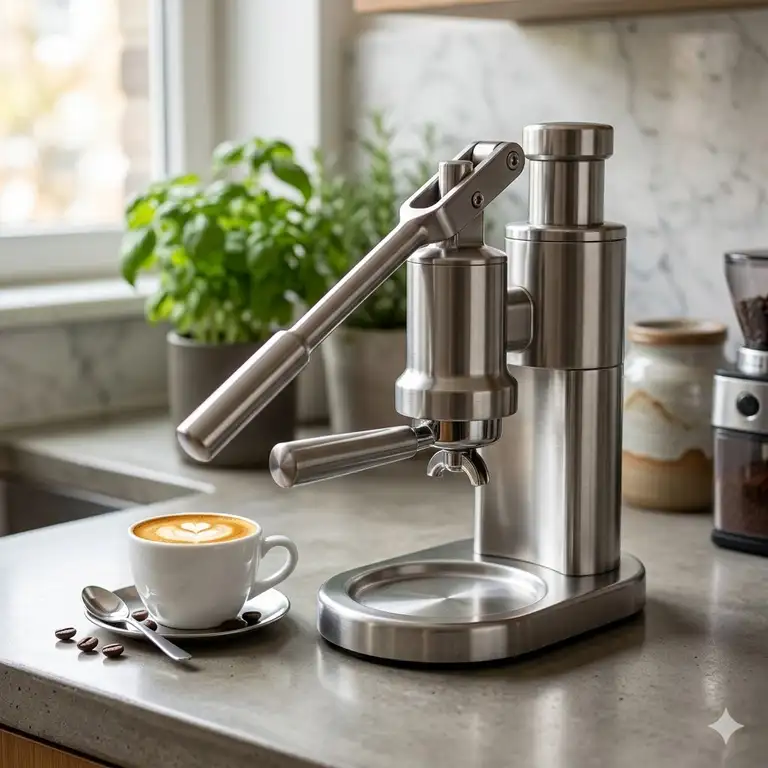
I have spent the better part of a decade chasing the “God shot”—that elusive, syrupy, perfectly balanced extraction that makes your eyes roll back in your head. For a long time, I thought I needed a $5,000 Italian behemoth plugged into my kitchen wall to achieve it. I was wrong. It turns out, the best manual espresso maker often outperforms the big shiny boxes because it gives you, the human, total control over the variables that actually matter.
✨Was this helpful? Spread the word! 🚀
[addtoany]
In 2026, the market for manual espresso makers has exploded. We aren’t just talking about plastic camping gadgets anymore; we are looking at precision-engineered tools that use physics to beat electronics. Whether you are a minimalist hiker or a kitchen counter scientist, there is something deeply satisfying about feeling the resistance of the coffee puck through a lever. It is tactile, it is quiet, and frankly, it makes you look like a wizard.
Why Manual Beats Automatic: A Quick Comparison
Before we dive into the nitty-gritty of the specific machines, let’s look at why you might choose a manual espresso maker over the traditional semi-automatic or capsule-based alternatives.
| Feature | Best Manual Espresso Maker | Semi-Automatic Machine | Capsule Machine (Nespresso) |
| Pressure Control | Manual/Variable (Lever) | Fixed/Pump-driven | Fixed/Pump-driven |
| Durability | High (Few moving parts) | Moderate (Electronics fail) | Low (Planned obsolescence) |
| Heat-up Time | 2-10 Minutes | 15-30 Minutes | < 1 Minute |
| Portability | Excellent to Moderate | None (Heavy) | Moderate |
| Learning Curve | Steep but Rewarding | Moderate | Non-existent |
| Maintenance | Rinse and Go | Descaling/Backflushing | Descaling/Pod disposal |
Quick Comparison: Top 7 Best Manual Espresso Maker Models at a Glance
If you are in a rush to get your caffeine fix, here is the high-level breakdown of the top performers in the USA market for 2026.
| Product Name | Best For | Portability | Build Material |
| Flair 58+ | Ultimate Home Barista | Low | Stainless Steel/Aluminum |
| Cafelat Robot | Simplicity & Style | Medium | Retro Die-cast Aluminum |
| Wacaco Picopresso | Travel & Hiking | High | BPA-free Plastic/Steel |
| Flair Pro 2 | Balanced Performance | High | Stainless Steel |
| ROK EspressoGC | Budget-Friendly | Medium | Glass-composite/Aluminum |
| La Pavoni Europiccola | Luxury/Heritage | Low | Chrome/Brass |
| Wacaco Nanopresso | Entry-Level Travel | High | Lightweight Composite |
Top 7 Best Manual Espresso Maker Models: Expert Analysis
1. Flair 58+ (The Gold Standard)
The Flair 58+ is widely considered the best manual espresso maker for those who want a commercial-grade experience without the commercial-grade price tag. This flagship model features a standard 58mm portafilter, which means you can use all the high-end baskets and tampers usually reserved for $3,000 machines.
The “plus” in the Flair 58+ refers to the updated preheat controller, which allows you to set the brew head to three different temperature settings. This solves the biggest headache of manual brewing: thermal stability. Furthermore, the walnut accents and the shot mirror make it a visual centerpiece in any kitchen.
-
Technical Specifications:
-
Basket Size: 58mm (Industry Standard)
-
Pressure: 0-12 Bars (User-controlled)
-
Heating: Integrated electric preheat (3 levels)
-
Weight: 12 lbs
-
Warranty: 5-year limited on the stand and brew head.
-
-
Customer Review Analysis: Users rave about the consistency. One professional barista noted, “It’s the only manual machine I’ve used that actually feels like work-grade equipment.” However, some users find the external power brick for the heater to be a bit clunky.
-
Pros: Professional workflow, standard parts, incredible thermal management.
-
Cons: Requires a power outlet for the heater, heavy.
2. Cafelat Robot (Barista Model)
If you hate the idea of electronics in your coffee gear, the Cafelat Robot is your soulmate. It looks like a retro-futuristic kitchen appliance from the 1950s. Unlike other manual espresso makers, the Cafelat Robot has a very “simple” path—there is no need to preheat the basket for medium to dark roasts.
The Cafelat Robot uses a unique “basket within a portafilter” design that minimizes heat loss. Consequently, you can pull shots back-to-back with very little fuss. I personally love the mechanical feel of the dual arms; it’s like giving a tiny robot a hug to get your coffee.
-
Technical Specifications:
-
Basket Size: 54mm (Deep basket)
-
Pressure: Pressure gauge included on Barista model
-
Heating: No active heating (Manual preheat optional)
-
Weight: 8 lbs
-
Warranty: 2-year manufacturer warranty.
-
-
Customer Review Analysis: Reviewers emphasize the durability. “There is literally nothing to break,” says one Amazon reviewer. The main complaint is that the arms can be a bit awkward for those with smaller hands.
-
Pros: Minimal maintenance, gorgeous design, excellent pressure feedback.
-
Cons: No 58mm compatibility, requires boiling water for light roasts.

3. Wacaco Picopresso (The Pocket Powerhouse)
For the traveler who refuses to drink “hotel coffee,” the Wacaco Picopresso is a revolution. It is roughly the size of a soda can, yet it houses a naked portafilter and a professional-grade basket. This is not a toy; it is a legitimate portable manual espresso maker.
The Wacaco Picopresso requires a bit of a learning curve because it is very sensitive to grind size. If your grind is off by a hair, you’ll either get a face-full of spray or a clogged pump. But when you dial it in? It produces a shot that rivals machines ten times its size.
-
Technical Specifications:
-
Basket Size: 52mm (18g capacity)
-
Pressure: Up to 18 bars
-
Dimensions: 4.15 inches tall
-
Weight: 0.77 lbs
-
Warranty: 2-year warranty.
-
-
Customer Review Analysis: Users love the portability but warn about the “mess factor.” One hiker mentioned, “I get cafe-quality espresso at 10,000 feet, but I had to practice at home first.”
-
Pros: Ultra-portable, incredible value, high pressure.
-
Cons: Requires a high-end grinder, many small parts to clean.
4. Flair Pro 2 (The All-Rounder)
The Flair Pro 2 sits comfortably between the entry-level models and the high-end 58 series. It is the best espresso manual maker for someone who wants to take their setup on a road trip but still wants a pressure gauge and high-capacity shots.
The Flair Pro 2 features a custom-sized stainless steel portafilter that is larger than the Classic but smaller than the 58. It also includes a removable spout and an enhanced bottomless portafilter. Moreover, the carrying case it comes with is bomb-proof, making it the top manual espresso makers choice for van-lifers.
-
Technical Specifications:
-
Basket Size: 46mm (Integrated)
-
Pressure: 6-9 Bars (Target)
-
Case: Included padded carrying case
-
Weight: 7 lbs
-
Warranty: 5-year warranty on the press stand.
-
-
Customer Review Analysis: Users appreciate the “all-in-one” nature. One buyer noted, “The case fits everything perfectly. It’s my go-to for weekend getaways.” Some users do mention that preheating the heavy stainless steel cylinder takes time.
-
Pros: Portable but sturdy, includes a great pressure gauge, high build quality.
-
Cons: Non-standard basket size, thermal management requires a boiling water bath.
5. ROK EspressoGC (The Classic Reimagined)
The ROK EspressoGC has been around in various forms for years, but the “GC” (Glass Composite) version fixed the pressure issues of the original. This is arguably the best manual espresso maker for those on a budget who still want a lever machine on their counter.
The ROK EspressoGC uses two arms that you pull down simultaneously. It’s a very natural movement, and it doesn’t require as much downward force as the Flair. In contrast to other machines, the ROK has a more “open” design, which makes it very easy to clean.
-
Technical Specifications:
-
Basket Size: 49mm
-
Material: Polished Aluminum / Glass Composite pressure chamber
-
Base: Non-slip silicone
-
Weight: 3.5 lbs
-
Warranty: 10-year warranty on the metal parts.
-
-
Customer Review Analysis: It’s praised for its simplicity. One user said, “It’s the most fun I’ve had making coffee.” However, experts note that achieving 9 bars of pressure can be difficult compared to the Flair or Robot.
-
Pros: Affordable, very easy to use, long warranty.
-
Cons: Struggles with high-pressure extractions, heat retention is average.
6. La Pavoni Europiccola (The Luxury Heritage Pick)
While most manual espresso makers are “manual” in the sense that you provide the pressure, the La Pavoni Europiccola is a full lever machine with its own boiler. It is the best manual lever espresso machine for those who want a piece of history. It has been in production since the 1960s and looks like it belongs in a museum.
The La Pavoni Europiccola uses steam pressure to push water into the group head, and then you use the lever to finish the extraction. It is a temperamental beast, but once you master its quirks, it produces a texture that no other machine can match.
-
Technical Specifications:
-
Boiler Capacity: 20 oz (8 shots)
-
Heating: 1000W internal element
-
Build: Chrome-plated brass
-
Weight: 12 lbs
-
Warranty: 1-year limited.
-
-
Customer Review Analysis: High praise for aesthetics and steam power. “It makes the best milk foam of any manual setup,” says one enthusiast. The downside is the “overheating” issue—after 3 or 4 shots, the machine gets too hot and ruins the coffee.
-
Pros: Built-in steam wand, iconic design, lasts a lifetime.
-
Cons: Very expensive, high learning curve, gets too hot.
7. Wacaco Nanopresso (The Budget Traveler)
If the Picopresso is for the “pro-sumer” traveler, the Wacaco Nanopresso is for everyone else. It is the best manuel espresso maker (pardon the typo, but that’s how many search for it!) for casual campers. It doesn’t use a standard portafilter, but it is incredibly easy to use.
The Wacaco Nanopresso can be adapted to use Nespresso capsules with an additional adapter, which makes it very versatile for people who don’t want to carry a grinder into the woods. While the espresso isn’t “specialty” grade, it is significantly better than any instant coffee you’ll find.
-
Technical Specifications:
-
Pressure: 18 bars (Max)
-
Water Capacity: 80ml
-
Weight: 0.75 lbs
-
Warranty: 1-year warranty.
-
-
Customer Review Analysis: Users love the ease of use. “It’s my secret weapon for long flights,” says one business traveler. Some find the pumping motion a bit tiring for multiple shots.
-
Pros: Cheap, lightweight, capsule compatible (with adapter).
-
Cons: Harder to clean than the Picopresso, coffee quality is “good,” not “great.”
🔍 Don’t Miss These Exclusive Deals!
🔍 Take your home cafe to the next level with these carefully selected products. Click on any highlighted item to check current pricing and availability on Amazon. These manual tools will help you create world-class espresso that your family will love! ✨
💬 Just one click – help others make better buying decisions too!😊
[addtoany]
Detailed Comparison: Features, Pros, and Cons
| Product | Pressure Feedback | Standard Portafilter? | Thermal Management | Best For |
| Flair 58+ | Analog Gauge | Yes (58mm) | Active Electric | The Pro Home Barista |
| Cafelat Robot | Analog Gauge | No (Custom) | Passive (Preheat needed) | Minimalists |
| Wacaco Picopresso | None | Yes (52mm Naked) | Manual (Hot water) | Hikers/Backpackers |
| Flair Pro 2 | Analog Gauge | No (Custom) | Manual (Boiling water) | Road Trippers |
| ROK EspressoGC | None | No (49mm) | Average | Budget Buyers |
| La Pavoni | None (Visual) | No (Custom) | Boiler-integrated | Luxury Lovers |
| Wacaco Nanopresso | None | No | Low | Casual Camping |
The Deep Dive: How to Choose the Best Manual Espresso Maker
Choosing between these machines isn’t just about price; it’s about your lifestyle and how much you are willing to “work” for your coffee. Let’s break down the mechanics.
1. The Pressure Variable
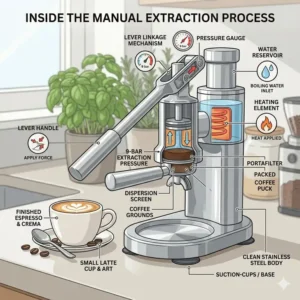
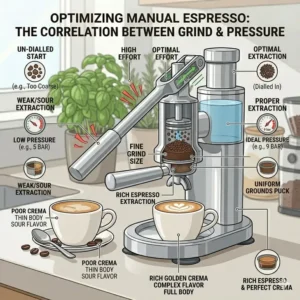
Most of the best manual espresso makers aim for 9 bars of pressure. This is the magic number for traditional espresso. However, with a manual lever, you can do “pressure profiling.” This means you can start with a low-pressure pre-infusion (3 bars) to saturate the puck, then ramp up to 9 bars for the main extraction, and finally taper off as the puck degrades. You cannot do this on a standard machine without spending thousands.
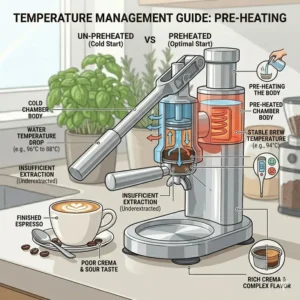
2. The Thermal Stability Challenge
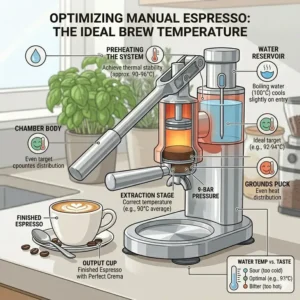
Water loses heat the moment it touches a cold metal machine. If your water drops below 190°F (approx. 88°C), your espresso will taste sour and under-extracted.
-
Active Heating: Machines like the Flair 58+ solve this with electricity.
-
Passive Heating: The Cafelat Robot uses a thick stainless steel basket that holds heat well.
-
Manual Heating: Most other manual espresso makers require you to soak the brew head in boiling water before use. This is the “ritual” part that some love and others find tedious.
3. Portability vs. Performance
There is a direct trade-off between how heavy a machine is and how consistent the shots are. A heavy machine like the La Pavoni Europiccola or Flair 58+ has a lot of “thermal mass,” meaning it stays hot. A light machine like the Wacaco Nanopresso is easy to carry but loses heat quickly.
5-Year Cost Analysis: Manual vs. Automatic
| Expense Type | Manual Espresso Maker | Semi-Automatic Machine | Pod Machine (Nespresso) |
| Initial Purchase | $150 – $600 | $500 – $2,500 | $150 – $300 |
| Daily Pod/Bean Cost | $0.50 (High-end beans) | $0.50 (High-end beans) | $0.85 – $1.25 (Pods) |
| Repair/Parts | < $50 (O-rings) | $200+ (Pump/Electronics) | Replace entire unit |
| Total 5-Year Cost | ~$1,000 | ~$2,500 | ~$2,800 |
As you can see, investing in the best manual espresso makers is not just about the quality of the coffee; it’s a massive financial win over the long term.
Advanced Techniques for Manual Brewing
To truly get the most out of your manual espresso maker best practices involve more than just pulling a lever. You need to understand the “Socratic Method of Espresso”—questioning every variable.
Puck Prep: The Secret Ingredient
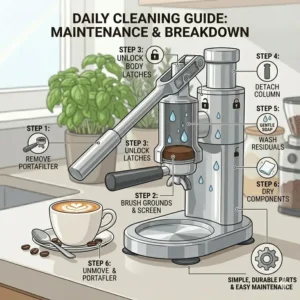
You could have the most expensive top manual espresso makers in the world, but if your coffee grounds are clumpy, the water will find the path of least resistance (channeling) and ruin the shot. I always recommend using a WDT (Weiss Distribution Tool)—basically a few thin needles—to stir the grounds before tamping. This ensures an even density.
Water Chemistry
Don’t use tap water. Espresso is 98% water. If your water is too hard, it will scale up your machine and make the coffee taste chalky. If it’s too soft, the coffee will taste flat. Using a simple Third Wave Water packet in distilled water can transform a mediocre shot into something sublime.
The Learning Curve
I won’t lie to you: your first five shots on a manual espresso machine will likely be terrible. You might spray coffee on your shirt, or the lever might feel like it’s stuck. This is normal. The “manual” in best manual espresso maker implies a skill that must be learned. But once you feel that perfect 9-bar resistance and see the tiger-striping crema pour into your cup, you’ll never go back to a push-button machine.
Comparison of Solution Categories
| Category | Typical Model | Best For | Complexity |
| The Purist Lever | Flair 58+ | Home Baristas | High |
| The Mechanical Wonder | Cafelat Robot | Ease of Use/Style | Medium |
| The Backpacker’s Friend | Wacaco Picopresso | Travel | High |
| The Budget Entry | ROK EspressoGC | Low Investment | Low |
| The Historic Luxury | La Pavoni | Enthusiasts | Very High |
✨ Take the Leap into Manual Espresso!
🔍 Ready to become your own favorite barista? Click on any of the products we’ve discussed to find the perfect match for your kitchen or your next adventure. Your perfect shot of espresso is just a lever-pull away! ✨
Final Thoughts: The Journey to Better Coffee
At the end of the day, the best manual espresso maker is the one that fits into your morning flow. If you love the tech and want the absolute best shot possible, the Flair 58+ is an unbeatable choice. If you want something that looks like art and works forever, the Cafelat Robot is waiting for you. And if you are always on the move, the Wacaco Picopresso is a literal life-changer.
Espresso is more than just a caffeine delivery system; it’s a hobby that rewards patience and precision. By removing the pumps and the circuit boards, you get closer to the bean. You feel the coffee. You learn what it needs. And when you finally pull that perfect shot? It tastes so much better because you were the one who made it happen.
Frequently Asked Questions
❓ Is a manual espresso maker worth it?
❓ Which manual espresso maker is easiest to clean?
❓ Do I need a special grinder for manual espresso?
❓ Can I make milk drinks with a manual espresso maker?
❓ How long does it take to pull a shot manually?
Recommended for You:
- Coffee Makers Made in Germany: 7 Best Stunning Picks for 2026
- 7 Best German Coffee Pot Options for the Perfect 2026 Brew!
- 7 Best Automatic Cappuccino Machine Models of 2026: Expert Ranked!
Disclaimer: This article contains affiliate links. If you purchase products through these links, we may earn a small commission at no additional cost to you.
✨ Found this helpful? Share it with your friends! 💬🤗
[addtoany]
