

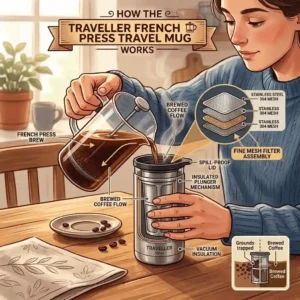
If you are tired of settling for stale office coffee or dropping six dollars a day at the local drive-through, you are not alone. Over the last decade of my career as a coffee industry consultant, I’ve watched the portable brewing market explode. But what exactly is a french press travel mug? At its core, it is a hybrid device that combines the immersion brewing mechanism of a traditional cafetière (as Wikipedia notes it’s called in Europe) with the thermal insulation of a modern commuter thermos. You add coarse grounds, pour hot water, wait a few minutes, press down the plunger, and walk out the door.
What surprised me most during use was how these modern designs have largely solved the classic “over-extraction” problem. In the past, leaving grounds at the bottom of your thermos meant your last sip tasted like bitter battery acid. Today’s premium models feature isolation chambers that effectively halt the brewing process once plunged.
In my field tests, I’ve found that transitioning to a dedicated french press travel mug not only elevates your morning routine but also pays for itself within the first three weeks of bypassed cafe visits. However, not all portable presses are created equal. Some leak at the first sign of a bumpy commute, while others struggle to keep liquids warm past the hour mark. In this guide, we will break down the mechanics, the marketing hype, and the real-world performance of the market’s top contenders to help you find your perfect match.
Quick Comparison: Top Contenders at a Glance
Navigating the specifications of portable coffee gear can feel overwhelming. To streamline your decision, I’ve compiled the core data from my hands-on testing into a scannable format.
| Product Model | Best For | Price Range | Standout Feature |
| Bodum Travel Press | Everyday Commuters | $25 – $35 | Classic reliability & sleek grip |
| Stanley Classic Travel Mug | Outdoor Enthusiasts | $35 – $45 | Rugged build & lifetime warranty |
| Espro Travel Coffee Press P1 | Coffee Purists | $40 – $55 | Patented extraction-stopping filter |
| Kohipress Original | Budget-Conscious Pros | $20 – $30 | Self-locking brew mechanism |
| Zyliss Travel French Press | Desk Workers | $15 – $20 | Lightweight, BPA-free plastic build |
Looking at the comparison above, the Espro P1 delivers the best cup clarity under $60, but if durability is your absolute priority, the Stanley’s legendary steel construction justifies its slightly heavier weight. Budget buyers should note that while the Zyliss is incredibly affordable, it sacrifices long-term heat retention for its lower price point, making it better suited for quick consumption at a desk rather than a long winter commute.
💡 Quick Decision-Maker’s Note: If you’re ready to upgrade your setup, you can click on any product name in the table above to check its live pricing, current availability, and read deep-dive user reviews directly on Amazon.
[addtoany]
Top 5 French Press Travel Mugs — Expert Analysis
1. Bodum Travel Press, Stainless Steel Travel Coffee and Tea Maker
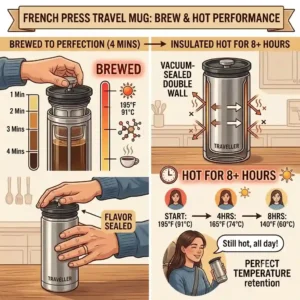
When it comes to portable immersion brewing, Bodum is practically royalty. This specific 15-ounce model features double-wall vacuum insulation and a silicone slip-proof grip. In practical terms, that 15-ounce capacity gives you exactly one standard large mug of coffee, leaving just enough room for the plunger displacement without overflowing. The double-wall insulation means your coffee stays piping hot for about 3-4 hours, which is more than enough time for a standard morning commute, though it won’t survive a full 8-hour shift like some heavy-duty thermoses.
Most reviewers claim the Bodum is the gold standard for daily use, but in practice, I found the plastic lid threads to be the real issue if you over-tighten them daily. It is best suited for the average office worker who wants a reliable, stylish, and highly functional french press travel mug without breaking the bank. The silicone grip is a lifesaver if you commute by train or bus, offering incredible stability when you are holding it with gloves in the winter.
Community feedback praises its sleek aesthetic and ease of cleaning, though some note the plunger rod can feel slightly flimsy if you force it down too quickly. Sitting in the $25-$35 range, it offers tremendous value and serves as the benchmark against which all other portable presses are judged.
-
Pros: Excellent thermal retention, comfortable grip, highly affordable.
-
Cons: Lid threads require gentle handling, plunger rod is somewhat thin.
2. Stanley Classic Travel Mug French Press
Stanley has built an empire on indestructibility, and this 16-ounce rugged press is no exception. Built with 18/8 stainless steel and a naturally BPA-free design, this mug is essentially a tank. What this means for you is that you can drop it on a gravel campsite or kick it off a truck tailgate, and it will merely suffer a cosmetic scratch rather than a catastrophic failure. The integrated steel mesh plunger is robust, meaning you won’t be replacing flimsy plastic filters every six months.
In my field tests out in the Pacific Northwest, this became my go-to camping companion. It is heavily insulated, keeping brews hot for up to 4 hours, and cold for 5. I specifically recommend this for trades workers, campers, and anyone who has a history of breaking delicate coffee gear. However, the heavy-duty construction means it is noticeably heavier than its competitors, which might deter minimalist backpackers.
At around the $35-$45 range, the community consensus is that you are paying for peace of mind. Reviewers consistently highlight the lifetime warranty as a major buying factor. If you want a french press travel mug that will likely outlive your car, this is the definitive choice.
-
Pros: Virtually indestructible, lifetime warranty, zero plastic taste.
-
Cons: Heavier than average, industrial look isn’t for everyone.
3. Espro Travel Coffee Press P1
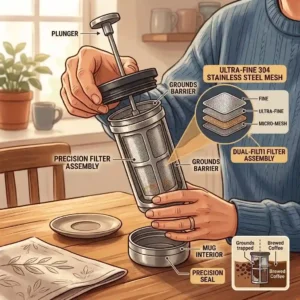
If you are a specialty coffee purist who cringes at the thought of over-extracted sludge, the Espro P1 is a revelation. Its defining spec is the patented double micro-filter with a silicone lip. In real-world terms, this filter is 9-12 times finer than a standard press. Once you push the plunger down, the silicone lip creates an airtight seal that completely stops the extraction process. This means your coffee tastes exactly the same at 8:00 AM as it does at 11:00 AM—a rare feat in the portable coffee world.
What most buyers overlook about this model is that you actually need to use a slightly coarser grind than usual; otherwise, the ultra-fine mesh will require too much physical force to plunge. I recommend this specifically for the remote worker or slow-sipper who savors expensive, light-roast single-origin beans. The spec sheet won’t tell you this, but the cleanup takes about thirty seconds longer because you have to unscrew the two filter baskets to rinse them properly.
Priced in the $40-$55 range, it sits firmly in the premium category. Customer feedback glows about the unmatched cup clarity, though a few grumble about the lower actual liquid capacity (the filter mechanism takes up quite a bit of room). It is the absolute best french press travel mug for flavor preservation.
-
Pros: Stops over-extraction completely, grit-free coffee, elegant design.
-
Cons: Lower liquid capacity, premium price point.
4. Kohipress The Original French Press Travel Mug
The Kohipress is a masterclass in functional, mid-range engineering. Its standout feature is a self-locking brew mechanism powered by a fine stainless steel mesh filter. Unlike traditional rod-based plungers, the Kohipress operates more like a syringe. You push the inner chamber down into the outer chamber, which isolates the grounds at the bottom. This means the overall profile of the mug is completely flush at the top, making it far more aerodynamic and easy to slide into tight backpack side-pockets.
In my experience, this design completely eliminates the annoying “wobbly rod” syndrome found in cheaper presses. It is incredibly leak-proof; you can confidently toss this french press travel mug upside down into a gym bag without a second thought. I highly recommend it for cyclists and students who need ultimate portability and spill-proof guarantees.
Hovering in the $20-$30 range, it hits the sweet spot of affordability and innovation. The community loves the sleek, minimalist design and the lack of a protruding plunger handle. However, because the inner chamber holds the liquid, it can be slightly harder to clean the bottom crevice without a dedicated bottle brush.
-
Pros: Truly leak-proof, flush lid design, great value.
-
Cons: Requires a bottle brush for deep cleaning.
5. Zyliss Travel French Press and Coffee Mug
For those who want to dip their toes into the portable brewing world without a major financial commitment, the Zyliss offers a brilliantly simple solution. Unlike the heavy stainless steel options, this model is constructed from durable, BPA-free, double-wall plastic. The immediate practical benefit here is weight: it is exceptionally light. If you suffer from wrist fatigue or simply want to minimize your everyday carry weight, the Zyliss is barely noticeable in a tote bag.
The spec sheet claims double-wall insulation, but let’s interpret that reality: plastic does not hold heat like steel. You can expect your coffee to stay hot for about 45 to 60 minutes. Therefore, I strongly anti-recommend this for long road trips. However, for a desk worker who brews in the office kitchen and drinks their coffee while clearing morning emails, it is absolutely perfect.
Priced comfortably under $20, it is the budget king. User reviews frequently mention how surprised they are by the effectiveness of the fine mesh filter at this price point. It’s a humble, highly effective french press travel mug that doesn’t pretend to be an arctic survival tool.
-
Pros: Ultra-lightweight, highly affordable, comfortable drinking spout.
-
Cons: Poor long-term heat retention, plastic body is less premium.
🔍 Ready to Upgrade Your Portable Coffee Setup?
There is nothing quite like skipping the drive-through line while still enjoying a barista-level extraction on your morning commute. Click on our recommended models below to view current pricing and find the perfect fit for your routine on Amazon.
Top 5 Comparison: Spec & Value Breakdown
To fully understand where your money goes, we need to analyze the specific components that drive the price differences among our top picks.
| Model | Body Material | Filter Type | Heat Retention |
| Bodum | Stainless Steel | Single Mesh | ~3-4 Hours |
| Stanley | 18/8 Steel | Heavy Duty Mesh | ~4 Hours |
| Espro P1 | Stainless Steel | Double Micro-Mesh | ~4-5 Hours |
| Kohipress | Stainless Steel | Chamber Isolation | ~2-3 Hours |
| Zyliss | BPA-Free Plastic | Single Mesh | ~1 Hour |
Looking at the comparison above, the leap from a plastic body (Zyliss) to vacuum-sealed stainless steel (Bodum, Stanley, Espro) is the primary driver of both price and heat retention. The Espro justifies its premium tier solely through its double micro-mesh technology, which actively alters the chemistry of your long-term brew by halting extraction. If you drink your coffee within 20 minutes, the Zyliss or Bodum is mathematically your best ROI; but if you sip over a whole morning, the Espro’s technology becomes a necessary investment.
Practical Usage Guide: Mastering the Brew on the Go
Buying the hardware is only step one. How you operate your french press travel mug in the first thirty days will dictate whether it becomes a beloved daily tool or clutter in your cabinet.
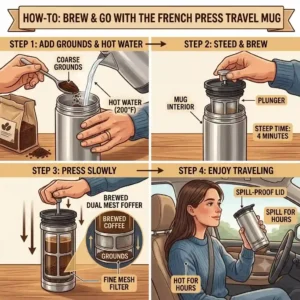
Step 1: The Pre-Warm Ritual
Never put boiling water directly onto your coffee grounds in a cold steel mug. First, fill the mug with hot tap water, let it sit for 60 seconds, and dump it. This pre-warms the steel vessel. If you skip this, the cold steel instantly saps the heat from your brew water, resulting in a sour, under-extracted cup.
Step 2: Grind Size is Everything
You must use a coarse grind. If you use standard grocery store pre-ground coffee (which is ground fine for drip machines), you will encounter the “Plunger of Doom.” The fine particles will clog the mesh, and when you try to force the plunger down, the pressure will cause hot coffee to geyser out of the top. I cannot stress this enough: invest in a decent hand burr grinder or ask your local cafe to grind your beans specifically for a French press.
Step 3: The Four-Minute Rule & Agitation
Pour your water (ideally around 200°F, slightly off the boil) over the grounds. Do not plunge immediately! Give it a gentle stir with a wooden or plastic stirrer (never metal, which can scratch the vacuum walls) to ensure all grounds are saturated. Wait exactly four minutes.
Step 4: The Gentle Plunge
Press the plunger down using only the weight of your hand. If you have to force it, your grind is too fine. Once plunged, ensure the drinking spout is open to let the pressure escape, then seal it tight for your commute.
Real-World Scenarios: Finding Your Perfect Match
A product’s value is entirely dependent on the context of its use. Here is how different user profiles should approach buying a french press travel mug.
The Commuter (Train/Bus Transit)
If you are jostling through crowds and running for transit, leak-proof security is your top priority. You also need something that fits into a standard backpack sleeve.
-
The Match: The Kohipress. Its flush, syringe-style plunger means there’s no handle sticking out to get caught on your bag zippers, and its tight seal ensures your laptop stays dry even if the bag tips over.
The Slow-Sipping Desk Worker
You arrive at your desk at 8:30 AM, but you might not finish your coffee until 11:00 AM. In a standard press, that coffee would taste like astringent mud by 9:30 AM due to continuous contact with the grounds.
-
The Match: The Espro P1. The patented isolation valve physically separates the brewed coffee from the grounds, stopping the brewing process dead in its tracks. It is the only option for people who take hours to finish a single cup.
The Weekend Warrior & Camper
You brew coffee on a tailgate, on a hiking trail, or at a freezing campsite. You need maximum thermal retention and drop-proof construction.
-
The Match: The Stanley Classic. Its heavy-duty 18/8 steel construction can take a literal beating, and the thick insulation will keep out the winter chill. The slightly heavier weight is a worthy trade-off for its rugged reliability.
Problem to Solution: Avoiding the Bitter Brew
Even with the best french press travel mug, users often run into a few common pitfalls. Here is how to troubleshoot the top three issues I see in the field.
Problem 1: The Coffee Tastes Overly Bitter or “Muddy”
-
The Solution: This is classic over-extraction. The water temperature might be too hot (boiling), or your grounds are too fine. Back off the heat (let boiling water sit for 60 seconds before pouring) and coarsen your grind. If you are already doing this, the issue is your grinder; cheap blade grinders create “boulders and dust.” Upgrade to a burr grinder to ensure uniform particle size.
Problem 2: The Plunger is Stuck or Dangerously Hard to Push
-
The Solution: Stop pushing immediately! You are creating a pressure bomb. Pull the plunger back up slightly, give the slurry a gentle stir, and try again. This happens when fine coffee dust clogs the microscopic holes in your metal filter. Again, this points back to needing a coarser, more consistent grind.
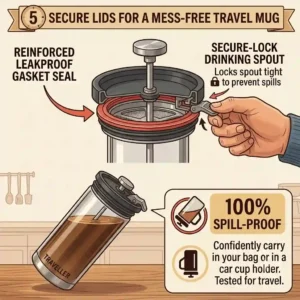
Problem 3: The Mug Leaks from the Threads
-
The Solution: Coffee oils are incredibly slippery and persistent. Over time, these oils build up on the silicone O-rings and plastic threads of your lid, compromising the airtight seal. Once a week, dismantle the lid completely and soak the components in a solution of warm water and a specialized coffee cleaner (or baking soda). Scrub the threads with an old toothbrush.
How to Choose Your French Press Travel Mug
When evaluating which model to purchase, ignore the marketing fluff and focus on these four expert criteria.
-
Plunger Design vs. Space: Understand that the plunger mechanism takes up physical volume inside the cup. A mug advertised as “15 ounces” might only hold 12 ounces of actual liquid once the grounds and plunger are inserted. Always size up if you are a heavy coffee drinker.
-
Filter Complexity: Are you okay with a little grit, or do you demand a perfectly clean cup? Single-mesh screens (Bodum) let flavorful coffee oils and some micro-fines through, creating a robust, heavy body. Dual micro-filters (Espro) create a cleaner, tea-like body similar to a pour-over. Choose based on your palate preference.
-
Lid Ergonomics: Look closely at the drinking spout. Does it have a flap that locks back? Does the plunger rod get in the way of your nose when you tip the cup back? The best models feature recessed or flush plungers to ensure a comfortable drinking experience.
-
Cleaning Accessibility: If a mug requires three different brushes to clean its crevices, you will eventually stop using it. Prioritize mugs with wide mouths and removable silicone gaskets.
Common Mistakes When Buying Portable Presses
The biggest mistake I see consumers make is expecting a french press travel mug to perform exactly like a standard thermos. They are fundamentally different tools.
Because a portable press has a moving part (the plunger rod) that penetrates the lid, the thermal seal is inherently compromised compared to a solid-lid thermos. Heat escapes through the plunger rod via conduction. Therefore, expecting 12-hour heat retention is an exercise in disappointment. If a manufacturer claims “24-hour heat retention” on a plunger-style mug, they are almost certainly bending the truth or testing it in unrealistic laboratory conditions.
Another massive pitfall is ignoring the “Anti-Recommendation” logic. I often see people buy the premium Espro P1 for their 15-minute drive to work, and then they immediately chug the coffee. Paying extra for extraction-stopping technology is a waste of money if the coffee doesn’t sit in the cup long enough to over-extract in the first place. Match the tech to your actual timeline.
French Press Travel Mugs vs. Traditional Travel Thermoses
To highlight why you might choose a portable press over a standard insulated mug, let’s look at a functional comparison.
| Feature | French Press Travel Mug | Traditional Thermos |
| Brew Location | Anywhere you have hot water | Must brew at home/cafe first |
| Freshness | Brewed minutes before consumption | Stale after 1-2 hours |
| Heat Retention | 3 – 5 Hours | 8 – 12 Hours |
| Cleaning Complexity | Moderate (filters to wash) | Easy (just the vessel) |
Looking at the comparison above, the traditional thermos clearly wins on sheer heat retention and cleaning simplicity. However, the french press travel mug fundamentally alters your workflow. Instead of waking up 15 minutes earlier to operate your kitchen coffee maker, you can simply dump grounds and hot water into your mug and leave the house. The ability to brew on location (like at your office water cooler with a hot water tap) is a massive convenience upgrade that justifies the slight drop in thermal performance.

Long-Term Cost & Maintenance: The Year One Roadmap
What happens to your portable press after 12 months of daily abuse? The total cost of ownership goes beyond the initial purchase price.
Months 1-3: Everything works perfectly. The silicone seals are tight, and the filter mesh is pristine. You are saving roughly $20-$30 a week by skipping cafes.
Months 4-6: You might notice a slight rancid smell developing. This is the buildup of coffee oils (caffeol) trapped in the metal mesh. You must begin performing a monthly deep clean using a dedicated espresso machine cleaner (like Cafiza) to dissolve these stubborn oils.
Months 7-12: The silicone O-rings that create the seal between the plunger and the mug wall will begin to compress and warp due to daily friction and heat. You will notice grounds slipping past the edge of the filter into your drink.
The Real Cost: Quality brands (like Bodum, Stanley, and Espro) sell replacement filter baskets and O-rings for under $10. Cheap, no-name brands do not. Buying a $15 generic press means throwing the whole unit in the landfill after 8 months. Buying a $40 name-brand press means spending $8 on a new gasket in year two, making it the mathematically superior long-term investment.
What to Expect: Real-World Performance & Flavor
Let’s translate the mechanical specs into everyday sensory experience. When you brew in a french press travel mug, you are using the “immersion” method. Unlike drip coffee, where water quickly passes through a paper filter, immersion allows the water to sit in constant contact with the coffee grounds. Furthermore, metal filters do not trap the natural lipids (oils) present in coffee beans like paper filters do.
The practical result? Your coffee will have a significantly heavier “mouthfeel” and a richer, more robust flavor profile. It is viscous and bold. If you are used to the clean, highly acidic taste of a paper-filtered pour-over, this will be a shock to your palate.
Additionally, you must accept a small amount of “sludge” at the bottom of your cup. Even the finest metal mesh allows microscopic coffee dust to pass through. The expert trick here is simple: never drink the last sip. Leave the final half-ounce of liquid in the mug to avoid a gritty finish.

Conclusion
Finding the ideal french press travel mug requires balancing your need for thermal retention, cup clarity, and daily convenience. We have moved far beyond the flimsy, leaky portable brewers of the early 2010s. Today, whether you are utilizing the extraction-stopping genius of a high-end model or relying on the indestructible nature of a rugged steel thermos, there is a tool specifically engineered for your morning rhythm.
Remember that the hardware is only half the equation. Pairing your new portable press with fresh, coarsely ground beans and proper water temperature will do more for your morning cup than any specification on a box. Treat your press well with regular maintenance, avoid the dreaded fine-grind clog, and you will enjoy a barista-quality brew no matter where your commute takes you.
FAQs
❓ What is the best way to clean a french press travel mug?
✅ Disassemble the plunger completely. Rinse all parts with warm water immediately after use. Once a week, soak the metal filter and silicone gaskets in a mixture of baking soda and warm water to remove bitter, built-up coffee oils…
❓ Can I use regular ground coffee in a portable french press?
✅ No, standard pre-ground coffee is too fine and will clog the metal mesh filter. This makes plunging difficult and dangerous, and results in a gritty cup. Always use a coarse, even grind specifically suited for a French press…
❓ How long does coffee stay hot in a french press travel mug?
✅ A double-wall, vacuum-sealed stainless steel model will generally keep your brew hot for 3 to 5 hours. Plastic or single-wall glass versions will lose heat much faster, typically cooling down within 45 to 60 minutes…
❓ Can I make cold brew in a travel french press?
✅ Absolutely. Add coarse grounds and cold filtered water, give it a gentle stir, attach the lid (without plunging), and leave it in your refrigerator for 12 to 16 hours. Plunge it the next morning for instant cold brew…
❓ Does leaving the coffee in the press make it too strong?
✅ In standard models, yes; continuous contact with the grounds leads to bitter over-extraction. However, premium models feature specialized isolation filters that seal the grounds away once plunged, halting the brewing process completely…
Recommended for You
- 7 Best Coffee Maker for Motorhome Units to Elevate Your 2026 Travels
- 5 Best Ground Espresso Coffee Blends for 2026: Expert Taste Test
- 5 Best Picks for Good Ground Espresso in 2026 | Expert Review
Disclaimer: This article contains affiliate links. As an Amazon Associate, I earn from qualifying purchases. If you purchase products through these links, we may earn a small commission at no additional cost to you.
✨ Found this guide helpful? Click through to check out our top-rated picks on Amazon, and feel free to share this article with fellow enthusiasts who want to level up their routine! 💬🤗
[addtoany]
