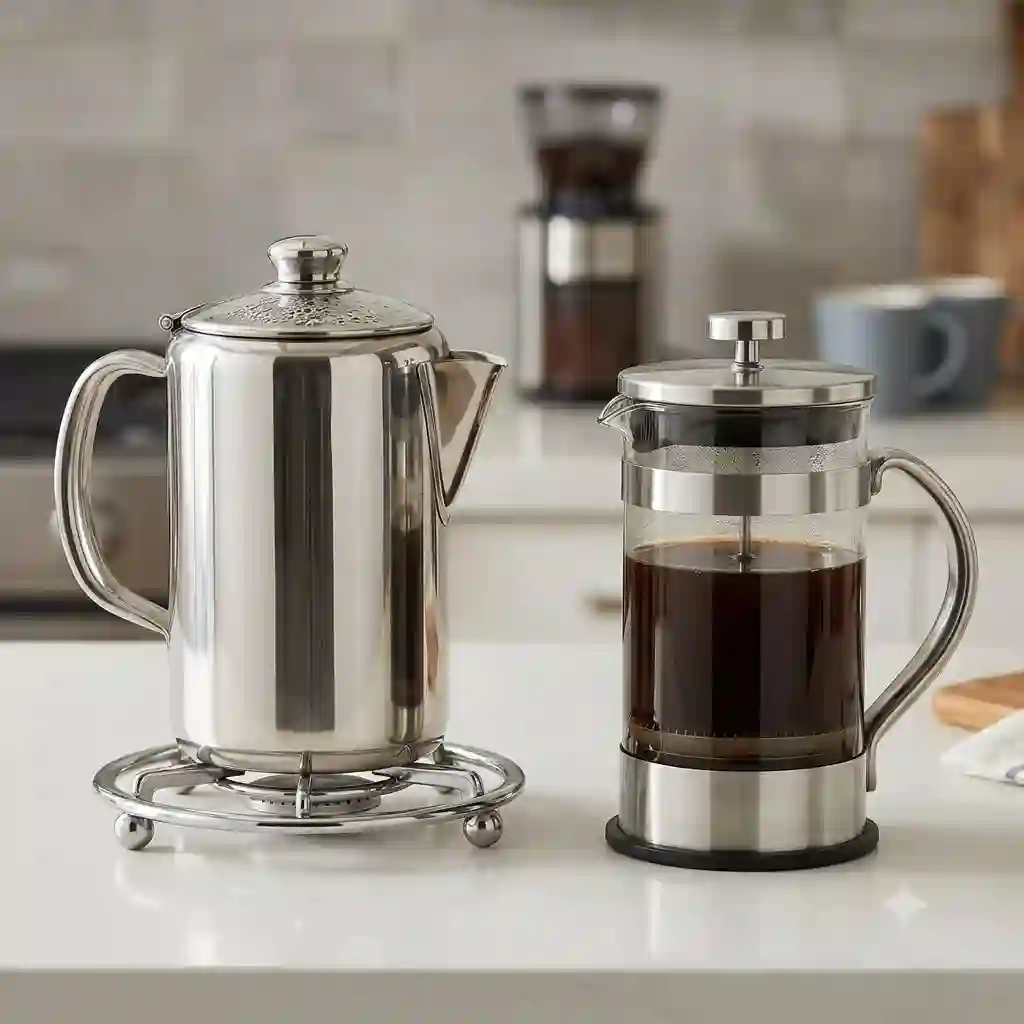
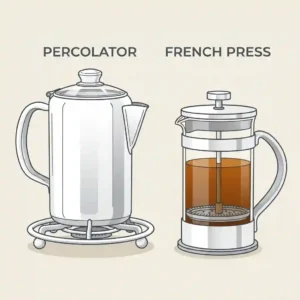
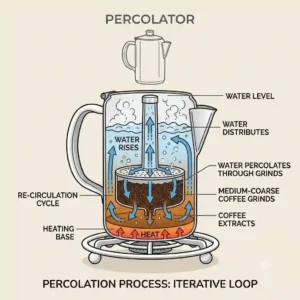
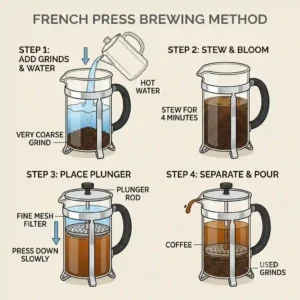
If you are serious about your morning ritual, you’ve likely found yourself staring down the classic debate of a percolator vs french press. What is the difference? Simply put, a percolator actively cycles boiling water up through a central tube and repeatedly over coffee grounds to create a piping hot, robust, and highly caffeinated brew. In contrast, a French press uses an immersion method where coarse coffee grounds steep gently in hot (but not boiling) water for several minutes before being pressed to the bottom by a mesh plunger, yielding a full-bodied, oil-rich cup.
Over my 10+ years as a coffee equipment consultant, I have tested hundreds of brewing devices, from commercial espresso machines to minimalist pour-overs. But when clients ask me which analog method reigns supreme, the answer always comes down to lifestyle and flavor preference. The percolator is the workhorse of the coffee world—unapologetically bold, exceptionally hot, and capable of serving a crowd. The French press is the tactile artist—delivering nuance, deep mouthfeel, and a ritualistic slowness.
In this comprehensive guide, I won’t just regurgitate spec sheets. I am going to share insider insights on how these two iconic methods actually perform after months of daily abuse on countertops and campfires. We will explore the hidden quirks, the maintenance realities, and exactly which brewing style aligns with your specific morning routine.
📊 Quick Comparison: Core Differences at a Glance
| Feature | The Percolator | The French Press | Best For |
| Brewing Method | Continuous active cycle (boiling water) | Static immersion (steeping) | Depends on desired boldness |
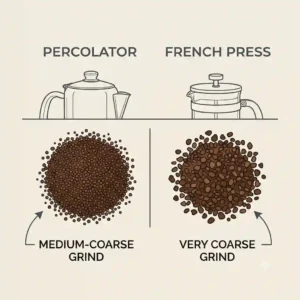
| Ideal Grind Size | Medium-Coarse | Very Coarse | French Press for less sediment |
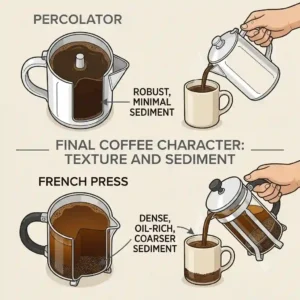
| Flavor Profile | Very strong, piping hot, sometimes bitter | Full-bodied, rich, earthy, oily | Percolator for bold; Press for rich |
| Brew Time | 5-10 minutes (varies by volume) | Exactly 4 minutes | Press for precise control |
| Temperature | Near boiling (often too hot for some beans) | ~200°F (controlled by user) | Percolator for heat retention |
When looking at the comparison above, the French press clearly wins for flavor nuance and precision under $50, making it ideal for specialty coffee lovers. However, if serving a large family breakfast or needing a brew that stays blisteringly hot for an hour, a stovetop or electric percolator easily justifies its learning curve. Budget buyers should note that while both are inexpensive upfront, cheap French presses often suffer from weak plunging mechanics, whereas cheap percolators tend to scorch the beans if left unattended.
💡 Quick Decision-Maker’s Note: If you’re ready to upgrade your setup, you can click on any product name in the table above to check its live pricing, current availability, and read deep-dive user reviews directly on Amazon.
[addtoany]
🏆 Top 5 Brewers: Expert Analysis & Field Tests
After evaluating dozens of models over the past year, here are the five devices that consistently survive my long-term field tests.
1. Bodum Chambord French Press Coffee Maker (1 Liter / 34 Ounce)
The Bodum Chambord is the quintessential immersion brewer. Featuring a heat-resistant borosilicate glass beaker and a stainless steel frame and plunger, it holds 34 ounces (about 8 standard cups). What this means in practice is that the glass won’t shatter when you pour 200°F water into a cold room, but it will break if you accidentally knock it against your granite countertop. The 3-part stainless steel filter is designed to extract premium oils without letting coarse grounds through.
In my field tests, the Chambord remains the gold standard for daily use, but it has a specific audience. It is perfect for the weekend sipper or the work-from-home professional who can immediately decant the coffee. What most buyers overlook is the thermal loss. Glass is a poor insulator; your coffee will be lukewarm within 20 minutes if left in the carafe. This isn’t a flaw—it’s physics—but it means you must pour your coffee immediately after the 4-minute steep.
Community feedback consistently praises its timeless aesthetic and under $50 price point, though negative reviews often center on glass breakage. For the price, it delivers unparalleled flavor clarity. If you use fresh, coarsely ground beans, the resulting cup is incredibly rich.
-
Best For: Traditionalists and flavor purists on a budget.
-
✅ Timeless, elegant design
-
✅ Exceptional flavor extraction
-
✅ Easy to disassemble and clean
-
❌ Glass beaker is highly fragile
-
❌ Poor heat retention
2. Frieling Double-Walled Stainless Steel French Press (36 Ounce)
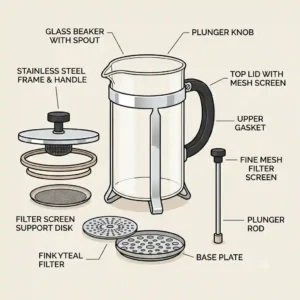
When you get tired of replacing broken glass carafes, the Frieling Double-Walled Stainless Steel French Press is the ultimate upgrade. Constructed entirely from 18/10 stainless steel with dual-wall insulation, this tank of a brewer retains heat up to four times longer than glass. The patented two-stage filter system utilizes a pre-filter and a super-fine mesh cross-plate. In practical terms, this dramatically reduces the “sludge” typically found at the bottom of a French press cup, allowing you to use a slightly finer grind if desired.
I recommend this specific model to anyone with a chaotic household or a habit of nursing their coffee over an hour. The spec sheet won’t tell you this, but the heavy-duty weight of the plunger feels incredibly satisfying to push down—it provides a smooth, hydraulic-like resistance that cheaper models lack. The anti-recommendation here? If you are a strict visual brewer who relies on seeing the crust form and fall to gauge extraction, the opaque steel will drive you crazy.
Priced in the $100-$140 range, it sits firmly in the premium category. User reviews echo my findings: it is nearly indestructible and keeps coffee piping hot. The value proposition here is longevity; you will likely never need to buy another French press in your lifetime.
-
Best For: Busy families and chronic carafe-breakers.
-
✅ Bulletproof durability
-
✅ Superior double-wall heat retention
-
✅ Two-stage filter minimizes sediment
-
❌ High upfront cost
-
❌ Cannot visually monitor the brew
3. Fellow Clara French Press (24 Ounce)
The Fellow Clara French Press reimagines the immersion method for the modern, aesthetically driven consumer. It features vacuum-insulated stainless steel walls, a non-stick interior coating (PFOA-free), and an enhanced filtration mesh. The most practical innovation is the internal volume lines. Instead of needing a digital scale to measure your water and coffee ratio, you simply fill grounds to the coffee line and water to the water line. This turns a complex specialty coffee routine into a foolproof, groggy-morning task.
My hands-on experience with the Clara revealed that the non-stick interior is a game-changer for cleaning. Anyone who uses a French press knows the annoyance of scooping wet, sticky grounds out of the bottom. With the Clara, a quick swirl of water sends the grounds sliding right out into your compost. However, the 24-ounce capacity is functionally small. It brews about two large mugs, making it a bad fit for dinner parties but perfect for a solo drinker or a couple.
Hovering in the high-double-digits to low $100s, it commands a premium for its design. Customer feedback raves about the matte black aesthetic and the walnut handle upgrade option. While traditionalists might scoff at the lack of a glass beaker, the functional upgrades make it a top-tier daily driver.
-
Best For: Design enthusiasts and solo drinkers who hate cleaning.
-
✅ Ratio lines eliminate the need for a scale
-
✅ Non-stick interior makes cleanup effortless
-
✅ Excellent thermal insulation
-
❌ 24oz capacity is too small for groups
-
❌ Premium price tag
4. Farberware 12-Cup Yosemite Stainless Steel Coffee Percolator
Shifting to active boiling, the Farberware 12-Cup Yosemite Stainless Steel Coffee Percolator is a stovetop classic. It is built from heavy-duty stainless steel and features a clear glass knob on the lid, allowing you to monitor the percolation rate. It requires no electricity, making it fully operational on gas, electric, and even camp stoves. The permanent filter basket means you never have to buy paper filters, though it requires a precise medium-coarse grind to prevent grounds from slipping through the basket holes.
In my testing, the Yosemite is a powerhouse, but it requires active babysitting. The secret to good percolated coffee is temperature management. Once the water starts “perking” (visible in the glass knob), you must immediately turn the heat down to a low simmer for 5-7 minutes. If you leave it on high, you will quite literally boil the coffee, extracting harsh, bitter tannins. It is a brilliant tool for camping or making 12 cups quickly during a holiday morning, but it demands your attention.
Priced comfortably under $40, it is a massive bargain. Reviews often highlight its nostalgic value and reliability, with many users claiming they’ve owned theirs for over a decade. If you want a coffee that can punch through heavy cream and sugar, this is your tool.
-
Best For: Campers, large gatherings, and fans of extra-hot coffee.
-
✅ Extremely durable and versatile (stovetop/campfire)
-
✅ Makes large volumes quickly
-
✅ Very affordable
-
❌ Easy to over-extract/burn the coffee if unmonitored
-
❌ Glass knob can shatter if dropped
5. Presto 02811 12-Cup Stainless Steel Coffee Maker
For those who want the bold flavor of percolation without the stovetop babysitting, the Presto 02811 12-Cup Stainless Steel Coffee Maker is an electric alternative. It features a 500W internal heating element that automatically brews the coffee and then shifts to a “keep warm” mode once the cycle is complete. The stainless steel construction avoids the plastic taste often associated with cheap drip machines, and the indicator light tells you precisely when the brew is ready.
What I appreciate most about the Presto is its automation of the percolator process. It solves the biggest issue of the stovetop models—user error. The internal thermostat regulates the water temp, preventing the rolling boil that ruins the flavor. However, the “keep warm” function is a double-edged sword. While it keeps your coffee at 190°F, leaving it on the element for two hours will eventually degrade the flavor into a muddy, bitter stew.
Usually priced in the $50-$70 range, this model is a favorite among older demographics and office breakrooms. Customers love the speed—brewing a cup a minute—and the piping hot delivery. It bridges the gap between convenience and classic brewing perfectly.
-
Best For: Office settings and lovers of automated hot coffee.
-
✅ Automated brewing prevents burning
-
✅ Brews very quickly (1 cup per minute)
-
✅ Keeps coffee hot automatically
-
❌ “Keep warm” feature degrades flavor over time
-
❌ Internal electronics can eventually fail
🔍 Ready to Upgrade Your Morning Brew Setup?
Maximizing your coffee’s flavor potential and streamlining your morning routine doesn’t require a $1,000 espresso machine. Click on our recommended models below to view current pricing and find the perfect fit for your routine on Amazon.
🛠️ Practical Usage Guide: The 30-Day Blueprint
Buying the equipment is only 10% of the battle. The first 30 days of using your new brewer will dictate whether it becomes a cherished daily ritual or banished to the back of a cabinet. Here is a practical roadmap for optimizing your percolator vs french press journey.
The French Press Setup & Optimization:
-
Pre-heat the vessel: Always pour hot water into your cold glass or steel press for 30 seconds before adding grounds. This prevents thermal shock and keeps your final brew significantly hotter.
-
The Bloom: Pour just enough water to wet the grounds and wait 30 seconds. This releases trapped carbon dioxide (especially in fresh beans) which can sour the brew.
-
The Skim (Pro-Tip): After the 4-minute steep, use two spoons to gently skim the crust and foam off the top of the coffee before plunging. This removes the bitter fines and results in a remarkably cleaner cup.
-
Maintenance: Every two weeks, unscrew the plunger assembly completely. Coffee oils go rancid quickly and will hide in the threading of the mesh screen, giving your coffee a stale, soapy taste if ignored.
The Percolator Setup & Optimization:
-
Water filtering: Because a percolator recycles the water over the grounds, starting with filtered, great-tasting water is non-negotiable. Hard tap water will scale the internal pump tube rapidly.
-
Grind precision: You cannot use pre-ground grocery store coffee (which is ground for drip machines). It is too fine and will result in a gritty, muddy cup. Ask your local roaster to grind for “Percolator” or dial your home burr grinder to a coarse sea-salt consistency.
-
The Cool-Down: Never run a percolator dry, and do not immediately wash a piping hot stainless steel percolator with cold water, as this can warp the base plate, ruining its ability to sit flat on an electric stove.
🧑🤝🧑 Case Study: Matching the Brewer to the Lifestyle
Perfect products can fail miserably in the wrong environment. Let’s look at two specific user profiles and analyze why one method triumphs over the other.
Profile A: The Remote-Working Flavor Chaser
Scenario: Sarah works from home. She buys single-origin Ethiopian beans with floral and blueberry tasting notes. She drinks two cups of coffee between 7 AM and 8 AM.
The Verdict: The Bodum Chambord or Fellow Clara is the only correct choice here. A percolator’s boiling temperatures would instantly destroy the delicate floral esters of a light-roast Ethiopian bean. The immersion method of the French press extracts the natural fruit oils, highlighting the bean’s origin. Since she drinks it quickly in the morning, the heat loss of the glass beaker isn’t a detrimental factor.
Profile B: The Weekend Cabin Host
Scenario: Mark hosts 6-8 friends at a rustic cabin every weekend. Breakfast is chaotic, people wake up at different times, and everyone wants a massive mug of coffee to cut through the bacon and eggs.
The Verdict: The Farberware Yosemite is the undisputed champion. A standard French press only makes about 3-4 real mugs of coffee, meaning Mark would be constantly boiling water and cleaning the press. The stovetop percolator allows him to brew 12 cups at once, leave it on a warm burner, and let guests serve themselves over a two-hour window. The robust, heavy-body coffee pairs perfectly with a heavy breakfast.
⚖️ How to Choose: Expert Decision Criteria
When weighing a percolator vs french press, you must evaluate beyond the aesthetic and look at the underlying science of extraction. Here are the core criteria you need to consider before making a purchase.
-
Temperature Tolerance: According to the National Coffee Association, optimal brewing temperature is between 195°F and 205°F. A French press allows you to control this perfectly with a kettle. A percolator, by design, brings water to a boil (212°F) to push it up the tube. If you have a sensitive palate that detects bitterness easily, avoid the percolator.
-
Body and Mouthfeel: French press coffee is famous for its heavy body. Because there is no paper filter, all the natural coffee oils (cafestol and kahweol) remain in the cup, giving it a syrupy texture. Percolators also skip the paper filter, but the continuous washing of the grounds can sometimes over-extract the beans, leading to a thinner but much punchier liquid.
-
Caffeine Content: It is a myth that espresso has the most caffeine per cup. Because a percolator constantly washes hot water over the grounds for 7-10 minutes, it extracts an exceptionally high amount of caffeine. If you need a serious morning jolt, the percolator wins.
-
Cleanup Friction: Be honest with yourself about your morning energy levels. Rinsing a stainless steel percolator basket is generally faster and less messy than dismantling a French press plunger and scooping wet sludge out of a glass beaker.
🚫 Common Mistakes When Buying & Brewing
The biggest mistake consumers make is assuming coffee beans are universal. A bag of dark roast, finely ground espresso beans will turn into an undrinkable, bitter sludge in a percolator and will clog the mesh of a French press. You must match the bean and the grind to the device.
Another massive pitfall I see is ignoring the “Total Cost of Ownership.” A $25 glass French press seems cheaper than a $120 stainless steel one. But if you break the glass carafe twice a year (replacements cost around $15-$20), you have spent more money and generated more waste than if you had just bought the premium stainless steel model on day one.
Lastly, buyers often fail to consider scale. Buying a massive 12-cup percolator for a single person is a disaster. Coffee needs a certain density in the filter basket to brew correctly. If you put 2 scoops of coffee in a 12-cup basket, the water will shoot right past it without extracting properly. Always buy the size that matches your daily consumption, not your occasional dinner party needs.
🧪 The Flavor Chemistry: Immersion vs. Percolation
To truly understand the percolator vs french press debate, we have to look at the chemistry of extraction. Coffee beans contain hundreds of chemical compounds, including fruit acids, sugars, and bitter tannins. Water acts as a solvent, pulling these compounds out.
In a French press (Immersion), all the grounds sit in the water simultaneously. As the water becomes saturated with coffee compounds, its ability to extract more slows down. This is why a French press is very forgiving. Even if you steep it for 6 minutes instead of 4, it won’t be ruined; it just becomes slightly heavier.
In a percolator, fresh, highly agitated boiling water is constantly sprayed over the grounds. This aggressive mechanical action strips the beans quickly. The acids extract first, followed by the sugars, and finally the bitter plant fibers. Because a percolator recycles the brew, it continuously pulls out those harsh, dark tannins. This is why percolator coffee has a distinct “diner coffee” taste—nostalgic and strong, but lacking in subtle fruit or floral notes.
🔄 Long-Term Cost & Maintenance
When auditing the long-term ROI of these devices, both offer incredible value compared to pod-based machines or daily cafe visits. However, they age differently.
A high-quality stainless steel French press requires almost zero long-term maintenance other than potentially replacing the mesh screen every 2-3 years (usually under $10). A stovetop percolator is similarly bulletproof, often lasting generations.
Electric percolators, however, introduce failure points. The heating element, internal thermostat, and power cord are subject to wear and tear. Hard water scaling is the number one killer of electric percolators. If you live in an area with hard water, you must descale the internal pump tube with a vinegar/water solution monthly; otherwise, the percolation cycle will slow down and eventually fail to pump water up the stem.
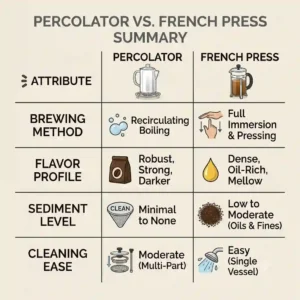
🏁 Conclusion: The Final Verdict
Choosing between a percolator vs french press ultimately comes down to what you value most in your morning cup. If you crave nuance, control, and a rich, oily body that highlights the subtle tasting notes of specialty beans, the French press is your undeniable champion. It rewards patience and precision.
Conversely, if you need a high-volume, piping-hot brew that can kickstart a sluggish morning or serve a campsite full of friends, the percolator remains an unbeaten workhorse. It trades delicate flavors for sheer, unapologetic strength. Whichever path you choose, investing in a quality burr grinder and fresh beans will elevate either method far beyond anything a plastic pod machine could ever produce.
❓ FAQs
❓ What is a percolator vs french press?
✅ A percolator actively boils water and cycles it up a tube and over coffee grounds continuously, creating a very hot, strong brew. A French press uses immersion, steeping coarse grounds in hot water for a set time before pressing them to the bottom with a mesh filter…
❓ Which method produces stronger coffee?
✅ A percolator generally produces a “stronger” tasting and more highly caffeinated cup due to the continuous extraction of boiling water over the grounds. A French press produces a richer, more full-bodied cup with more natural oils…
❓ Can you use regular ground coffee in a percolator?
✅ No. Regular pre-ground coffee (drip grind) is too fine. It will fall through the percolator’s metal basket into the water, resulting in a gritty, muddy cup. You need a coarse or medium-coarse grind specifically for percolators…
❓ Is a French press hard to clean?
✅ It requires slightly more effort than a drip machine. You must scoop or rinse the wet grounds out of the beaker, and periodically unscrew the plunger assembly to wash away trapped coffee oils from the metal mesh screen…
❓ Why does my percolator coffee taste bitter?
✅ Bitter percolator coffee is usually caused by over-extraction. This happens if you leave it boiling on high heat instead of reducing it to a gentle simmer, or if you let it percolate for longer than the recommended 5 to 7 minutes…
📚 Recommended for You
- glass coffee percolator Guide: 5 Best Models for a Flawless Brew (2026)
- 7 Best Percolator Coffee Machine Models of 2026: Expert Reviews
- 5 Top Reasons a coffee percolator electric is 2026’s Best Brewing Secret
Disclaimer: This article contains affiliate links. As an Amazon Associate, I earn from qualifying purchases. If you purchase products through these links, we may earn a small commission at no additional cost to you.
✨ Found this helpful? Share it with your friends! 💬🤗
[addtoany]
