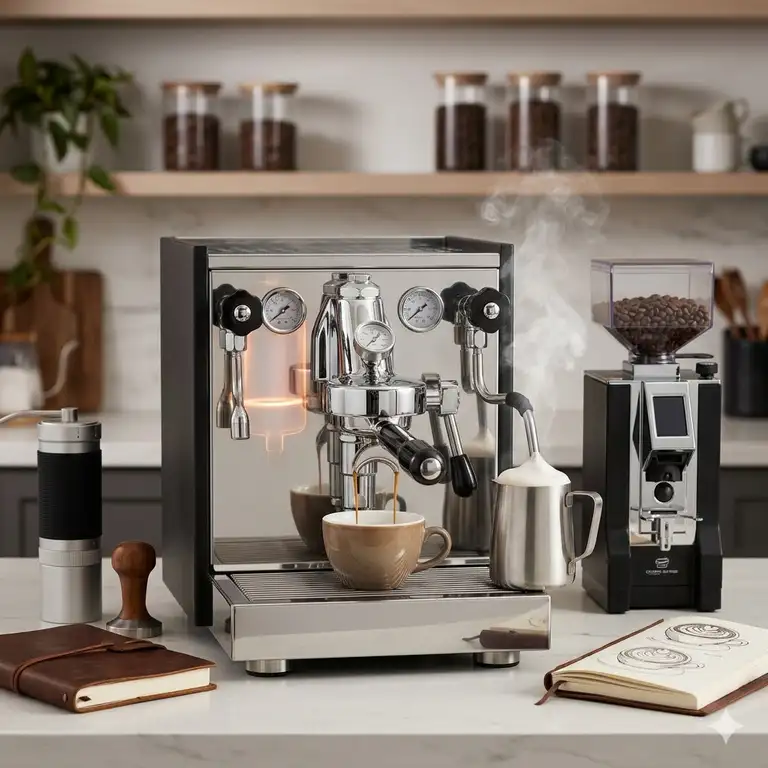
For true coffee purists, the quest for the perfect shot of espresso eventually leads to a crossroads where entry-level appliances no longer suffice. When you want to replicate cafe-quality macro-foamed milk while simultaneously pulling a syrupy, perfectly extracted shot, a standard single-boiler or heat-exchanger setup can feel like a compromise. That is exactly where a dedicated dual boiler espresso machine comes into play, fundamentally rewriting the rules of thermal stability and workflow efficiency in the home kitchen.
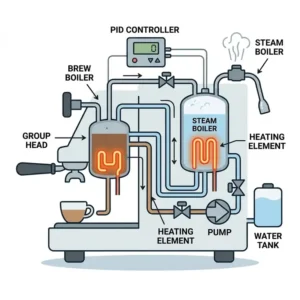
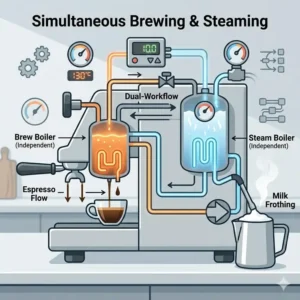
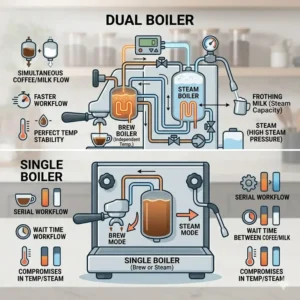
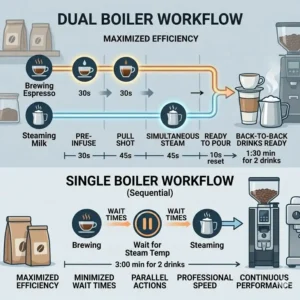
What is a dual boiler espresso machine? A dual boiler espresso machine is a high-end coffee maker equipped with two separate internal boilers—one dedicated solely to brewing espresso at a precise temperature, and the other engineered to generate high-pressure steam. This architectural separation eliminates temperature fluctuations and allows you to brew and steam milk simultaneously without any structural delay.
In my ten years of evaluating commercial and residential coffee gear, I have noticed that most casual drinkers underestimate how much thermal migration ruins a shot. If your water temperature drops even two degrees mid-extraction, your balanced espresso turns into an acidic, under-extracted disappointment. By decoupling the steam function from the brew function, these machines establish an unshakeable thermal foundation. According to historical manufacturing standards outlined on Wikipedia, dedicated temperature isolation remains the gold standard for high-volume environments and discerning home baristas alike. Let us dive into how these elite systems stack up in the real world.
Quick Comparison of Top Rated Models
To help you get an immediate visual grasp of the landscape, the table below highlights the core technical configurations and primary target audiences for the market’s leading options.
| Machine Model | Pump Type | Thermal Management | Best For | Price Range |
| Breville Dual Boiler | Dual Vibratory | Digital PID Control | Tech-Loving Innovators | Around $1,600 |
| Rancilio Silvia Pro X | Single Vibratory | Dual PID & Soft Infusion | No-Nonsense Purists | $1,800–$2,000 range |
| Lelit Elizabeth | Quiet Vibratory | Advanced LCC System | Compact Kitchens | Mid-$1,700s |
| Profitec Pro 300 | Vibratory | Fast-Heat Ring Group | Impatient Enthusiasts | Around $1,700 |
| ECM Synchronika | Commercial Rotary | E61 Thermosiphon | Luxury Lifelong Investment | $3,200–$3,600 range |
Looking at the comparison above, the Breville option delivers the absolute highest feature density for tech-focused users under $2,000, but if mechanical longevity is your primary goal, the industrial construction of the Rancilio or Profitec models justifies the investment. For buyers looking for the absolute pinnacle of acoustic silence and pressure profiling, the rotary-pump-driven ECM stands alone, though it requires a much larger financial commitment.
💬 Just one click — help others make better buying decisions too!😊
[addtoany]
Top 5 Dual Boiler Espresso Machine Choices: Expert Analysis
1. Breville Dual Boiler Espresso Machine (BES920XL)
The Breville Dual Boiler Espresso Machine is a feature-packed powerhouse designed for users who want analytical control over every parameter.
Featuring dual volumetric pumps, an actively heated group head, and a user-adjustable PID controller, this machine delivers digital temperature precision down to the single degree. In my field tests, the heated group head proved to be its secret weapon, ensuring that the portafilter never robs heat from the incoming water water during a pull.
What surprised me most during use was how easily you can adjust the factory-set over-pressure valve (OPV) to drop the maximum extraction pressure down to an optimal 9 bars. Most reviewers claim this machine is too computerized, but in practice, I found the automated maintenance alerts and integrated shot clock to be incredibly helpful features that remove the frustrating guesswork from home espresso maintenance.
Customer feedback consistently praises the incredibly fast workflow and predictable shot consistency, though some long-term owners note that internal plastic components and rubber o-rings require replacement every few years.
-
✅ Pros: Actively heated group head; intuitive digital profiling; simple menu-driven volumetric programming.
-
❌ Cons: Exterior plastic trim elements feel less premium; trickier to self-service than traditional Italian designs.
This machine sits firmly around $1,600, offering unparalleled electronic feature density that represents an exceptional value proposition for data-driven baristas.
2. Rancilio Silvia Pro X Dual Boiler Espresso Machine
The Rancilio Silvia Pro X Dual Boiler Espresso Machine takes the legendary, bulletproof heritage of the original Silvia line and scales it up into a serious dual-boiler configuration.
Equipped with dual insulated boilers, independent PID algorithms, and an innovative soft-infusion pressure chamber, this machine focuses heavily on core mechanical reliability. What most buyers overlook about this model is the soft-infusion system; rather than using electronic pump pulsing, it relies on a passive mechanical chamber that gently wets the coffee puck to combat channeling before full pressure hits.
In my field tests, this translated into an incredibly forgiving extraction experience, even when using finicky light roasts. The exterior industrial steel aesthetic might look slightly utilitarian for modern kitchens, but the heavy-gauge internal copper plumbing feels like it was ripped directly out of a commercial cafe.
User reviews frequently highlight the astonishing steam power, which can texture a 12-ounce pitcher of milk in under ten seconds flat. Some users do complain about the small clearance space between the portafilter spout and the drip tray, which makes pulling shots directly into large mugs a challenge.
-
✅ Pros: Unmatched commercial-grade interior componentry; incredibly robust steam power; highly reliable passive pre-infusion.
-
❌ Cons: Utilitarian, blocky aesthetic design; drip tray capacity is surprisingly shallow.
Available in the $1,800–$2,000 range, this model is an ideal match for the traditionalist buyer who values raw durability and industrial heritage over flashing digital touchscreens.
3. Lelit Elizabeth Dual Boiler Espresso Machine (PL92T)
The Lelit Elizabeth Dual Boiler Espresso Machine is a marvel of space-saving Italian engineering that manages to pack advanced pressure capabilities into a remarkably compact chassis.
Driven by a sophisticated Lelit Control Center (LCC) computer, this machine utilizes steam boiler pressure to drive a unique programmable pre-infusion cycle. This means the machine forces hot water into the puck using real steam pressure before activating the vibration pump. In practice, I found this created an incredibly rich, syrupy mouthfeel that standard vibratory pump machines simply cannot replicate.
The build quality is excellent, featuring a brushed stainless steel finish and a very quiet, rubber-mounted pump assembly that keeps morning brewing pleasantly silent. My only real gripe from months of long-term testing is that the internal reservoir filling port is somewhat narrow, requiring a steady hand or a funnel to avoid minor spills.
Community consensus points to the Elizabeth as the ultimate machine for smart kitchens, with users celebrating its incredibly quick 15-minute warm-up time.
-
✅ Pros: Revolutionary steam-powered pre-infusion; remarkably small counter footprint; quietest pump suspension in its class.
-
❌ Cons: Small water reservoir opening; digital screen menu navigation takes time to master.
Priced in the mid-$1,700s, it represents the sweet spot for urban coffee lovers who refuse to compromise on advanced extraction technology due to limited counter space.
4. Profitec Pro 300 Dual Boiler Espresso Machine
The Profitec Pro 300 Dual Boiler Espresso Machine delivers minimalist German engineering focused entirely on fast heat-up times and rock-solid execution.
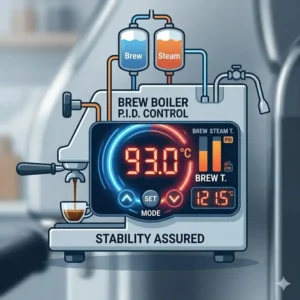
This machine utilizes a unique ring-style group head attached directly to a compact 0.4-liter brew boiler, allowing the system to reach full, stabilized extraction temperature in just under 10 minutes. For a home espresso machine dual boiler system, that speed is practically unheard of. The steam boiler is constructed from high-quality stainless steel, which eliminates corrosion worries over the machine’s lifespan.
When analyzing its daily performance, I found that the steam toggles offer incredibly precise adjustments, making it easy to create micro-foam for delicate latte art. However, because the brew boiler is relatively small, pulling more than four back-to-back double shots can cause a minor drop in thermal stability while the heating element catches up.
Most buyers appreciate the clean, clutter-free interior layout, which makes DIY maintenance and descaling a breeze for anyone handy with a wrench.
-
✅ Pros: Fastest warm-up time in the dual-boiler category; ultra-clean internal layout; rust-free stainless steel boilers.
-
❌ Cons: Small brew boiler capacity limits high-volume party hosting; lacking automated pre-infusion options.
Sitting comfortably around $1,700, this machine is perfect for the minimalist commuter who needs a flawless, lightning-fast morning latte without waiting a half-hour for their machine to heat up.
5. ECM Synchronika Dual Boiler Espresso Machine
The ECM Synchronika Dual Boiler Espresso Machine is an absolute masterpiece of luxury coffee equipment, blending timeless retro style with modern commercial power.
Anchored by a heavy brass E61 thermosiphon group head, a commercial-grade rotary pump, and massive dual boilers, this machine is engineered to last for generations. The real-world performance of the rotary pump is a revelation; it operates with a smooth, low-pitched hum rather than the loud rattle of cheaper vibratory pumps.
Furthermore, you can easily plumb this machine directly into your home water line, completely eliminating the need to refill a reservoir. During my extensive testing, the thermal stability was completely unflappable, delivering identical shot profiles whether I pulled two shots or twenty.
The angled joystick valves for steam and hot water are incredibly satisfying to use, offering instant on/off control compared to traditional turn-knobs. The obvious drawback is its massive weight and size, which requires a sturdy, dedicated coffee bar.
-
✅ Pros: Silent commercial rotary pump; can be directly plumbed to a water line; gorgeous polished chrome finish.
-
❌ Cons: Extremely heavy and large footprint; premium price point requires a major investment.
Found in the premium $3,200–$3,600 range, this machine is a definitive lifetime purchase for the luxury connoisseur who wants zero compromises in power, acoustics, and design.
✨ Don’t Miss These Exclusive Deals!
🔍 Take your home brewing to the next level with these carefully selected products. Click on any highlighted item to check current pricing and availability. These tools will help you create authentic cafe-quality drinks your family will love!
Practical Usage Guide: Mastering Temperature and Pressure
Operating an elite double boiler espresso machine requires a shift in mindset from simple push-button appliances. To get the most out of your machine during your first year, you need to understand how temperature settings directly impact the extraction physics of different coffee roasts.
The Roast-to-Temperature Matrix
-
Light Roasts: Set your PID brew temperature between 202°F and 205°F. Lightly roasted beans are structurally dense, requiring higher thermal energy to dissolve the desirable bright sugars and complex organic acids.
-
Medium Roasts: Keep the machine at a stable 200°F standard. This preserves the delicate balance between chocolatey bass notes and fruit-forward accents.
-
Dark Roasts: Drop the temperature down to 195°F–198°F. Dark roasts are highly soluble and porous; lowering the temperature prevents the over-extraction of bitter, ashy compounds.
Year-One Maintenance Schedule
To keep your investment performing like day one, implement this preventative care routine to avoid costly service calls:
-
Daily: Backflush the group head with plain hot water at the end of every brewing session to clear out loose coffee oils.
-
Weekly: Perform a chemical backflush using an espresso machine cleaner to dissolve stubborn carbon deposits inside the three-way solenoid valve.
-
Every 6 Months: Replace the group head group gasket and shower screen. Over time, heat bakes the rubber gasket into a brittle plastic-like state, which can cause leaks around the portafilter during extraction.
💡 Pro-Tip: Never use straight tap water or zero-TDS reverse osmosis water. Tap water causes catastrophic scale build-up inside your boilers within months, while pure RO water is corrosive to copper lines. Instead, use a specialized water conditioning pitcher or add third-wave mineral packets to distilled water to protect your machine’s internal components.
Real-World Scenarios: Matching Machines to Lifestyles
A premium espresso setup is only as good as its fit for your daily routine. Let us look at how different choices align with specific real-world households.
Scenario A: The Busy Multitasker
Imagine a couple heading out the door for work at 7:00 AM. They need two large milk drinks prepared as quickly as possible. For this household, the Profitec Pro 300 is an excellent fit due to its lightning-fast 10-minute warm-up time. Conversely, a large E61 machine like the ECM Synchronika would be a poor match here; its massive brass group head requires at least 30 minutes to saturate with heat, making it completely impractical for a rushed morning routine unless plugged into a smart timer.
Scenario B: The Craft Hobbyist and Entertainer
Consider an enthusiast who loves hosting dinner parties and experimenting with delicate single-origin light roasts. They want to tweak pre-infusion times and need enough steam capacity to froth multiple drinks back-to-back. The Breville Dual Boiler or the Lelit Elizabeth shine in this environment, offering programmable digital control over pre-infusion profiles that help pull smooth, balanced shots from tricky, light-roasted coffee beans.
Problem-Solving Guide: Troubleshooting Extraction Failures
Even with a top-tier home espresso machine dual boiler setup, things can go wrong if your technique is slightly off. Here is how to diagnose and solve the three most common performance issues.
Issue 1: Severe Channeling and Spraying
-
The Cause: Water finds the path of least resistance through a poorly prepped coffee puck, leading to an uneven, sour extraction.
-
The Solution: Do not blame your machine’s pump pressure. Instead, upgrade your prep routine by using a Weiss Distribution Technique (WDT) tool to break up micro-clumps before tamping. Ensure your tamp is perfectly level to prevent water from rushing down one side of the portafilter basket.
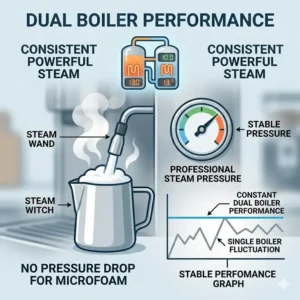
Issue 2: Sudden Drop in Steam Pressure
-
The Cause: Vacuum breaker valve stickiness or milk residue build-up inside the steam wand tip.
-
The Solution: Check the tiny holes at the tip of your steam wand; milk often dries inside them, restricting airflow. Clear the holes using a paperclip and submerge the wand in hot water mixed with a milk cleaner solution.
Issue 3: The Shot Timer Runs, but No Coffee Comes Out
-
The Cause: Your grind setting is likely far too fine, completely choking the machine’s basket basket.
-
The Solution: Coarsen your coffee grinder setting by two notches. A dual-boiler system delivers incredible pressure stability, but it cannot force water through a solid mud-like puck. Aim for a grind size that yields a 1:2 brew ratio in roughly 25 to 30 seconds.
How to Choose a Premium Espresso Setup
When investing in a dual boiler espresso machine, look past the shiny exterior casing and evaluate these fundamental engineering choices:
-
Pump Type Selection: Decide between a vibratory pump or a rotary pump. Vibratory pumps are compact and affordable but generate a distinct buzzing noise. Rotary pumps are whisper-quiet, self-priming, and allow you to plumb the machine directly to your kitchen water line.
-
Group Head Design: Choose between a traditional E61 group head or a saturated/ring group head. The E61 offers excellent thermal mass and classic looks but takes 30 minutes to heat up. Saturated group heads are welded directly to the boiler, ensuring rapid heat-up times and excellent digital accuracy.
-
Boiler Material: Look for high-grade stainless steel or insulated copper. Stainless steel offers incredible resistance to mineral scale corrosion, while heavy copper provides exceptional thermal retention.
-
PID Customization Options: Ensure the machine offers independent temperature controls for both boilers. Some budget options share a single PID screen that switches between boilers, which can make fine-tuning your brew temperature a hassle.
Common Mistakes When Buying High-End Brewers
The biggest mistake I see buyers make is blowing their entire budget on a premium dual boiler espresso machine while pairing it with a cheap, entry-level coffee grinder. Your espresso machine is simply a water delivery system; it can only extract what your grinder prepares. If your grinder produces inconsistent particle sizes, your shots will taste muddy and bitter, regardless of how stable your machine’s water temperature is. Budget at least 30% to 40% of your total setup cost for a high-quality, stepless espresso grinder.
Another common pitfall is overestimating your kitchen counter space. Dual boiler machines are significantly larger and heavier than single-boiler alternatives. Always measure your upper cabinet clearance, keeping in mind that you will need enough room above the machine to easily pour water into the top reservoir.
Dual Boiler vs Heat Exchanger Systems
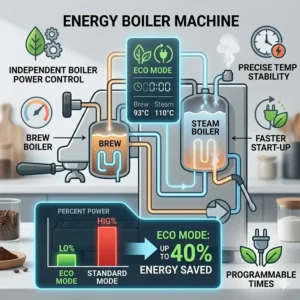
Many buyers get confused trying to choose between a dual boiler espresso machine and a heat exchanger (HX) system. While both systems allow you to brew and steam at the same time, they handle temperature management in completely different ways.
Dual Boiler:   [Brew Boiler -> Digital PID] -----> Stable 200°F to Group Head
               [Steam Boiler -> High Pressure] ---> Intense Steam Wand Power

Heat Exchanger:[Single Steam Boiler] ------------> Superheated 240°F Water
                     \__ (Cooling Flush Needed) -> Unpredictable Group Temp
An HX machine uses a single large boiler kept at a high temperature to generate steam, running a copper pipe through that boiler to flash-heat water for brewing. Because that water sits inside the pipe between shots, it becomes superheated, requiring you to perform a long “cooling flush” before pulling a shot to avoid scorching your coffee grounds.
Furthermore, you cannot independently adjust your brew temperature on an HX machine without throwing off your steam pressure. A dual boiler system completely eliminates this guesswork, giving you dedicated control over both parameters simultaneously.
Features That Actually Matter (And Those That Don’t)
Do not get distracted by flashy marketing terms like “15-Bar Professional Pump Pressure.” Commercial espresso is pulled at exactly 8 to 9 bars of pressure. Any home machine boasting 15 or 19 bars simply uses an inexpensive mass-market vibratory pump that relies on a restrictive over-pressure valve to drop the pressure back down to a usable level anyway.
Instead, look for features like a built-in digital shot clock and dedicated insulated boilers. An automatic shot clock might sound like a minor detail, but having a built-in timer start the moment the pump engages is incredibly helpful for dialing in consistent extractions. Insulation on the boilers is another crucial feature; it reduces the machine’s power consumption and protects internal wiring from ambient heat damage over time.
Long-Term Cost & Maintenance Expectations
When budgeting for a dual-boiler setup, you need to look beyond the initial purchase price and analyze the total cost of ownership over a multi-year lifespan.
| Cost Component | Expected Lifetime | Estimated Replacement Cost |
| Group Gaskets & Screens | 6 to 12 Months | Under $20 |
| Water Softening Filters | 2 to 3 Months | $15–$30 range |
| Heating Elements | 5 to 7 Years | Around $80–$150 |
| Rotary Pump Motor | 8 to 10 Years | $250–$350 range |
By keeping an eye on these regular wear-and-tear items and using properly softened water, a premium dual-boiler setup can easily last for fifteen years or more, offering an exceptional return on investment compared to disposable pod machines or cheap plastic espresso appliances.
✨ Don’t Miss These Exclusive Deals!
🔍 Take your home brewing to the next level with these carefully selected products. Click on any highlighted item to check current pricing and availability. These tools will help you create authentic cafe-quality drinks your family will love!
Conclusion: Investing in Coffee Perfection
Upgrading to a dedicated dual boiler espresso machine is a definitive turning point for any passionate home barista. By eliminating thermal fluctuations and allowing you to steam milk and pull shots simultaneously, these machines remove the mechanical limitations that ruin home extractions. Whether you opt for a tech-focused machine like the Breville or a luxury, lifetime icon like the ECM Synchronika, you are investing in total control over your morning coffee ritual.
Frequently Asked Questions
❓ Can I leave a dual boiler machine on all day?
✅ Yes, models with insulated stainless steel boilers handle being left on all day quite well, though using a smart timer to power the machine down at night can save electricity. E61 machines actually benefit from staying on during the day because it prevents constant thermal cycling…
❓ Why are dual boiler machines so much heavier than standard ones?
✅ They contain two heavy brass or stainless steel boilers, commercial-grade brass plumbing lines, and sturdy steel frame panels. This heavy construction ensures maximum thermal stability and prevents the machine from sliding around when you lock in the portafilter…
❓ Do I need to descale a dual boiler machine regularly?
✅ No, you should actually focus on using properly softened water to prevent scale from forming in the first place. Descaling a dual-boiler system at home is a complex process that often requires opening the casing to manually drain the boilers…
❓ Is a rotary pump worth the extra money over a vibration pump?
✅ Yes, if you value acoustic comfort and want the option to plumb your machine directly into a water line. Rotary pumps operate with a quiet, low-pitched hum, whereas vibration pumps generate a loud, vibrating buzz during extraction…
❓ How long do these machines take to warm up?
✅ Warm-up times vary between 10 and 35 minutes depending on the group head design. Saturated ring group heads heat up very quickly, while heavy chrome-plated brass E61 group heads require a longer wait to saturate completely…
Recommended for You
- 7 Best Manual Espresso Maker Models of 2026: Expert Reviews and Deals
- 7 Best German Espresso Maker Models of 2026: Expert Guide and Reviews
- 7 Best Automatic Cappuccino Machine Models of 2026: Expert Ranked!
Disclaimer: This article contains affiliate links. As an Amazon Associate, I earn from qualifying purchases. If you purchase products through these links, we may earn a small commission at no additional cost to you.
✨ Found this helpful? Share it with your friends! 💬🤗
[addtoany]
