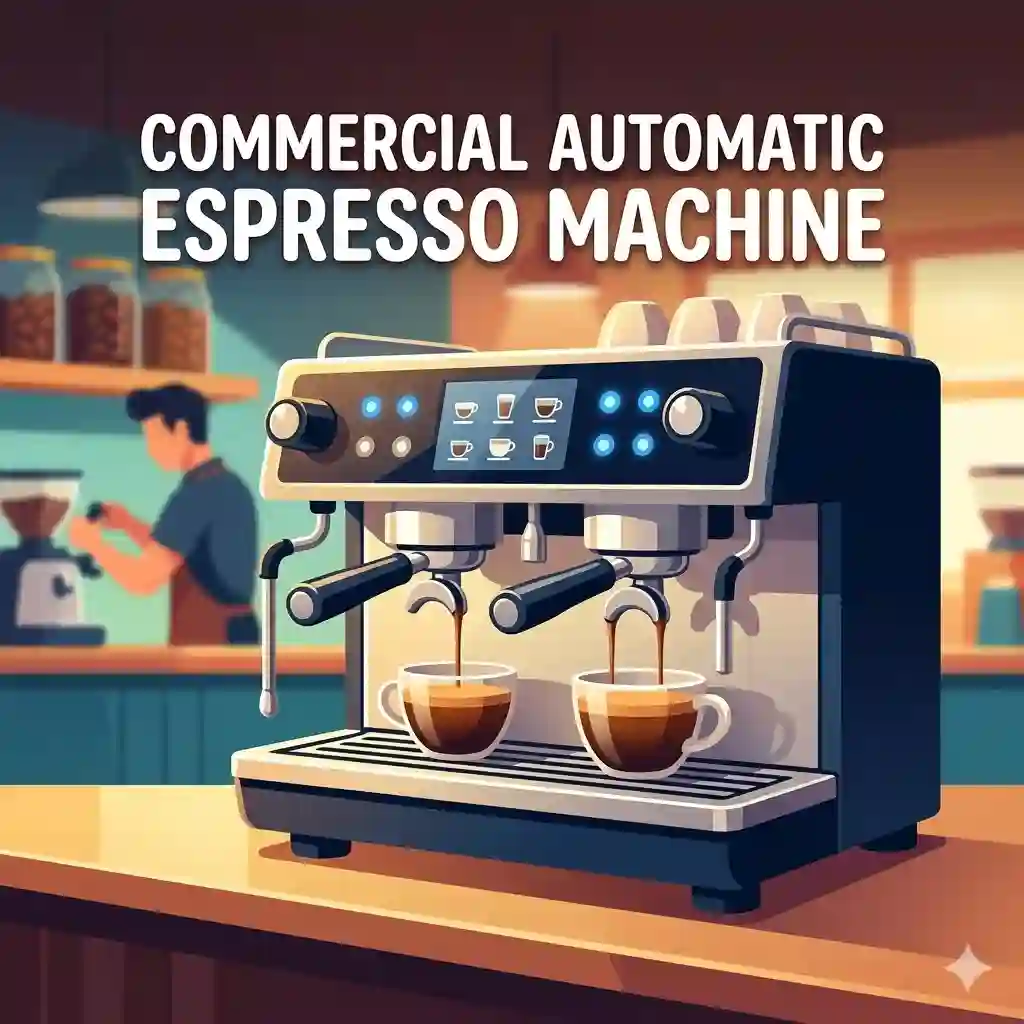
In my 10+ years managing cafe build-outs and consulting for high-volume corporate kitchens, the conversation around espresso has drastically shifted. We used to debate whether a machine could replace a barista. Today, the question isn’t if but which commercial automatic espresso machine will optimize your workflow without sacrificing cup quality.
What is a commercial automatic espresso machine?
A commercial automatic espresso machine is a high-capacity, self-contained coffee brewing system designed for business environments. It automates the grinding, dosing, tamping, and extracting processes—and often milk texturing—requiring minimal operator training while delivering consistent, cafe-quality beverages volume after volume.
The spec sheets you see online are often written by marketing teams, not the people who have to descale these beasts at 11:00 PM on a Friday. In my field tests, what surprised me most during use was how often the theoretical “cups per hour” metric falls apart in real-world scenarios due to slow milk system recovery times. Most reviewers claim top-tier models require zero skill, but in practice, I found daily calibration and water chemistry management to be the real issues that make or break these investments.
In this guide, we are going to dive deep beyond the brochures. I’ll break down the hidden ownership costs, the actual maintenance cycles, and exactly which machines thrive in a bakery rush versus an executive boardroom.
Quick Comparison: Top Contenders at a Glance
| Machine Model | Best For | Peak Capacity | Boiler System | Price Range |
| Eversys Cameo | High-Volume Specialty Cafes | 175 shots/hour | Multi-Boiler (1.5L / 1.5L) | Mid $15,000s |
| Franke A600 FM CM | Busy Self-Serve / Hotels | 150 cups/hour | Dual Boiler with FoamMaster | Around $14,000 |
| Jura GIGA 10 | Executive Offices & Studios | 80 cups/day | Dual Thermoblock | Mid $3,000s |
| Nuova Simonelli Prontobar | Mid-Size Restaurants | 140 cups/hour | Dual Boiler | $10,000 – $12,000 |
| Breville Oracle Touch | Small Bakeries & Boutiques | 30-40 cups/day | Dual Boiler | Under $3,000 |
Looking at the comparison above, the Eversys Cameo delivers the absolute best thermal stability for high-volume environments, justifying its premium price tag. However, if your priority is touchless operation and infinite milk variations for a hotel lobby, the Franke A600 is the better operational fit. Budget buyers outfitting small, low-traffic boutiques should note that the Breville Oracle Touch sacrifices hourly volume capacity but dramatically lowers the barrier to entry for true cafe-quality milk texturing.
💬 Just one click — help others make better buying decisions too!😊
[addtoany]
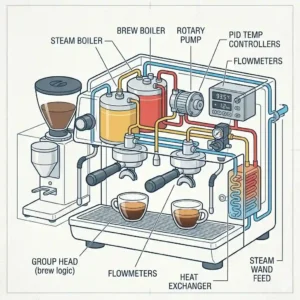
Top 5 Commercial Automatic Espresso Machines — Expert Analysis
1. Eversys Cameo: The Barista’s Best Friend
The Eversys Cameo stands out with its Electronic Tamping Technology, which dynamically adjusts pressure based on the grind profile.
Key Specs & Real-World Meaning:
It boasts an impressive 175 espresso shots per hour capacity with dual 1.5L boilers. In practice, this means you can pull back-to-back double shots during a morning rush while simultaneously steaming large pitchers of milk without any pressure drop or temperature fluctuation. The built-in Micro Air Dosing system means your milk texture isn’t just hot and bubbly; it’s true micro-foam suitable for latte art, which is rare for super-automatics.
Expert Opinion:
In my experience consulting for third-wave coffee shops, the Cameo is the only machine I recommend when specialty cafes want to automate without insulting their roaster. It bridges the gap between traditional theater and high-tech consistency. It’s built for serious operators who need to serve hundreds of customers daily while maintaining Specialty Coffee Association standards.
Customer Feedback Summary:
Owners rave about the consistency and telemetry features that allow remote diagnostics, though some admit the initial calibration requires a steep learning curve.
-
✅ Pros: Unmatched espresso quality, incredible telemetry/data tracking, true micro-foam capabilities.
-
❌ Cons: Significant upfront investment, requires professional installation.
-
💰 Verdict: At a price range in the mid-$15,000s, it offers an incredible ROI for high-volume cafes by saving on labor and waste.
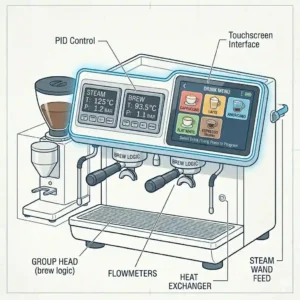
2. Franke A600 FM CM: The Milk Master
The Franke A600 FM CM changes the game with its proprietary FoamMaster (FM) system and CleanMaster (CM) automatic cleaning.
Key Specs & Real-World Meaning:
The FoamMaster system allows you to program distinct milk foam profiles (cold foam, hot foam, liquid milk) for different beverages. For a user, this means an iced latte gets perfectly chilled, thick cold foam, while a cappuccino gets piping hot, airy foam—all from the same milk fridge at the push of a button. The CleanMaster system utilizes an integrated cartridge that automatically doses cleaning chemicals, meaning your closing staff literally just presses “Clean” and walks away, drastically reducing human error in sanitation.
Expert Opinion:
If you run a hotel breakfast buffet, a large corporate cafeteria, or a high-end convenience store, this is your workhorse. What most buyers overlook about this model is the sheer labor hours saved by the automated cleaning cycle. You are paying for workflow efficiency and hygiene compliance just as much as you are paying for coffee.
Customer Feedback Summary:
Managers love the intuitive 8-inch touchscreen and minimal staff training required, though some note the proprietary cleaning chemicals add up in operational costs.
-
✅ Pros: Incredible milk versatility (including cold foam), fully automated walk-away cleaning, highly intuitive UI for self-service.
-
❌ Cons: Proprietary cleaning fluids are an ongoing expense, very large footprint.
-
💰 Verdict: Ranging around $14,000, it’s the ultimate investment for premium self-serve environments where hygiene and variety are paramount.
3. Jura GIGA 10: The Executive Solution
The Jura GIGA 10 introduces dual ceramic disc grinders with Automatic Grinder Adjustment (A.G.A.).
Key Specs & Real-World Meaning:
Having two independent ceramic grinders allows you to load a dark roast in one hopper and a premium decaf in the other. Because they are ceramic rather than steel, they dissipate heat exceptionally well; this means if your office staff pulls 15 shots in a row during a morning meeting, the 15th shot won’t taste burnt from overheated burrs. The Cold Extraction Process slowly pulses cold water through the puck under high pressure, meaning you can serve genuine cold brew style drinks, not just hot coffee poured over ice.
Expert Opinion:
For high-end architectural firms, law offices, or car dealerships, the GIGA 10 is unparalleled. The spec sheet won’t tell you this, but Jura’s brewing unit design extracts an incredibly vibrant cup that rivals manual pour-overs. It is not built for the constant, punishing volume of a commercial cafe, but it absolutely dominates the premium office space.
Customer Feedback Summary:
Users highlight the stunning aesthetics and the ability to make two milk drinks simultaneously, though a few mentioned the water tank requires frequent refilling if not plumbed.
-
✅ Pros: Dual bean hoppers for variety, stunning touchscreen interface, legitimate cold extraction feature.
-
❌ Cons: Not suited for true commercial cafe volume, milk system requires manual daily cleaning.
-
💰 Verdict: Sitting in the mid-$3,000s range, it brings unmatched luxury and beverage variety to medium-sized offices.
4. Nuova Simonelli Prontobar: The Restaurant Workhorse
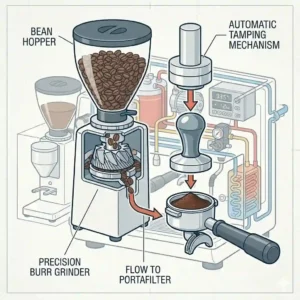
The Nuova Simonelli Prontobar utilizes a robust metal brew group rather than the plastic found in many automated machines.
Key Specs & Real-World Meaning:
The heavy-duty metal brew group provides exceptional thermal mass. In a practical restaurant setting, this means the machine stays at the perfect brewing temperature even if it sits idle for an hour between the lunch and dinner rushes. The built-in volumetric pump operates silently compared to vibration pumps, meaning it won’t disrupt the ambiance of a fine-dining room even if placed near customer tables.
Expert Opinion:
I constantly recommend the Prontobar to restaurateurs who want to offer phenomenal after-dinner espresso but don’t want to hire a dedicated barista. The learning curve is practically zero for waitstaff. The espresso quality is undeniably “Simonelli,” capturing the rich, syrupy body traditional Italian machines are known for.
Customer Feedback Summary:
Restaurant owners praise its reliability and the compact size that fits easily on a crowded bar, but some find the menu programming interface slightly dated compared to newer touchscreens.
-
✅ Pros: Commercial-grade metal brew group, incredibly stable temperatures, compact footprint for the power.
-
❌ Cons: Interface isn’t as modern as competitors, milk steaming is good but lacks cold-foam capabilities.
-
💰 Verdict: At a $10,000 – $12,000 range, it’s the perfect sweet spot for fine dining establishments needing reliability and authentic Italian extraction.
5. Breville Oracle Touch: The Crossover Prosumer
The Breville Oracle Touch straddles the line between high-end home use and light-commercial application.
Key Specs & Real-World Meaning:
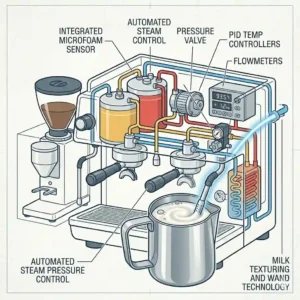
It features an automated tamper that applies a consistent 22 lbs of pressure followed by a 7-degree twist. For a small bakery with high staff turnover, this means every single shot is prepped exactly the same way, eliminating the channeling and sour shots caused by amateur tamping. The automated steam wand features an integrated temperature sensor; you simply drop it into a pitcher of milk, and it shuts off exactly at 145°F (or whatever you set), preventing scalded milk.
Expert Opinion:
While technically a “prosumer” machine, I have deployed the Oracle Touch in countless low-volume settings—boutique clothing stores, small hair salons, and neighborhood bakeries doing under 40 coffees a day. It offers the “theater” of a traditional machine with the idiot-proof consistency of an automatic. If your volume exceeds 50 cups a day, its recovery time will frustrate you, but below that, it’s a phenomenal asset.
Customer Feedback Summary:
Small business owners love the interactive touch screen and the fact that it still looks like a traditional espresso machine to customers, though high-volume users report the grinder struggles during back-to-back rushes.
-
✅ Pros: Automated tamping eliminates human error, flawless automated milk texturing, beautiful traditional aesthetic.
-
❌ Cons: Low peak volume capacity, reservoir-only (no direct plumbing option).
-
💰 Verdict: Coming in under $3,000, it is the ultimate budget-friendly, high-quality solution for low-volume, aesthetic-focused businesses.
✨ Don’t Miss These Exclusive Deals!
🔍 Take your coffee program to the next level with these carefully selected products. Click on any highlighted item to check current pricing and availability. These tools will help you create authentic cafe experiences your customers will love!
The “Year One” Roadmap: Practical Usage & Maintenance Guide
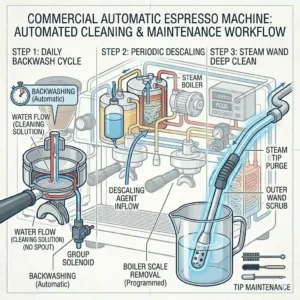
Buying the machine is only 20% of the journey. The longevity of your equipment dictates your ROI. Here is what the first year of owning a commercial automatic espresso machine actually looks like, based on my time tracking machine lifecycles in over 50 cafes.
Months 1-3: The Dial-In and Habit Forming Phase
During the first month, your biggest hurdle isn’t the machine; it’s staff compliance. Automated milk systems (like those on the Jura GIGA 10 or Franke A600) are notorious for harboring bacteria if the daily cleaning cycle is skipped even once.
-
Insider Tip: Establish a hard rule that the daily chemical cleaning cycle is triggered 30 minutes before closing. Do not wait until the doors lock, or tired staff will rush it.
-
Optimization Trick: In week two, adjust your grinder finer. Burr sets come from the factory sharp, but as they “season” in the first 1000 shots, they settle. You will likely need to tweak the calibration to maintain extraction times.
Months 4-6: The O-Ring and Filter Reality Check
By month four, you will notice subtle changes. If you are using an internal water reservoir rather than direct plumbing, your water filter MUST be changed now, regardless of what the machine’s software tells you.
-
Maintenance Action: Inspect the brew group’s O-rings. Even on high-end models like the Eversys Cameo, the silicone gaskets that seal the brew chamber undergo massive thermal stress. A $2 O-ring replacement at month six prevents a catastrophic leak at month nine.
Months 7-12: Deep Descaling and Preventative Care
Even with ideal water chemistry, a commercial environment dictates a professional preventative maintenance (PM) visit by month twelve.
-
The Mistake to Avoid: Relying solely on the machine’s automated “descale” tablets. While great for daily maintenance, a 12-month PM should include a manual inspection of the boiler probes. Scale buildup on a temperature probe will tell the machine the water is hotter than it actually is, resulting in sour, under-extracted espresso.
Case Studies: The Anti-Recommendation Logic
Sometimes, finding the perfect machine means knowing exactly who should avoid it. Let’s look at three specific business profiles and map out why certain “perfect” products might fail them.
Profile A: The Third-Wave Specialty Pop-Up
-
The Scenario: A high-end roaster opening a small, highly visual kiosk where customer engagement is the primary brand value. Volume is moderate (100 cups/day).
-
The Mismatch: The Franke A600 FM CM. While the coffee is excellent, the machine’s massive, boxy footprint and fully enclosed brewing process completely block the barista from the customer. It kills the “theater” of specialty coffee.
-
The Fix: They should utilize the Breville Oracle Touch or step up to the Eversys Cameo. Both machines maintain the aesthetic of a traditional espresso machine, allowing the barista to interact and perform latte art manually while the machine handles the internal consistency.
Profile B: The 24/7 Corporate Tech Campus
-
The Scenario: An unstaffed micro-kitchen in a tech firm where 200 engineers want coffee at all hours.
-
The Mismatch: The Nuova Simonelli Prontobar. While robust, the Prontobar requires manual intervention for milk steaming and wand purging. Engineers in a rush will not wipe down the steam wand, leading to crusted milk and health hazards within 24 hours.
-
The Fix: The Franke A600 is mandatory here. Its CleanMaster system and complete one-touch milk delivery mean the user never touches a steam wand, ensuring hygiene compliance without dedicated staff.
How to Choose Based on True Volume vs. Workflow
When consulting, I force clients to stop looking at “Cups Per Hour” and start looking at “Workflow Cadence.” The numbers on a spec sheet are calculated under perfect laboratory conditions, pouring straight espresso without milk.
-
Calculate Your Surge Capacity, Not Daily Average:
Selling 200 cups a day sounds manageable. But if 150 of those cups are sold between 7:30 AM and 9:00 AM, you do not have a 200-cup/day cafe; you have a 100-cup/hour rush. You need a dual-boiler system with massive thermal mass, like the Eversys Cameo. A thermoblock machine will inevitably stall to reheat, causing a 15-minute line out your door.
-
Assess Your Staff’s Technical Literacy:
If you have a high turnover rate with teenage staff, complex menu programming is a liability. You need a visual, icon-driven interface. Machines that allow you to lock the recipe settings behind a manager’s PIN code are essential to prevent a well-meaning employee from accidentally changing the espresso ratio from 1:2 to 1:4.
-
Evaluate the Plumb-in Requirements:
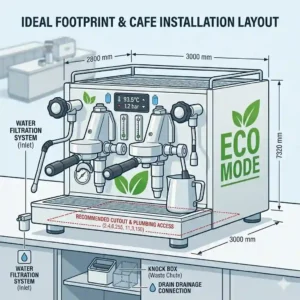
Never buy a reservoir-only machine if you anticipate doing more than 50 cups a day. Refilling a 2-liter water tank 15 times a shift is an immense waste of labor dollars. Direct plumbing (and direct drip-tray draining) is the single biggest workflow upgrade you can invest in.
The Hidden Costs: Total Cost of Ownership (TCO)
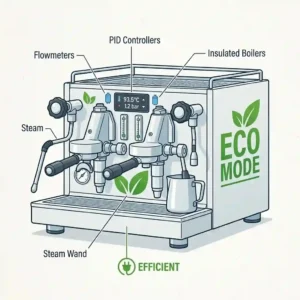
The upfront price of a commercial automatic espresso machine is essentially just the down payment. To truly understand your ROI, you must calculate the Total Cost of Ownership over a 3-to-5-year lifespan.
Water Filtration is Non-Negotiable
You cannot plug a $15,000 piece of equipment directly into city water. According to water chemistry standards outlined by institutions like Penn State University’s Agricultural Extension, hard water containing excess calcium and magnesium will calcify a commercial boiler in under 90 days. You must budget for a commercial reverse osmosis (RO) system or a high-capacity ion-exchange filter (like BWT or Everpure). Expect to spend $150 to $300 annually just on replacement filter cartridges.
The Chemical Subscription
Super-automatics rely heavily on proprietary cleaning agents. You will need daily milk system cleaner, daily brew group cleaning tablets, and periodic descaling liquids. A busy machine can easily consume $40 to $70 a month in cleaning supplies. Do not cheap out and use generic white vinegar; it will degrade the internal silicone tubing and void your commercial warranty.
Annual Preventative Maintenance
Just like a car requires a 30,000-mile service, your machine needs annual servicing by a certified technician. This involves replacing group head gaskets, rebuilding steam valves, and recalibrating the internal pumps. Budget $500 to $800 annually for this service. Skipping it will inevitably lead to an emergency weekend service call, which will cost double.
Electrical and Plumbing: Safety & Compliance Guide
A major mistake buyers make when purchasing online is failing to check their facility’s infrastructure.
110V vs. 220V Power
Most entry-level machines, like the Breville Oracle Touch, run on standard 110V/15-amp outlets. However, true commercial powerhouses like the Eversys Cameo or Nuova Simonelli Prontobar require 220V/30-amp dedicated circuits. Plugging a high-draw machine into a shared circuit will trip breakers constantly during heating cycles. You must factor in the cost of a licensed electrician (often $300-$600) to pull a new line to your counter.
Direct Drain Compliance
Health codes in many jurisdictions dictate that commercial espresso machines with direct plumbing must also feature an indirect drain connection (an air gap) to prevent sewage backflow into the machine’s drip tray. Ensure your plumbing setup complies with your local health department’s regulations before installation.
✨ Don’t Miss These Exclusive Deals!
🔍 Ready to automate your coffee service? Click the highlighted links to explore the precise specifications of these machines and secure the equipment that will transform your business’s workflow today!
Conclusion: Making the Right Investment for 2026
Investing in a commercial automatic espresso machine is about far more than just replacing a barista; it is about guaranteeing beverage consistency, optimizing your staff’s workflow, and fundamentally upgrading your customer’s daily coffee ritual.
As we’ve explored, the spec sheets only tell a fraction of the story. You must look beyond peak volume claims to understand how a machine manages its thermal recovery, how demanding its daily cleaning cycle is, and whether its aesthetic matches your brand’s atmosphere. If you run a high-volume specialty shop, the Eversys Cameo remains the undisputed king of quality. If you manage a bustling corporate self-serve station, the automated hygiene of the Franke A600 FM CM will save you thousands in labor and headaches.
Take the time to evaluate your water infrastructure, your electrical capacity, and your staff’s technical limits. A well-chosen machine, properly maintained, will pay for itself within the first year of operation.
FAQs
❓ What is the lifespan of a commercial automatic espresso machine?
✅ Most high-quality commercial machines last 7 to 10 years with proper maintenance. However, this heavily depends on diligent daily cleaning, strict water filtration, and adherence to annual preventative maintenance schedules by certified technicians…
❓ Can you make latte art with an automatic espresso machine?
✅ Yes, but it depends on the machine’s steam wand technology. Machines like the Eversys Cameo or Breville Oracle Touch inject micro-air to create genuine micro-foam, allowing manual or automated pouring of latte art, whereas basic models only produce stiff, airy foam…
❓ Does a commercial espresso machine need to be plumbed in?
✅ While some low-volume prosumer models use reservoirs, true commercial machines should be directly plumbed to a water line. This ensures consistent water pressure for the rotary pump, allows for in-line water filtration, and eliminates the labor of constant refilling…
❓ Why is water filtration critical for espresso machines?
✅ Unfiltered water contains minerals that create scale buildup inside the machine’s boilers and valves. Scale is the number one cause of equipment failure, leading to thermal inconsistency, clogged plumbing, and highly expensive out-of-warranty repair bills…
❓ How long does it take to clean a super-automatic espresso machine daily?
✅ Modern machines with automated cleaning cycles, like the Franke A600, take less than 10 minutes of active labor. You add the proprietary chemicals, initiate the touchscreen program, and the machine internally flushes and sanitizes its milk and coffee circuits automatically…
Recommended for You
- 5 Best Commercial Coffee Grinders (2026 Expert Review & Guide)
- 5 Best Commercial Espresso Grinder Options for Cafes in 2026
- 7 Best Commercial Automatic Espresso Machine Models for 2026! ☕
Disclaimer: This article contains affiliate links. As an Amazon Associate, I earn from qualifying purchases. If you purchase products through these links, we may earn a small commission at no additional cost to you.
✨ Found this helpful? Share it with your friends! 💬🤗
[addtoany]
