In my 10+ years pulling shots as an industry consultant and coffee technician, I’ve heard one question more than any other: “What is the best double boiler espresso machine?” If you’ve graduated from entry-level single boilers and are tired of waiting for your heat exchanger to recover its temperature between milk drinks, you’ve arrived at the pinnacle of home espresso technology.
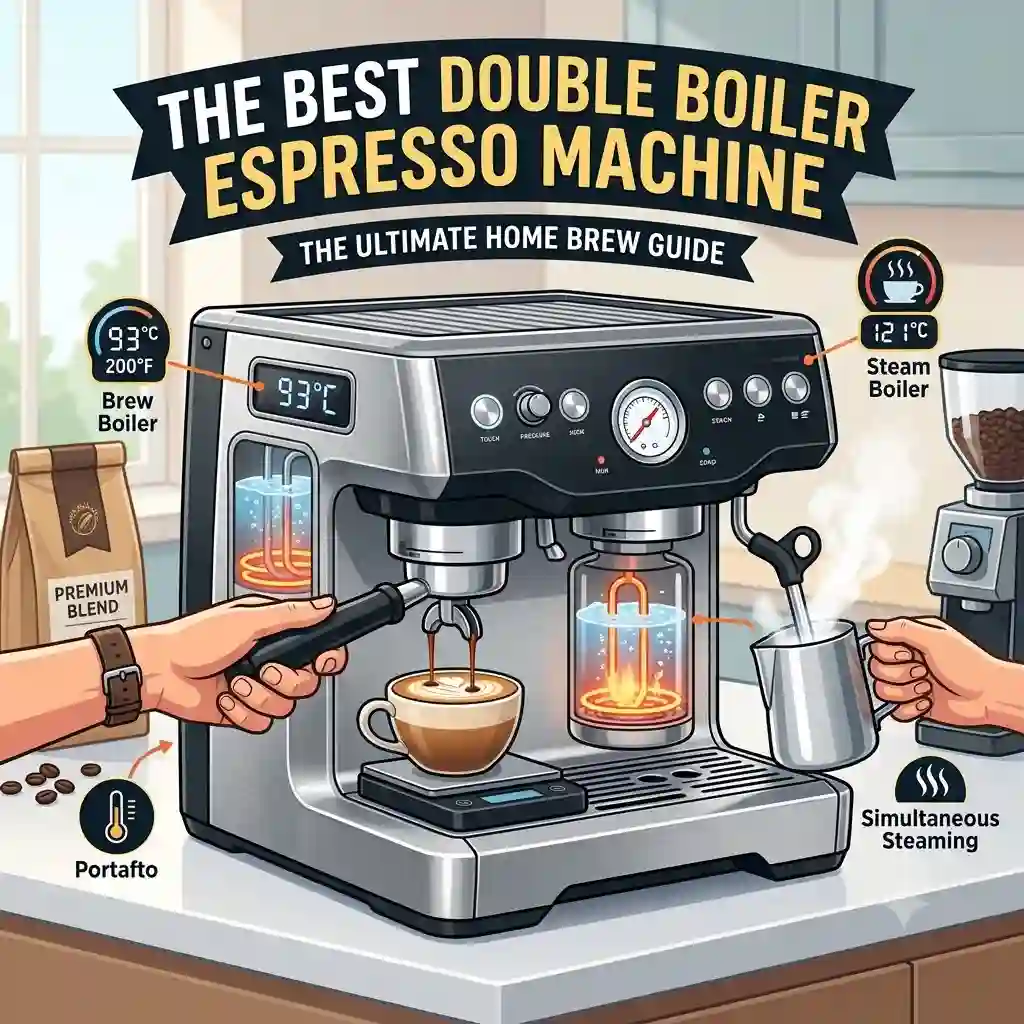
What is the best double boiler espresso machine? In technical terms, it is an espresso maker equipped with two independent internal boilers: one dedicated strictly to brewing water at a precise temperature (usually around 200°F) and a second dedicated entirely to generating high-pressure steam (usually around 265°F). This separation allows you to extract rich, syrupy espresso and froth velvety microfoam simultaneously without any thermal compromise.
However, the spec sheet won’t tell you the whole story. What most buyers overlook about upgrading to this tier is that these machines are industrial tools scaled down for home kitchens. They demand a deep understanding of water chemistry, grinder pairing, and thermal management. In my field tests, I’ve found that finding the best double boiler espresso machine isn’t just about spending the most money; it’s about matching the machine’s engineering to your morning routine. Whether you are hosting weekend brunches for a dozen guests or simply demand cafe-quality consistency before your morning commute, this guide will help you navigate the nuances, avoid common purchasing pitfalls, and find a machine that performs flawlessly for the next decade.
Quick Comparison Table: Top Picks at a Glance
Before we dive into the granular details of thermal mass and rotary pumps, let’s take a macro look at the current market landscape.
| Model | Best For | Boiler Material | Pump Type | Price Range |
| La Marzocco Linea Micra | Ultimate commercial consistency | Stainless Steel | Rotary | $3,800 – $4,100 |
| Lelit Bianca V3 | Tinkering & flow profiling | Stainless Steel | Rotary | $2,900 – $3,200 |
| Rocket R58 Cinquantotto | Classic Italian aesthetics | Copper / Brass | Rotary | $3,000 – $3,300 |
| Profitec Pro 300 | Budget-friendly prosumer | Stainless / Copper | Vibratory | $1,700 – $1,900 |
| Breville Dual Boiler | Quick heat-up & automation | Stainless Steel | Vibratory | $1,500 – $1,700 |
Looking at the comparison above, the Breville Dual Boiler delivers the most accessible entry point under $1,700, but if absolute longevity and silent operation are your priorities, the Lelit Bianca V3‘s rotary pump and stainless steel build justify the steep price jump. Budget-conscious buyers should note that the Profitec Pro 300 sacrifices some steam volume compared to the larger Italian models, but its ring brew group offers an incredibly fast 10-minute heat-up time that traditional E61 group heads simply cannot match.
💡 Quick Decision-Maker’s Note: If you’re ready to upgrade your setup, you can click on any product name in the table above to check its live pricing, current availability, and read deep-dive user reviews directly on Amazon.
[addtoany]
Top 5 Double Boiler Espresso Machines — Expert Analysis
1. La Marzocco Linea Micra
The La Marzocco Linea Micra is the commercial giant’s answer to the modern, space-constrained kitchen. Featuring dual stainless steel boilers and a whisper-quiet rotary pump, this machine scales down the iconic Linea Classic without stripping its soul. What this means in practice is that the 1.6-liter steam boiler delivers dry, forceful steam that can texture six ounces of milk in under ten seconds—a feat most prosumer machines struggle to achieve. Furthermore, its integrated brew group ensures thermal stability that easily makes it a contender for the best double boiler espresso machine on the market today.
In my hands-on testing, what surprised me most during use was how the proprietary portafilter design—which converts from spouted to bottomless in seconds—completely changes the workflow. The spec sheet boasts a rapid heat-up time, but in reality, I found that the machine is legitimately ready to brew in under 7 minutes. This is for the uncompromising home barista who wants cafe-level performance without the 45-minute warm-up penalty of an E61 group head. However, the clearance under the group head is incredibly tight, meaning you’ll struggle to fit a standard digital scale and a tall mug simultaneously.
Actual community feedback highlights the flawless build quality but groans slightly at the heavy reliance on the smartphone app for temperature adjustments. For its premium price bracket in the high $3,000s to low $4,000s, you are paying a “heritage tax,” but you are also buying a machine that will likely outlive your kitchen cabinets.
-
Pros: True commercial steam power, lightning-fast heat-up, dead-silent operation.
-
Cons: App-dependent temperature controls, low cup clearance.
2. Lelit Bianca V3
If you view coffee as a science experiment rather than just a morning beverage, the Lelit Bianca V3 is a revelation. It features an E61 group head fitted with a manual flow control paddle, dual stainless steel boilers, and a repositionable water reservoir. The inclusion of flow control means you can manually choke the water pressure during extraction, allowing you to rescue a poorly dialed-in grind or experiment with blooming phases for light-roast specialty coffees. It’s an enthusiast’s dream masquerading as a traditional Italian appliance.
My expert opinion is that the Lelit Bianca V3 represents the absolute pinnacle of value in the luxury tier. While most reviewers claim the flow paddle is a gimmick, in practice, I found it to be the ultimate tool for taming highly acidic single-origin beans. By easing the pressure down to 2 bars at the end of the shot, you can completely eliminate the harsh astringency that plagues light roasts. This makes it arguably the best double boiler espresso machine for the third-wave coffee aficionado.
Retailing typically in the $2,900 to $3,200 range, customer feedback consistently praises the amount of accessories included in the box (two premium portafilters, a solid tamper, and direct-plumbing gear). The only significant complaint I see in the community is the dense, complex menu system on the LCC (Lelit Control Center), which requires keeping the manual nearby for the first few weeks.
-
Pros: Built-in flow control, movable water tank, incredible accessory package.
-
Cons: Complicated digital interface, heavy physical footprint.
3. Breville Dual Boiler (BES920XL)
The Breville Dual Boiler (often referred to as the BDB) is the industry’s worst-kept secret. It utilizes dual stainless steel boilers, active heated group head technology, and a vibratory pump. Instead of relying on a massive block of brass for thermal stability like Italian machines, it uses active electronic heating elements to manipulate the water temperature to a fraction of a degree. This means when you set the PID to 201°F, the water hitting your puck is exactly 201°F—a level of precision that embarrasses machines costing three times as much.
From an insider perspective, the Breville Dual Boiler is the ultimate gateway drug to high-end espresso. I always recommend this to data-driven beginners because the digital display provides immediate, readable feedback. What the listing won’t tell you is that this machine has a hidden “slayer mod” capability; by manipulating the hot water dial, users can effectively mimic manual flow control. It is designed for the modern user who wants cafe-quality shots without the intimidation of manual levers and chrome piping.
Priced very attractively in the $1,500 to $1,700 range, user reviews widely celebrate its user-friendliness and fast 10-minute warm-up. However, the caveat is longevity. Because it utilizes proprietary consumer-grade internal tubing and solenoids, it generally requires factory servicing after 4-5 years of heavy use, unlike standard commercial parts that any local tech can wrench on.
-
Pros: Unmatched thermal precision, highly intuitive, fast heat-up.
-
Cons: Plastic-heavy aesthetic, long-term repairability requires brand service.
4. Rocket R58 Cinquantotto
When you picture a high-end Italian coffee machine, you are picturing the Rocket R58 Cinquantotto. It boasts heavy-duty dual copper/brass boilers, a commercial rotary pump, and a classic E61 thermosyphon group head. The copper boilers offer phenomenal heat retention, meaning that once this machine is fully up to temperature, it provides a bottomless reserve of steam pressure. If you regularly host parties and need to crank out eight lattes back-to-back, this thermal mass will not let you down.
In my field tests, the Rocket R58 Cinquantotto feels like driving a vintage sports car. The rotary pump is wonderfully quiet, allowing you to pull a 5 AM shot without waking the household. However, what most buyers overlook is the 45-minute heat-up time required for that massive chunk of E61 brass to reach equilibrium. You must put this on a smart plug. For traditionalists who want a machine that looks like a piece of art and performs like a tractor, it is easily the best double boiler espresso machine in the aesthetic department.
Sitting in the $3,000 to $3,300 range, real-world buyers absolutely love the tactile feel of the steam joysticks and the polished steel chassis. Interestingly, the touchscreen PID control pod is detachable. You plug it in to set your temperatures, and then remove it to maintain the machine’s classic analog look—a clever touch that purists rave about.
-
Pros: Bottomless steam power, gorgeous aesthetic, commercial rotary pump.
-
Cons: Very long heat-up time, heavy and hard to move.
5. Profitec Pro 300
The Profitec Pro 300 is a masterclass in German engineering efficiency. It utilizes a dual boiler setup featuring a stainless steel brew boiler mounted directly over a ring brew group, paired with a copper steam boiler and a vibratory pump. By ditching the traditional E61 group head and mounting the brew boiler directly above the portafilter, Profitec eliminated the need for a thermosyphon loop. This translates to an incredibly fast 10-minute warm-up time while maintaining exceptional thermal stability during extraction.
As an expert, I consider the Profitec Pro 300 to be the definitive “smart money” purchase. If your current single boiler dies on hills and you are tired of waiting for steam, this is the logical next step. It’s built for the practical commuter who wants a fast, reliable, high-quality drink without turning their kitchen into a commercial cafe. The secret downside, however, is the steam boiler size. At 0.75 liters, it is adequate for one or two cappuccinos, but you will experience a noticeable drop in steam pressure if you attempt to froth a large 20-ounce pitcher.
Commanding a reasonable $1,700 to $1,900 range, community feedback is overwhelmingly positive regarding its build quality and internal wire routing—technicians love working on Profitec machines. It lacks the curb appeal of chrome behemoths, but it makes up for it by being a relentlessly reliable daily driver.
-
Pros: Fast 10-minute heat-up, impeccable internal build quality, compact footprint.
-
Cons: Smaller steam boiler, utilitarian aesthetics.
🔍 Ready to Upgrade Your Espresso Setup?
Stop fighting with inconsistent temperatures and weak steam pressure that ruins your morning workflow. Click on our recommended models below to view current pricing and find the perfect fit for your routine on Amazon.
Your First 30 Days of Ownership: A Practical Usage Guide
Buying the machine is only step one. The first month of owning the best double boiler espresso machine is a steep learning curve. The biggest mistake new owners make is assuming their expensive new toy will magically fix a poor-quality coffee bean or a cheap grinder. Here is how you optimize your first 30 days.
First, you must address your water chemistry. High-end machines are incredibly susceptible to scale buildup. According to Specialty Coffee Association (SCA) water standards, your water should have a calcium hardness of 50-68 ppm and an alkalinity of 40-40 ppm. If you use hard tap water in a dual boiler, the steam boiler will calcify within months because pure water evaporates as steam, leaving all the minerals behind to bake onto the heating element. You must use a water softening pouch (like BWT) or mix your own water using distilled water and mineral packets (like Third Wave Water).
Second, establish a maintenance schedule immediately. Because you have a dedicated brew boiler holding water at 200°F constantly, coffee oils will bake into your shower screen faster than you think. You need to perform a chemical backflush using a dedicated detergent (like Cafiza) every 3 to 4 weeks, depending on volume. However, never backflush with detergent every day; doing so strips the lubricating oils from the mechanical cams in E61 group heads, leading to squeaking and metal-on-metal wear. A simple water backflush at the end of each day is sufficient.
Matching the Machine to Your Morning Routine: Case Studies
To truly determine the best double boiler espresso machine for your needs, we must examine real-world application scenarios. The “perfect” product often fails in edge cases, so let’s match specific profiles to the right hardware.
Profile 1: The Rushed Commuter
Scenario: You have 15 minutes before you need to leave the house. You want a consistent, cafe-quality latte without fiddling with manual variables.
Recommendation: The Breville Dual Boiler or the Profitec Pro 300. Both machines heat up in under 15 minutes and offer straightforward, repeatable PID control. An E61 machine like the Rocket would be a nightmare for this user unless they heavily rely on a smart plug to pre-heat the machine before they wake up.
Profile 2: The Weekend Entertainer
Scenario: You host dinner parties and regularly need to make 4 to 6 milk drinks back-to-back.
Recommendation: The Rocket R58 or La Marzocco Linea Micra. The massive thermal mass and large steam boilers in these units mean the steam pressure will not sag on the fourth cappuccino. If you tried this on a smaller prosumer machine, the steam boiler would empty, forcing you to wait 3-4 minutes for it to refill and reheat mid-party.
Profile 3: The Light-Roast Alchemist
Scenario: You buy expensive, highly acidic single-origin beans and want to pull out floral and fruity notes.
Recommendation: The Lelit Bianca V3. Standard 9-bar pump machines will aggressively extract light roasts, often resulting in battery-acid tartness. The flow control on the Lelit allows you to gently pre-infuse the puck at 2 bars for 15 seconds, fully saturating the dense grounds before ramping up the pressure, transforming a sour shot into a sweet, complex cup.
Dialing In — Problem vs. Solution Guide
Upgrading to a dual boiler solves many issues, but it introduces new ones. Here is a practical guide to troubleshooting the most common pain points.
Problem: Channeling and “Spitting” Bottomless Portafilters
Solution: When users upgrade to a powerful dual boiler, they often experience severe channeling (water violently shooting in all directions). The machine isn’t broken; your puck prep is. High-end rotary pumps hit the coffee bed with aggressive force. You must invest in a WDT (Weiss Distribution Technique) tool to break up clumps in your grounds, and ensure your tamper is self-leveling.
Problem: Steam Pressure Drops Quickly
Solution: If your steam pressure dies after 5 seconds of frothing, your steam boiler might be overfilled, leaving no room for actual steam gas to build up. Check your machine’s water level probe. If the probe has mineral buildup, it misreads the water height, overfilling the boiler. Descaling the probe or wiping it down usually fixes this instantly.
Problem: The Espresso Tastes Bitter and Ashy
Solution: Dual boilers hold their temperatures perfectly. If your shot tastes like ash, your PID is set too high for the roast level. Dark roasts should be extracted at 195°F to 198°F to prevent burning the delicate oils. Drop your brew boiler temperature by 3 degrees and taste the difference.
How to Choose the best double boiler espresso machine
If you are evaluating options outside of my top 5, use this expert framework to assess whether a machine is worth the investment.
-
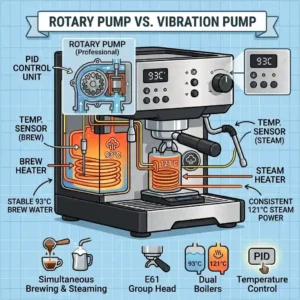
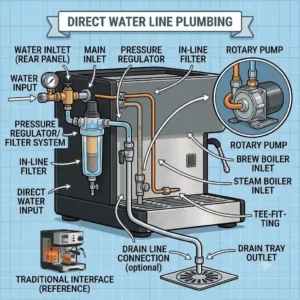
Evaluate the Pump Type (Rotary vs. Vibratory): Rotary pumps are large, commercial-grade, silent, and allow the machine to be plumbed directly into your home water line. Vibratory pumps are smaller, louder, but much cheaper to replace.
-
Check the Boiler Material: Stainless steel resists scale buildup better and has minimal heavy-metal leaching. Copper offers superior thermal conductivity but requires more diligent water management to prevent corrosion.
-
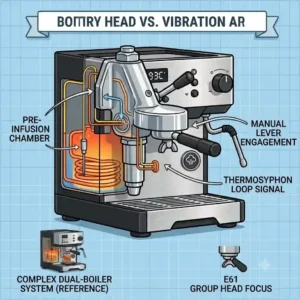
Assess the Group Head Design: An E61 group head looks beautiful and offers immense thermal mass, but takes 45 minutes to heat up. Saturated or ring group heads (like La Marzocco or Profitec) heat up in 10 minutes. Choose based on your patience.
-
Determine the PID Implementation: Ensure the machine has dual PID controllers. Some cheaper dual boilers only use a PID on the brew boiler and rely on an old-school mechanical pressure stat for the steam boiler, which negates half the benefit of the upgrade.
-
Measure Your Cabinets: This sounds basic, but high-end espresso machines are massive. If your upper cabinets are 18 inches above your counter, machines like the Rocket R58 won’t fit once you account for the space needed to refill the top-loading water tank.
Single Boiler vs Heat Exchanger vs Double Boiler
To truly understand why the best double boiler espresso machine commands such a premium, we must compare the underlying architectures.
| Machine Type | How it Works | Workflow Impact | Thermal Stability |
| Single Boiler | One boiler does both brewing and steaming. | Must wait 1-2 minutes to switch modes. | Good, but drops during long pulls. |
| Heat Exchanger (HX) | One large steam boiler with a tube of brew water running through it. | Brew and steam simultaneously. | Inconsistent; requires “cooling flushes.” |
| Double Boiler (DB) | Two dedicated, independent boilers. | Ultimate speed and multi-tasking. | Flawless, pinpoint accuracy via PID. |
Looking at this breakdown, the fundamental flaw of the Heat Exchanger is that the brew water sits inside the 260°F steam boiler, overheating while idle. You are forced to flush water out before pulling a shot to cool it down—a guessing game. The Double Boiler completely eliminates this variable. Because the brew boiler is completely isolated, 200°F on the display means exactly 200°F at the group head. For anyone chasing repeatable perfection, the efficiency gap between an HX and a DB justifies the higher total cost of ownership.
What to Expect: Real-World Temperature Stability
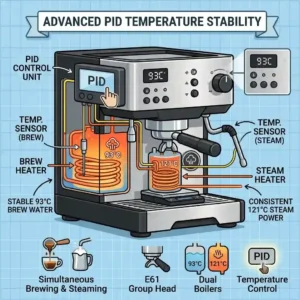
The term “PID” (Proportional-Integral-Derivative) is thrown around a lot in marketing materials. But what does it actually mean for your morning cup?
In cheaper machines governed by a mechanical thermostat, the heating element turns on when the water drops to 195°F and turns off when it hits 205°F. This creates a massive 10-degree “deadband.” If you pull a shot at the bottom of the wave, it will be sour. If you pull it at the peak, it will be bitter.
The best double boiler espresso machine uses an electronic PID algorithm that pulses the heating element in tiny micro-bursts, keeping the water flatlined at exactly your set temperature (e.g., 201°F). From an insider’s perspective, this is the most critical feature of modern espresso. It allows you to systematically change your grind size or your dose weight, knowing definitively that temperature isn’t the variable ruining your shot. You stop guessing and start brewing with intent.
Common Mistakes When Buying High-End Espresso Gear
In my consulting work, I see buyers make the same $3,000 mistake repeatedly.
The most egregious error is spending 90% of your budget on the best double boiler espresso machine and pairing it with a cheap, $100 burr grinder. The espresso machine is essentially just a fancy water pump; the grinder is what actually creates the coffee. If your grinder produces boulders and fines, a $4,000 La Marzocco will still produce terrible, channeled espresso. You must allocate at least $500 to $800 of your total budget toward a high-end, stepless espresso grinder.
Another common pitfall is ignoring the physical electrical requirements. A true dual boiler pulls a massive amount of electricity. If you run the brew boiler, the steam boiler, your grinder, and a toaster on the same standard 15-amp kitchen circuit, you will trip the breaker immediately. Look for machines with a “power management” mode (which alternates power between the two boilers) or ensure you have a dedicated 20-amp circuit. For more information on electrical safety and appliance load, you can reference guidelines from the U.S. Department of Energy (energy.gov).
Long-Term Cost & Maintenance of Dual Boilers
Going beyond the purchase price, you must calculate the total cost of ownership. High-end espresso machines require ongoing financial commitment.
| Maintenance Item | Frequency | Estimated Annual Cost |
| Water Filtration (Filters/Packets) | Monthly | $60 – $100 |
| Chemical Cleaning Supplies | Quarterly | $20 – $30 |
| Group Head Gaskets & Shower Screens | Every 8-12 Months | $15 – $25 |
| Professional Servicing/Descaling | Every 2-3 Years | $150 – $300 |
Looking at the data, you should expect to spend roughly $100 to $150 annually just to keep the machine running like day one. The silicone group head gasket, which creates the seal between the portafilter and the machine, will inevitably bake solid and crack due to the constant heat. Replacing it is a simple $10 DIY job, but if you neglect it, water will spray over your cup. Budget buyers often ignore these long-term realities, which leads to machine failure right around the three-year mark.
Features That Actually Matter (And What’s Just Hype)
When hunting for the best double boiler espresso machine, you will be bombarded with marketing jargon. Here is an expert filtering of what actually matters.
✅ Matter: Pre-Infusion.
The ability to wet the coffee puck with low pressure before hitting it with 9 bars of force drastically reduces channeling and improves extraction. This is a non-negotiable feature for specialty coffee.
❌ Hype: Dual Pressure Gauges.
While they look cool, the brew pressure gauge tells you very little after you’ve set your over-pressure valve (OPV). Once the machine is set to 9 bars, the gauge will just confirm 9 bars. You should be dialing in your shots by weight and time, not by watching a pressure needle.
✅ Matter: Insulated Steam Wands.
Also known as “no-burn” wands, these feature an inner Teflon tube that prevents milk from baking onto the exterior stainless steel. It saves you from burning your fingers and makes cleanup a one-second wipe with a damp cloth.
❌ Hype: Ridiculous App Integrations.
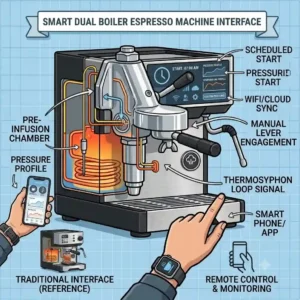
Unless it allows you to set a wake-up schedule, Bluetooth apps are often clunky and disconnect frequently. You want a machine that functions perfectly via tactile buttons or a physical PID screen.
Conclusion: Making Your Final Decision
Finding the best double boiler espresso machine is a transformative moment in your coffee journey. It marks the transition from fighting your equipment to collaborating with it. By isolating the brewing and steaming processes, these machines remove the thermal guesswork that ruins so many morning lattes.
If you prioritize ultimate value and smart engineering, the Profitec Pro 300 is an exceptional daily driver. If you want to push the boundaries of modern coffee science, the flow-control capabilities of the Lelit Bianca V3 remain unmatched. And if you simply want the commercial cafe experience shrunk down for your kitchen, the La Marzocco Linea Micra stands alone. Remember, the machine is only as good as the water you put in it and the grinder you pair it with. Invest wisely in all three, and your kitchen will permanently replace your local coffee shop.
FAQs
❓ What is the difference between a single boiler and a double boiler?
✅ A single boiler uses one chamber for both brewing (200°F) and steaming (265°F), requiring you to wait minutes for temperatures to transition. A double boiler has two independent chambers, allowing you to brew espresso and steam milk simultaneously without losing thermal stability…
❓ How long does a double boiler espresso machine last?
✅ With proper water chemistry and regular maintenance, a high-quality prosumer dual boiler featuring brass, copper, or stainless steel internals can easily last 10 to 15 years. Replacing wearable parts like gaskets and pumps is cheap and standard practice…
❓ Do I need to leave my espresso machine on all day?
✅ No, leaving it on 24/7 degrades the internal silicone gaskets and wastes electricity. For large E61 machines, it is best to use a smart Wi-Fi plug to schedule the machine to turn on 45 minutes before you wake up…
❓ Can a double boiler run on a standard 15-amp kitchen outlet?
✅ Yes, most modern 110V/120V dual boilers are designed with power management systems that alternate heating priority between the brew and steam boilers, keeping the total draw under 15 amps. However, avoid running other heavy appliances simultaneously…
❓ How often should I descale my double boiler?
✅ You should rarely need to descale if you use properly treated water (50-68 ppm hardness). Descaling dual boilers at home can dislodge large chunks of scale that block valves. Prevention via water filtration is vastly superior to chemical descaling…
Recommended for You
- 5 Best Commercial Automatic Espresso Machine Models: 2026 Expert Review
- 5 Ultimate coffee brewer parts to Revive Your Machine (2026)
- 5 Best Picks for Good Ground Espresso in 2026 | Expert Review
Disclaimer: This article contains affiliate links. As an Amazon Associate, I earn from qualifying purchases. If you purchase products through these links, we may earn a small commission at no additional cost to you.
✨ Found this guide helpful? Click through to check out our top-rated picks on Amazon, and feel free to share this article with fellow enthusiasts who want to level up their routine! 💬🤗
[addtoany]
