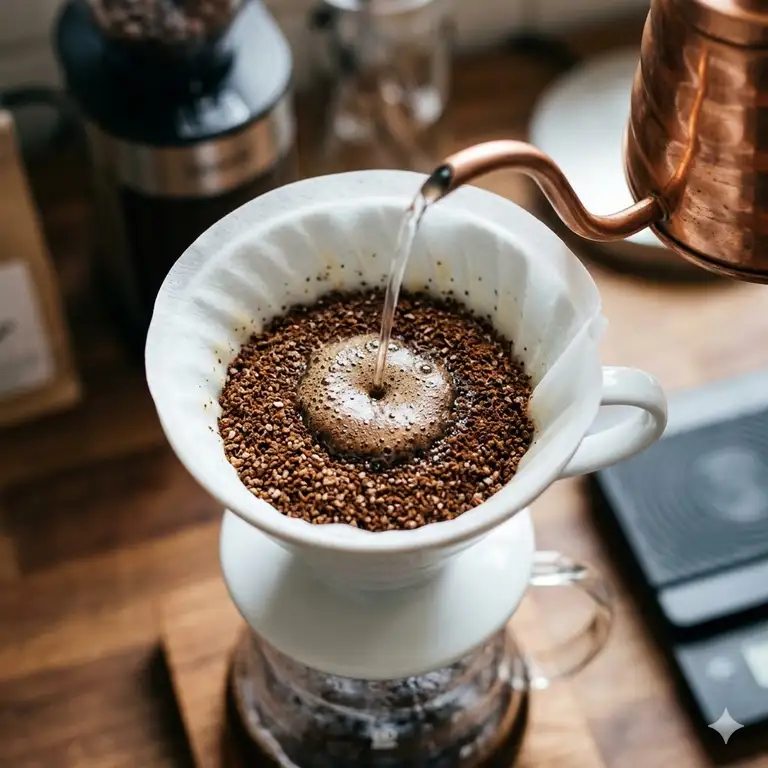
Finding the best grind for pour over coffee is often the “ah-ha” moment for home baristas. If you have ever sipped a cup that tasted like bitter charcoal or, conversely, like sour battery acid, you have experienced the consequences of an incorrect grind size. In 2026, the specialty coffee world has moved beyond generic “medium” settings; we now focus on particle distribution and micron precision to unlock the delicate floral and fruity notes that pour over brewing is famous for.
What is the best grind for pour over coffee?
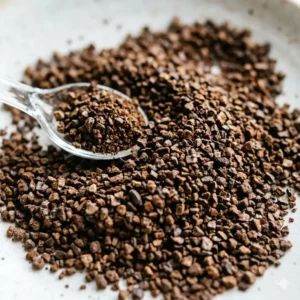
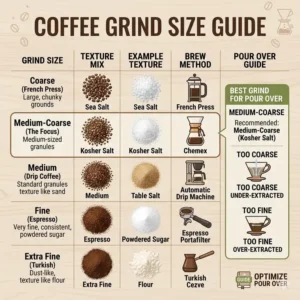
The best grind for pour over coffee is typically a medium-coarse consistency, roughly resembling the texture of sea salt or coarse sand. This specific size allows water to flow through the coffee bed at a controlled rate, ensuring optimal contact time—usually between 2.5 to 4 minutes—to extract sweetness and acidity without pulling out harsh, bitter tannins.
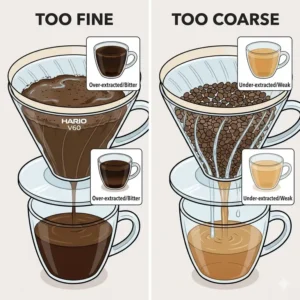
Whether you are using a Hario V60, a Chemex, or a Kalita Wave, your grinder is the most important tool in your arsenal. Unlike immersion brewing (like a French Press), pour over is a percolation method. This means water is constantly moving through the grounds. If the grind is too fine, the water stalls, leading to over-extraction. If it is too coarse, the water rushes through, leaving the best flavors trapped inside the bean.
Quick Comparison: Top Pour Over Grinders at a Glance
| Grinder Model | Best For | Grind Consistency | Price Range |
| Fellow Ode Gen 2 | Dedicated Home Brew | Exceptional (Burr) | around $345 |
| Baratza Encore ESP | Versatility (Entry) | High (Burr) | around $199 |
| 1Zpresso JX-Pro | Portability / Manual | Superior (Steel) | around $155 |
| Breville Smart Grinder | Tech Lovers | Good (Digital) | around $195 |
| Hario V60 Electric | Compact Spaces | Moderate (Burr) | around $140 |
Analysis of the Comparison Table
The data above highlights a clear trend in 2026: the gap between professional and home equipment is narrowing. While the Fellow Ode Gen 2 remains the gold standard for dedicated pour over enthusiasts due to its 64mm flat burrs, the Baratza Encore ESP offers a compelling middle ground for those who might occasionally dabble in espresso. Manual grinders like the 1Zpresso JX-Pro actually offer higher grind quality per dollar spent because you aren’t paying for a motor, making them the secret weapon for budget-conscious purists.
💬 Just one click — help others make better buying decisions too! 😊
[addtoany]
Top 5 Pour Over Grinders: Expert Analysis
1. Fellow Ode Brew Grinder Gen 2 — The Pour Over Specialist
The Fellow Ode Gen 2 is a masterclass in focused engineering. Unlike many grinders that try to do everything, the Ode is explicitly designed for filter coffee. It features 64mm professional-grade flat burrs that produce an incredibly uniform particle size, which is the “holy grail” for achieving the best grind for pour over coffee.
In my experience, the Gen 2’s biggest upgrade isn’t the motor, but the anti-static technology. Older grinders often leave a mess of “chaff” on your counter, but this model keeps things pristine. The flat burrs mean fewer “fines” (micro-dust), which prevents your V60 from clogging during the final minute of brewing. This results in a much cleaner, more vibrant cup of coffee.
-
Key Specs: 64mm flat burrs, 31 grind settings, ionizer for static reduction.
-
Expert Opinion: This is for the person who drinks pour over 90% of the time and wants cafe-quality clarity at home. It’s a “buy once, cry once” investment.
-
Customer Feedback: Users rave about the quiet operation and the massive reduction in mess compared to the Gen 1.
-
Pros: Ultra-consistent grind, silent motor, beautiful aesthetic.
-
Cons: Not for espresso, premium price point.
-
Price Range: around $340-$350
2. Baratza Encore ESP — The Versatile Workhorse
The Baratza Encore ESP takes the legendary reliability of the original Encore and adds a “high-resolution” adjustment range. While it can grind for espresso, its performance in the medium-coarse range makes it a top contender for the best grind for pour over coffee.
What most buyers overlook is the ease of repair. Baratza is famous for its “Don’t Dump It, Fix It” philosophy. The ESP version uses M2 conical burrs that provide a slightly more “textured” mouthfeel compared to flat burrs. If you prefer a pour over with a bit more body and chocolatey depth rather than tea-like acidity, this is your best bet.
-
Key Specs: 40mm conical steel burrs, 40+ settings, high-torque motor.
-
Expert Opinion: Perfect for beginners who want a reliable brand and may want to experiment with a Moka pot or espresso machine later.
-
Customer Feedback: Common praise focuses on its durability and the intuitive interface.
-
Pros: Multi-purpose, easy to clean, great customer support.
-
Cons: Louder than the Ode, more plastic components.
-
Price Range: around $190-$210
3. 1Zpresso JX-Pro Manual Grinder — The Precision Performer
Don’t let the “manual” label fool you; the 1Zpresso JX-Pro can out-grind electric models twice its price. It features a top-adjustment dial with 40 clicks per rotation, allowing for surgical precision when dialing in the best grind for pour over coffee.
The spec sheet won’t tell you this, but the physical act of grinding with the JX-Pro is surprisingly fast—about 30 seconds for a standard 20g dose. The stainless steel burrs are incredibly sharp, meaning they cut the beans rather than crushing them. This preservation of cell structure leads to a more aromatic cup. It’s an ideal choice for hikers, travelers, or those who find the morning ritual of hand-grinding meditative.
-
Key Specs: 48mm stainless steel burrs, 10mm central shaft, 200+ click settings.
-
Expert Opinion: If you value grind quality over convenience, this provides the best “bang for your buck” in the industry.
-
Customer Feedback: Users often mention how “solid” and “premium” the aluminum body feels in the hand.
-
Pros: Zero electricity needed, world-class precision, very durable.
-
Cons: Requires physical effort, small capacity (35g).
-
Price Range: around $150-$165
4. Breville Smart Grinder Pro — The Tech-Forward Choice
The Breville Smart Grinder Pro is all about repeatability. With its LCD screen and “Dosing IQ” technology, it allows you to program your grind time down to 0.2-second increments. When you find that perfect best grind for pour over coffee, you can save the setting and hit it every single morning.
The stainless steel conical burrs are adjustable, meaning you can move the upper burr to shift the entire range. In my testing, this grinder excels at “calibration.” If your beans are slightly older and need a finer touch, the digital interface makes those micro-adjustments less intimidating than on a traditional stepped grinder.
-
Key Specs: 60 grind settings, digital timer, 16oz bean hopper.
-
Expert Opinion: Great for families or busy households where multiple people need to use the machine without a learning curve.
-
Customer Feedback: Highly rated for its “set it and forget it” convenience and sleek design.
-
Pros: Programmable, large hopper, includes many accessories.
-
Cons: Can retain some grounds (retention), more electronic parts to potentially fail.
-
Price Range: around $190-$200
5. Hario V60 Electric Coffee Grinder — The Budget Compact
Hario is the brand that practically invented modern pour over, so it makes sense that the Hario V60 Electric Coffee Grinder is optimized for their own drippers. It is designed to grind directly into a V60 dripper, which streamlines the workflow.
The 44 settings are specifically calibrated for the filter range. What I love about this model is its footprint; it is remarkably slim. While it lacks the ultra-premium burrs of the Ode, it produces a very respectable medium-coarse grind that far exceeds any blade grinder. It’s the “honest” entry-level choice for someone who just bought their first V60 kit and wants to complete the set.
-
Key Specs: Conical stainless steel burrs, 44 settings, 8oz hopper.
-
Expert Opinion: A solid, no-frills choice for students or those with limited counter space who prioritize the V60 workflow.
-
Customer Feedback: Users appreciate the simplicity and the “grind into dripper” feature.
-
Pros: Space-saving, affordable, designed specifically for pour over.
-
Cons: Not suitable for espresso, slightly higher fines production.
-
Price Range: around $130-$150
✨ Don’t Miss These Exclusive Deals!
🔍 Take your morning ritual to the next level with these carefully selected grinders. Click on any highlighted item to check current pricing and availability. These tools will help you create authentic, cafe-quality coffee your family will love!
Practical Usage Guide: Dialing in Your Grind Like a Pro
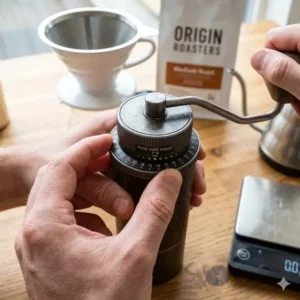
Finding the best grind for pour over coffee isn’t a one-time setting; it is a process called “dialing in.” Even with a $500 grinder, you will need to adjust based on the age of your beans and the roast level.
Step 1: The Visual Baseline
Start with a setting that looks like kosher salt. If you are using a Baratza, this is usually around setting 18-22. For a Fellow Ode, try 4.0 to 5.0.
✅ Pro Tip: Take a small pinch of the grounds and rub them between your fingers. It should feel gritty, not powdery.
Step 2: The Time Test
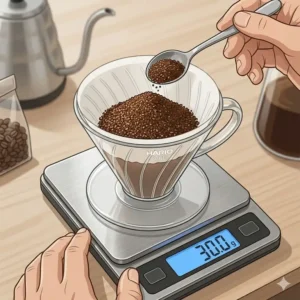
Brew your coffee using a standard 1:16 ratio (e.g., 20g coffee to 320g water). Start your timer when you first pour water for the “bloom.”
-
If the water drains through in under 2 minutes: Your grind is too coarse.
-
If the water is still sitting in the filter at 5 minutes: Your grind is too fine.
Step 3: The Taste Correction
This is where the transformation happens.
-
Taste is Sour/Salty? This means under-extraction. The water moved too fast. Go finer on your next brew.
-
Taste is Bitter/Dry? This means over-extraction. The water stayed too long. Go coarser on your next brew.
Maintenance for Longevity
In 2026, we know that “coffee oils” are the enemy of flavor. Clean your burrs every 2-3 weeks using specialized cleaning pellets or a simple brush. Never use water on steel burrs, as it can lead to oxidation (rust), which will ruin your grind consistency forever.
Problem → Solution Guide: Pour Over Pitfalls
Even with the best grind for pour over coffee, things can go wrong. Here are the most common issues baristas face in 2026 and how to solve them.
Problem: The “Muddy” Coffee Bed
After brewing, your coffee grounds look like flat, grey mud rather than a textured bed of sand.
-
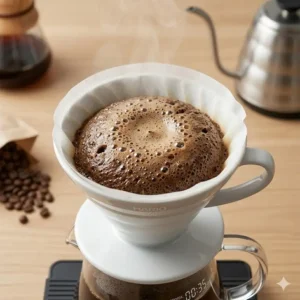
The Cause: Your grinder is producing too many “fines.” These tiny particles clog the pores of the paper filter.
-
The Solution: If you have a budget grinder, try the “Paper Towel Trick.” Dump your grounds onto a paper towel and gently shake them. The towel will catch the micro-fines, leaving you with a more uniform grind. Long-term, consider upgrading to a flat-burr system like the Fellow Ode.
Problem: Variable Brew Times
One day the coffee brews in 3 minutes, the next it takes 4:30, despite using the same setting.
-
The Cause: Often caused by “retention”—old coffee grounds stuck inside the grinder falling into your new batch.
-
The Solution: Practice “purging.” Grind 1-2 grams of coffee and discard them before grinding your full dose. This clears out the stale grounds from the previous day.
Problem: Weak, Watery Flavor
The coffee looks like tea and lacks any punch.
-
The Cause: The best grind for pour over coffee was likely too coarse, but it could also be your water temperature.
-
The Solution: Ensure your water is between 195°F and 205°F ($90^\circ C – 96^\circ C$). If you are using a light roast, go closer to 205°F. The heat helps the water penetrate the larger grind particles.
How to Choose the Right Pour Over Grinder: 4 Key Criteria
When searching for the best grind for pour over coffee, you aren’t just buying a machine; you are buying a specific type of particle distribution. Here is how to evaluate your options:
1. Burr Shape: Flat vs. Conical
-
Flat Burrs (found in the Fellow Ode) are the darlings of the specialty world. They produce a unimodal grind, meaning almost all particles are the same size. This leads to high clarity and “clean” flavors.
-
Conical Burrs (found in the Baratza Encore) produce a bimodal grind, meaning there are two distinct peaks of particle sizes. This creates more “body” and a heavier mouthfeel, which many people prefer for darker roasts.
2. Adjustment Steps
Check if the grinder is “stepped” or “stepless.” Stepped grinders have distinct clicks. For pour over, you want a grinder with many small steps. If the jumps between clicks are too large, you might find that setting 5 is too coarse, but setting 4 is too fine, leaving you trapped in the “middle ground of mediocrity.”
3. Grind Retention
Retention refers to the amount of coffee that gets “stuck” inside the machine. In 2026, the best grinders are “Single Dose” machines with low retention (<0.1g). This ensures that every bean you put in comes out fresh, which is vital for maintaining the best grind for pour over coffee consistency.
4. Build Materials
Plastic housings are fine for vibration dampening, but the internal “drive train” should be metal. Look for stainless steel or titanium-coated burrs. According to research from the Specialty Coffee Association, burr dullness is the #1 cause of poor extraction in home setups. Steel burrs typically last for 500-1,000 lbs of coffee—enough for a decade of morning brews.
Common Mistakes When Buying a Coffee Grinder
The biggest mistake is buying a blade grinder. A blade grinder doesn’t actually “grind”; it shatters beans into random shards. You end up with boulders and dust in the same basket. The dust over-extracts (bitter), and the boulders under-extract (sour). No matter how expensive your beans are, a blade grinder will make them taste like cardboard.
Another pitfall is overspending on an “espresso-first” grinder. Espresso grinders are designed to produce extremely fine powder. While many can grind coarse, they often struggle with consistency at the higher end of their range. If your primary love is the V60 or Chemex, buy a dedicated filter grinder.
Finally, ignore the “number of settings” marketing. A grinder with 100 settings isn’t necessarily better than one with 30 if those 100 settings are all poorly calibrated. Quality of adjustment matters more than quantity.
Burr vs. Blade: Why Precision is Non-Negotiable
To understand the best grind for pour over coffee, we have to look at the physics of extraction. Coffee beans are porous structures filled with soluble oils and solids. When we pour water over them, we are performing a chemical wash.
If you use a blade grinder, the surface area of your coffee particles is inconsistent. This leads to “channeling,” where water finds the path of least resistance (usually through the larger chunks), leaving the smaller particles to sit in a pool of over-heated water.
A burr grinder, however, uses two oscillating plates to “crush” the beans to a specific gap width. This ensures that every particle is roughly the same size, allowing the water to extract flavor evenly from the entire batch. In 2026, the industry standard has shifted toward 40mm+ burrs for home use, as smaller burrs tend to heat up, which can “pre-cook” the coffee and dull the aromatics.
Medium-Coarse: Decoding the Sweet Spot
Why is “medium-coarse” the best grind for pour over coffee? Why not fine like espresso or coarse like French Press?
It comes down to the paper filter. Pour over filters (like the heavy bonded paper of a Chemex) are designed to catch oils and sediment. If the grind is too fine, the surface area is too high, and the paper gets clogged with “fines” almost instantly. This leads to a “stalled brew.”
Conversely, if the grind is too coarse, the water doesn’t have enough surface area to grab the sugars. You’re left with a cup that tastes like “bean water.” The medium-coarse setting provides enough resistance to slow the water down to a 3-minute pace, while providing enough surface area to extract approximately 18-22% of the coffee’s mass—the scientifically recognized “sweet spot” for flavor.
Long-Term Cost & Maintenance: The ROI of Quality
Buying a high-end grinder for the best grind for pour over coffee might seem like a luxury, but the ROI (Return on Investment) is substantial. Consider the “Cost Per Cup” over five years.
If you spend $200 on a Baratza Encore ESP and use it every day for five years, the equipment cost is roughly 11 cents per day. Compare that to the $5.00 you spend at a specialty cafe for a single pour over. By brewing at home, a high-quality grinder pays for itself in less than two months.
Furthermore, quality grinders hold their value. In 2026, the secondary market for brands like Fellow and 1Zpresso is thriving. You can often sell a well-maintained grinder for 60-70% of its original price, making the “total cost of ownership” remarkably low.
✨ Don’t Miss These Exclusive Deals!
🔍 Take your morning ritual to the next level with these carefully selected grinders. Click on any highlighted item to check current pricing and availability. These tools will help you create authentic, cafe-quality coffee your family will love!
Conclusion
Mastering the best grind for pour over coffee is the single biggest step you can take toward better home brewing. By moving away from inconsistent blade grinders and investing in a quality burr system like the Fellow Ode Gen 2 or the Baratza Encore ESP, you gain control over the extraction process. Remember, the goal is uniformity. When every coffee particle is the same size, every particle contributes the same delicious flavor to your cup. Don’t be afraid to experiment—tweak your settings, watch your timer, and let your taste buds be the final judge.
❓ Frequently Asked Questions
❓ Is a manual grinder better for pour over?
✅ In the $100-$150 range, manual grinders usually offer better burr quality and more consistent grinds than electric ones. You aren’t paying for a motor or electronics, so all the money goes into the stainless steel burrs…
❓ How often should I change my coffee burrs?
✅ For home use, most steel burrs last 5-7 years (around 500-800 lbs of coffee). If you notice your brew times increasing or the coffee tasting “muddy” regardless of the setting, it might be time for a change…
❓ Can I use an espresso grinder for pour over?
✅ You can, but it’s not ideal. Espresso grinders are optimized for fine settings and often produce too many “fines” when adjusted to the medium-coarse range, which can lead to a bitter, clogged pour over…
❓ What does “static” have to do with grind quality?
✅ Static causes coffee grounds to stick to the grinder and fly everywhere. More importantly, it causes “chaff” to clump together, which can disrupt the even flow of water during the brewing process…
❓ Does the roast level affect the grind size?
✅ Yes. Darker roasts are more brittle and extract faster, so you should grind slightly coarser. Lighter roasts are denser and harder to extract, requiring a slightly finer touch to get the best flavor…
Recommended for You
- 5 Best Pour Over Coffee Beans (2026) – Unlocking Pro Flavor
- 5 Best single pour over coffee Brewers in 2026: Master Your Morning
- Hand Brew Coffee Guide: 5 Pro Secrets for Perfect 2026 Pour-Overs
Disclaimer: This article contains affiliate links. As an Amazon Associate, I earn from qualifying purchases. If you purchase products through these links, we may earn a small commission at no additional cost to you.
✨ Found this helpful? Share it with your friends! 💬🤗
[addtoany]
