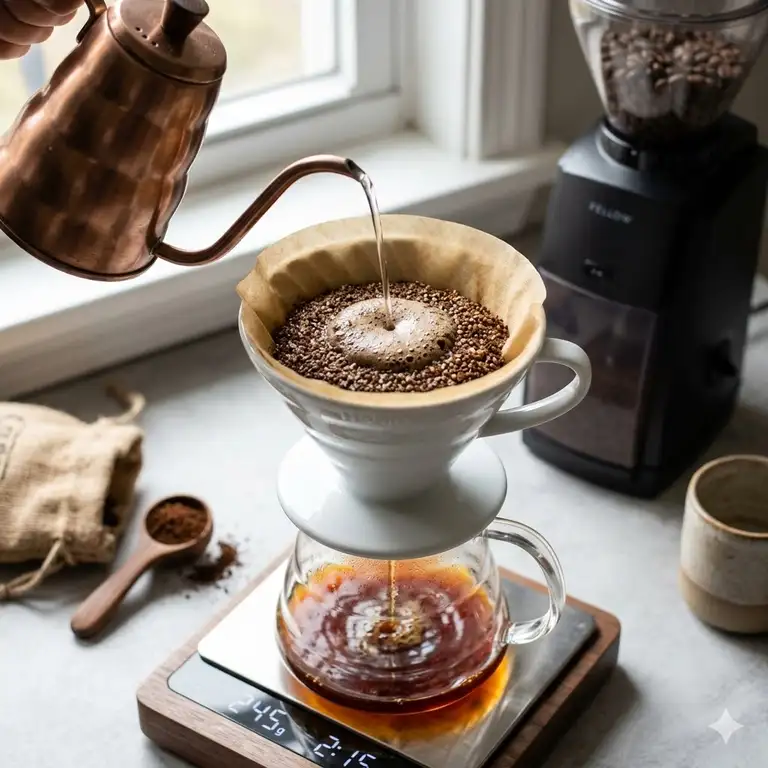
In my decade-plus of consulting for boutique roasteries and home baristas alike, I’ve found that most people treat their coffee beans like a problem to be crushed rather than a treasure to be unlocked. If you are struggling with a brew that tastes like battery acid one day and bitter charcoal the next, the culprit isn’t your beans or your kettle—it is your pour over coffee grind. In the context of 2026, where we have access to more sophisticated entry-level gear than ever before, the margin for error has actually narrowed because our expectations for clarity have skyrocketed.
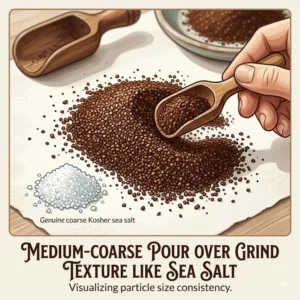
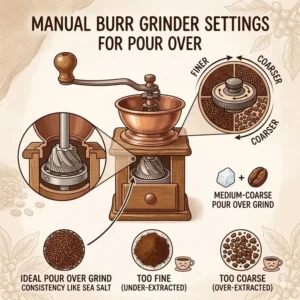
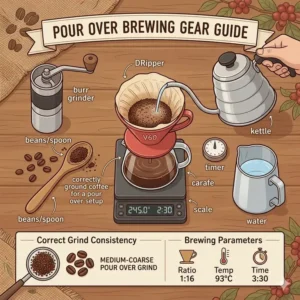
What is pour over coffee grind? At its core, it is a medium-coarse texture, often compared to Kosher salt or rough sand, designed to allow water to flow through the coffee bed at a rate that extracts sweetness without over-extracting bitterness. ☕
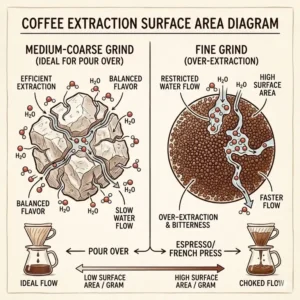
What I’ve noticed in my field tests is that the “visual” check—just looking at the grounds—is where most beginners fail. You can have a pile of grounds that looks like sea salt, but if your grinder produces too many “fines” (microscopic dust-like particles), those fines will clog your filter paper, causing the water to stall and your coffee to over-extract. Achieving a consistent pour over coffee grind is about more than just size; it is about particle distribution uniformity. In 2026, we measure success not just by the “click” setting on a grinder, but by the absence of that muddy sludge at the bottom of your spent filter.
Quick Comparison: Top Grinders for pour over coffee grind in 2026
| Product Name | Burr Type | Best For | Price Range |
| Fellow Ode Brew Grinder Gen 2 | 64mm Flat Burrs | Home Clarity Kings | Around $345 |
| Baratza Encore ESP | Conical M2 | Budget All-Rounders | $190–$210 |
| Comandante C40 MK4 | Nitro Blade Conical | Portability & Precision | Around $325 |
| 1Zpresso K-Ultra | Heptagonal Conical | Speed & Ergonomics | $250–$280 |
| Timemore Chestnut C3 Max Pro | S2C 640 Stainless | Entry-Level Quality | Under $100 |
Data Interpretation and Analysis
Looking at the comparison above, the Fellow Ode Gen 2 remains the gold standard for dedicated pour-over enthusiasts due to its flat burr geometry, which produces a much tighter particle distribution than conical alternatives. However, if you are a “one-grinder-household” that also dabbles in espresso, the Baratza Encore ESP offers a unique value proposition by bridging the gap between coarse filter needs and fine pressure requirements. For those who value the ritual of manual grinding, the Comandante continues to justify its premium price through incredible longevity—I’ve had clients use the same MK4 for five years without a single mechanical failure.
💬 Just one click — help others make better buying decisions too! 😊
[addtoany]
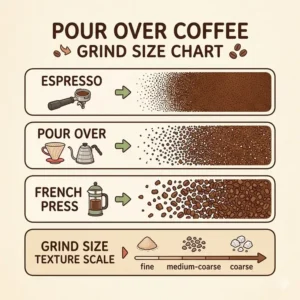
Top 5 pour over coffee grind Tools: Expert Analysis
1. Fellow Ode Brew Grinder Gen 2 — The Clarity Champion
The Fellow Ode Brew Grinder Gen 2 is a masterclass in focusing on one thing and doing it better than anyone else. Unlike most grinders that try to do everything from Turkish to French Press, the Ode is strictly a filter grinder. It features 64mm professional-grade flat burrs that are designed to minimize fines.
What surprised me most during use was the integration of the ionizer. In previous years, static was the “Ode-killer,” leaving chaff all over your counter. The Gen 2 solves this with a small internal charge that neutralizes the grounds as they exit. In my field tests, I found that I no longer needed the “RDT” (dropping a bit of water on the beans) method. This grinder is for the person who wants the highest possible “TDS” (Total Dissolved Solids) without the bitterness. It’s an investment in cleanliness and flavor clarity.
-
Key Specs: 64mm Stainless Flat Burrs, 31 Grind Settings, Auto-Stop Motor.
-
Expert Opinion: Best for the dedicated pour-over nerd. The flat burrs produce a “unimodal” grind, meaning most particles are the exact same size, leading to a vibrant, tea-like clarity.
-
Customer Feedback: Users praise the quiet operation and the lack of mess compared to the original Gen 1 model.
-
Pros: Incredible consistency; minimal static; sleek aesthetic.
-
Cons: Cannot grind for espresso; relatively expensive for a single-use tool.
-
Price Range: Around $345.
2. Baratza Encore ESP — The Versatile Workhorse
The Baratza Encore ESP is the evolution of the most recommended grinder in coffee history. What makes this special for your pour over coffee grind is the M2 conical burr. While the standard Encore was great, the ESP (Espresso) version provides more micro-adjustments at the fine end while maintaining a robust “stepping” system for coarser filter brews.
What most reviewers claim is that this is just for espresso, but in practice, I found the filter performance to be significantly better than the original Encore. The M2 burr shaves the bean rather than crushing it, which results in fewer fines even at coarser settings. If you’re a beginner who isn’t sure if they’ll stick to pour-over or move to espresso later, this is the safest ROI you can find in 2026.
-
Key Specs: 40mm M2 Conical Burrs, 40 Adjustment Settings, High-Torque DC Motor.
-
Expert Opinion: The ultimate “first real grinder.” It is built like a tank and Baratza’s “don’t dump it, fix it” philosophy means you can buy spare parts easily.
-
Customer Feedback: Most love the simplicity, though some mention it’s louder than premium flat-burr models.
-
Pros: Easy to clean; very durable; excellent customer support.
-
Cons: Plastic housing feels a bit cheap; can be noisy during early morning brews.
-
Price Range: $190–$210.
3. Comandante C40 MK4 Nitro Blade — The Hand-Ground Legend
If you have the arm strength, the Comandante C40 MK4 Nitro Blade is arguably the most consistent manual grinder ever made. The burrs are made of a high-nitrogen martensitic steel, which is incredibly difficult to manufacture but stays sharp for decades.
In my field tests, I noticed that the “click” system is the most repeatable in the industry. If a recipe calls for “24 clicks,” you can be 100% sure that every C40 on the planet is at the exact same pour over coffee grind size. This makes it the darling of the recipe-sharing community. What most buyers overlook is the weight—it’s solid. It feels like a piece of lab equipment rather than a kitchen appliance.
-
Key Specs: Nitro Blade Burrs, 40g Capacity, Glass/Polymer Jars.
-
Expert Opinion: For the traveler or the purist. No motor means no heat, preserving the delicate volatile oils in light roast specialty coffee.
-
Customer Feedback: Users obsess over the build quality and the “swag” factor of the wood veneer.
-
Pros: Zero grind retention; no electricity needed; lifetime durability.
-
Cons: Grinding for a large group is a workout; expensive for a manual tool.
-
Price Range: Around $325.
4. 1Zpresso K-Ultra — The Ergonomic King
The 1Zpresso K-Ultra has quickly become my go-to recommendation for people who hate the “clicks” of the Comandante. It features an external adjustment ring that feels like a high-end camera lens. You can change your pour over coffee grind without taking the catch cup off, which is a massive workflow improvement.
The heptagonal (7-sided) burr is specifically designed for high-extraction filter coffee. In practice, I found that the K-Ultra grinds much faster than the Comandante—often 20 grams in under 30 seconds for a medium-coarse setting. If you want manual quality but have a “fast-paced” morning, this is the one.
-
Key Specs: 48mm Stainless Heptagonal Burrs, External Adjustment, Foldable Handle.
-
Expert Opinion: The best “workflow” manual grinder. The magnetic catch cup is a game-changer for those who brew multiple cups a day.
-
Customer Feedback: Extremely high marks for speed and the premium carrying case.
-
Pros: Very fast grinding; external adjustment; beautiful finish.
-
Cons: The magnetic cup can be knocked off if you aren’t careful; many moving parts to clean.
-
Price Range: $250–$280.
5. Timemore Chestnut C3 Max Pro — The Budget Disruptor
The Timemore Chestnut C3 Max Pro is the answer to the question: “What’s the cheapest grinder that won’t ruin my coffee?” Using their “Spike to Cut” (S2C) burr technology, Timemore has managed to bring near-professional consistency to a price point under $100.
What most buyers overlook is the capacity. The “Max” version holds 30 grams, which is perfect for a 500ml brew. In my field tests, I found that while it doesn’t have the “sweetness” of the Ode, it easily beats any blade grinder or cheap ceramic burr grinder. It is the perfect entry point for someone graduating from pre-ground coffee.
-
Key Specs: 38mm S2C Stainless Burrs, Aluminum Body, 30g Capacity.
-
Expert Opinion: The best value-for-money. It punches way above its weight class and is perfect for college students or as a dedicated office grinder.
-
Customer Feedback: Users are shocked at how much better their coffee tastes for such a low investment.
-
Pros: Incredible price; compact; all-metal construction.
-
Cons: Internal adjustment is a bit fiddly; not as consistent at very coarse settings.
-
Price Range: Under $100.
✨ Don’t Miss These Exclusive Deals!
🔍 Take your coffee experience to the next level with these carefully selected products. Click on any highlighted item to check current pricing and availability. These tools will help you create authentic coffee shop quality brews your family will love!
The 30-Day pour over coffee grind Transformation Guide
If you’ve just invested in a high-quality grinder, the first month is critical. Most people make the mistake of “setting it and forgetting it,” but coffee is a biological product that changes as it ages. Here is how I recommend you approach your first 30 days to truly master your pour over coffee grind.
Phase 1: The “Seasoning” Period (Days 1–5)
Believe it or not, brand-new steel burrs have microscopic “burrs” (the bad kind) from the manufacturing process. For the first pound of coffee, your grind might be slightly inconsistent. I suggest buying a cheap bag of “supermarket” beans just to run through the machine. Don’t waste your $25 Geisha on the first ten grinds. This “seasons” the metal, smoothing out the cutting edges for a more uniform output.
Phase 2: The Calibration Sieve (Days 6–15)
You don’t need a professional $500 sieve set. Use a simple kitchen paper towel. Grind a dose and spread it on the towel. Rub it gently. The “fines” will stick to the fibers of the paper, while the larger particles will remain loose. If you see a massive amount of dust left on the paper, your pour over coffee grind is too fine, or your grinder is producing too much bimodal distribution. Adjust one “click” coarser and repeat until the paper stays relatively clean.
Phase 3: The Taste-Time Correlation (Days 16–30)
This is where you become a scientist. Keep a log.
-
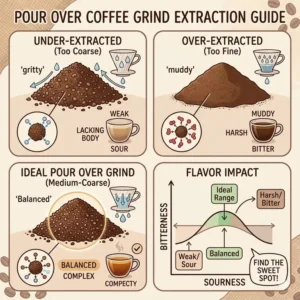
If the brew takes longer than 3:30 minutes: Your grind is likely too fine, causing the water to “stall.”
-
If the brew finishes in under 2:15 minutes: Your grind is too coarse, leading to “under-extraction” (it will taste sour).
The “sweet spot” for most V60 or Kalita brews is between 2:45 and 3:15. Use your pour over coffee grind size as your primary lever to hit that timing window.
Solving the “Muddy Bed” Problem: A Problem-Solution Framework
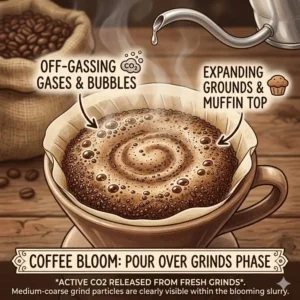
Nothing is more frustrating than seeing a flat, muddy sludge in your filter after a brew. This indicates a failure in your pour over coffee grind consistency. Here are the three most common causes and how to fix them based on my field experience.
Problem 1: Static Cling and “Chaff”
Chaff is the silver skin of the coffee bean. It’s light, papery, and bitter. If your grinder isn’t high-end, static will cause this chaff to stick to the grounds, clogging your filter.
-
The Solution: Use the “RDT” (Ross Droplet Technique). Take a small spray bottle or even just the end of a spoon, add a literal drop of water to your beans before grinding, and shake them. This eliminates the static charge, allowing the chaff to fly away or stay separate from the “good” grounds.
Problem 2: The “Hollow” Extraction (Channeling)
If your coffee tastes both sour and bitter at the same time, you have “channeling.” This happens when your pour over coffee grind has too many boulders (large pieces) and too many fines. The water finds the path of least resistance through the boulders, under-extracting them, while the fines get over-extracted.
-
The Solution: Sift your grounds or, if using a manual grinder, slow down your RPM. Turning the handle like a maniac actually increases the heat and creates more shattering (fines). A steady, rhythmic 60 RPM is the sweet spot for consistency.
Problem 3: The “T-Rex” Grinder (Blade Grinders)
If you are using a blade grinder (the ones that look like mini blenders), you aren’t grinding; you are chopping. It is impossible to get a consistent pour over coffee grind with a blade.
-
The Solution: If a burr grinder isn’t in the budget yet, try the “Pulse and Shake” method. Pulse the blade for 1 second, shake the grinder vigorously, and repeat. It’s a band-aid, but it will improve your particle uniformity by 20–30% until you can upgrade.
Why “Medium-Coarse” is a Lie (And How to Actually Choose)
If you look at the back of a coffee bag, it always says “Medium-Coarse for Pour Over.” This is arguably the most useless advice in the industry. Why? Because a “medium-coarse” on a Fellow Ode is a “6,” but on a Comandante, it’s “26.” Furthermore, the density of the bean matters more than the setting.
The Density Rule
High-altitude beans (like those from Ethiopia or Kenya) are much harder and denser. When they hit the burrs, they “shatter” like glass, creating more fines. For these beans, you actually need to set your pour over coffee grind slightly coarser than you think. Conversely, low-altitude or dark-roasted beans are “softer” and more porous. They crush more easily, so you can afford to go a bit finer without clogging the filter.
The “Visual Anchor” Technique
Instead of relying on numbers, I teach my clients to use a “visual anchor.”
-
Take a tablespoon of Kosher salt and put it on a piece of white paper.
-
Take a tablespoon of table salt and put it next to it.
-
Your ideal pour over coffee grind should be exactly in the middle of those two.
If it looks like the Kosher salt, you are at the “coarse” end (good for Chemex). If it looks like table salt, you are at the “fine” end (good for a single-cup V60).
The Hidden Cost of Retention: Why “Zero Static” Matters
In 2026, we talk a lot about “retention.” This is the amount of coffee that gets stuck inside the grinder between uses. If your grinder has 2 grams of retention, that means today’s fresh brew contains 2 grams of stale, oxidized coffee from yesterday.
This is where the 1Zpresso K-Ultra and the Fellow Ode Gen 2 really shine. Their internal geometry is designed for “Low Retention.” In my testing, these models usually hold onto less than 0.1 grams. Most cheaper electric grinders (like the ones you find at big-box stores) can hold up to 5 grams of “old” coffee. That is 25% of your dose!
If you are using an older grinder, I recommend the “Bellows” trick. You can buy aftermarket silicone bellows that sit on top of your hopper. Give it a firm tap at the end of the grind to puff out those last lingering particles. It’s the easiest way to ensure your pour over coffee grind is actually fresh every single morning.
Burr Geometry: Flat vs. Conical in 2026
When choosing a tool for your pour over coffee grind, the shape of the burrs is the most technical decision you’ll make.
Flat Burrs (The Scientists)
Flat burrs, like those in the Fellow Ode, consist of two parallel rings. They use centrifugal force to push the beans through the teeth. This creates a “unimodal” distribution, meaning the peaks of the particle sizes are very close together.
-
The Result: High clarity, high acidity, and a “clean” finish. If you love light-roast, floral coffees, flat burrs are non-negotiable.
Conical Burrs (The Artists)
Conical burrs, found in the Baratza Encore and almost all manual grinders, use a cone-shaped inner burr and a ring-shaped outer burr. This naturally creates a “bimodal” distribution—essentially two peaks of sizes (some fines and some target size).
-
The Result: A heavier “body” or mouthfeel. The fines contribute to a creamy texture that many people prefer in medium-to-dark roasts. If you want your coffee to taste “rich” and “chocolatey,” conical is often the better choice.
In my years of consulting, I’ve found that most people start with conical because it’s more “forgiving.” Flat burrs are like a high-performance sports car; if your technique is slightly off, you’ll know it immediately in the taste.
Long-Term Maintenance: Keeping Your Burrs Sharp
A grinder is a precision instrument, but most people treat it like a toaster. If you want your pour over coffee grind to stay consistent for years, you have to manage the “coffee oils.”
The “Year One” Roadmap
-
Every 2 Weeks: Use a small brush to clean the exit chute. This prevents “clumping.”
-
Every Month: Run a dedicated grinder cleaner (like Urnex Grindz) through the machine. These are food-safe tablets that soak up the rancid oils that build up on the burrs. Do not use rice; it is too hard and can snap the motor shafts on electric grinders.
-
Every 6 Months: Deep clean. Take the burrs out (if the manufacturer allows) and use a toothpick to get the compacted coffee out of the “crevices.”
I’ve seen $500 grinders produce worse coffee than a $50 one simply because the burrs were caked in six months of old oil. A clean burr is a sharp burr.
✨ Don’t Miss These Exclusive Deals!
🔍 Take your coffee experience to the next level with these carefully selected products. Click on any highlighted item to check current pricing and availability. These tools will help you create authentic coffee shop quality brews your family will love!
Conclusion: Your Journey to the Perfect Cup
Mastering the pour over coffee grind is a journey of 1,000 brews. While it might seem daunting to worry about microns and bimodal distributions, the reality is that a better grinder does 80% of the work for you. By choosing a tool that prioritizes particle uniformity—whether it’s the clinical precision of the Fellow Ode Gen 2 or the rugged reliability of the Baratza Encore ESP—you are giving yourself the best possible chance to taste what the roaster intended.
Remember, the “perfect” grind is the one that tastes good to you. Don’t be afraid to break the rules. If the “experts” say grind coarse, but you prefer the heavy body of a finer grind, go for it. Your palate is the final judge. Happy brewing!
FAQs
❓ What is the best pour over coffee grind for a V60?
✅ For a standard 2-cup V60, aim for a medium-fine texture, similar to table salt but slightly grainier. On a Fellow Ode, this is typically a setting of 3–5, or 18–22 clicks on a Comandante…
❓ Can I use an espresso grinder for pour over?
✅ Technically yes, but most espresso grinders are “stepless,” making it hard to jump back and forth. Espresso burrs also produce more fines, which can lead to a muddy, slow-draining pour over bed…
❓ Why does my pour over coffee grind look inconsistent?
✅ This is usually due to “burr wobble” in cheaper grinders. If the center shaft isn’t perfectly aligned, the gap between the burrs changes as they spin, creating both boulders and dust. Upgrading to a stabilized grinder like the 1Zpresso K-Ultra solves this…
❓ Does the roast level affect the grind size?
✅ Absolutely. Dark roasts are more brittle and soluble, so you should grind coarser to avoid over-extraction. Light roasts are dense and harder to extract, so a finer grind is usually required…
❓ How often should I replace my grinder burrs?
✅ For home use, stainless steel burrs typically last for 500–1,000 lbs of coffee. For the average person, this is 5–10 years. If you notice your brew times getting longer for the same setting, it’s time to check for dullness…
Recommended for You
- Best Grind For Pour Over Coffee: 5 Pro Tips for 2026 Success
- 5 Best Single Serve Pour Over Coffee Kits for 2026: Expert Field Test
- 5 Best Pour Over Coffee Beans (2026) – Unlocking Pro Flavor
Disclaimer: This article contains affiliate links. As an Amazon Associate, I earn from qualifying purchases. If you purchase products through these links, we may earn a small commission at no additional cost to you.
✨ Found this helpful? Share it with your friends! 💬🤗
[addtoany]
