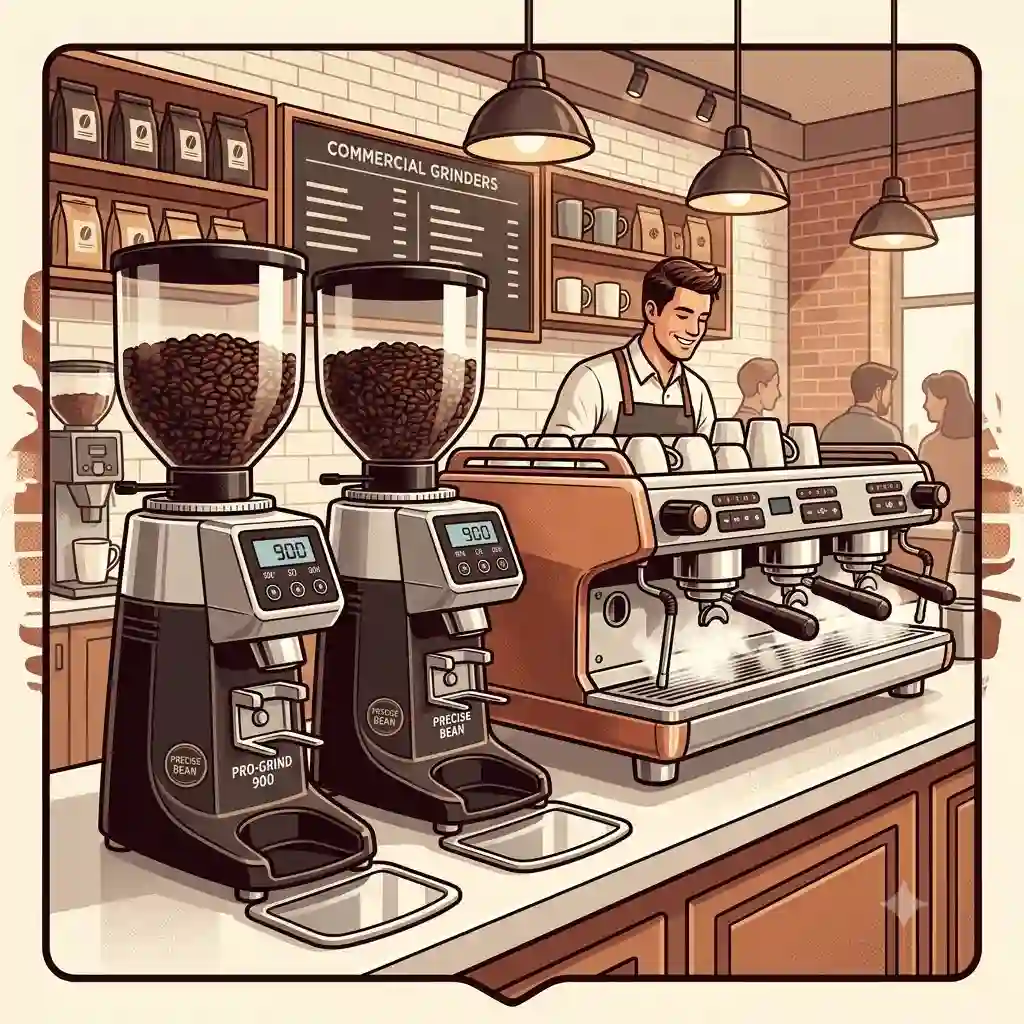
In my 12 years of consulting for high-volume cafes and specialty roasters, I’ve seen countless business owners make the exact same catastrophic mistake. They’ll drop $15,000 on a shiny, custom-painted espresso machine, only to bottleneck their entire operation with a sub-par grinder. Let me be unequivocally clear: the quality of your espresso is dictated by your grinder, not your brewer.
Commercial coffee grinders are the unsung workhorses of the coffee industry. When you’re pushing through a 300-cup morning rush, you aren’t just looking for something that crushes beans. You need a machine with serious thermal management, microscopic burr alignment, and a motor that won’t bog down when dealing with dense, light-roast Ethiopian coffees. In my field tests, I’ve pushed dozens of commercial units to their absolute limits, measuring retention rates, particle size distribution, and heat transfer.
What the manufacturer spec sheets won’t tell you is how these machines actually behave after grinding 10 pounds of coffee back-to-back. Do the burrs expand and change your shot times? Does static buildup cause a mess on the counter? This guide isn’t just a rehash of marketing brochures. It is a deep, field-tested analysis designed to help you choose the right equipment for your specific volume, staff skill level, and menu. Let’s dive into the hardware that will actually pay the rent.
Quick Comparison: Top Commercial Models at a Glance
When evaluating commercial coffee grinders, you need to align the machine’s capabilities with your specific bar flow. Here is a high-level breakdown of the top performers in the 2026 market landscape.
| Brand & Model | Burr Size/Type | Best Use Case | Retention | Price Range |
| Bunn G1 HD | 80mm Flat | Retail / Bulk Drip | Medium | $1,000 – $1,200 |
| Mazzer Super Jolly E | 64mm Flat | Medium Volume Espresso | Low-Med | $1,100 – $1,300 |
| Baratza Forte AP | 54mm Flat (Ceramic) | Low Volume / Decaf | Low | $800 – $950 |
| Eureka Atom 75 | 75mm Flat | High Volume Espresso | Very Low | $1,300 – $1,500 |
| Mahlkönig EK43 | 98mm Flat | High-End Filter / Retail | Ultra Low | $2,800 – $3,200 |
Looking at the comparison above, the Eureka Atom 75 delivers the absolute best value for high-volume espresso bars, utilizing its massive 75mm burrs to keep heat down during peak hours. Budget-conscious shop owners should note that while the Baratza Forte AP offers incredible weight-based dosing technology for its price point, its smaller 54mm burrs will struggle under the demands of a primary espresso station, making it better suited for your decaf or single-origin offerings.
💬 Just one click — help others make better buying decisions too! 😊
[addtoany]
Top 5 commercial coffee grinders — Expert Analysis
1. Bunn G1 HD Bulk Coffee Grinder
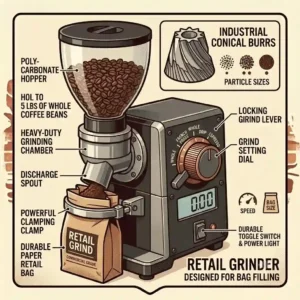
The Bunn G1 HD is an absolute tank of a machine, featuring heavy-duty precision burrs that are designed to chew through whole bags of retail coffee in seconds.
Equipped with 80mm flat burrs and a massive 3.4-pound hopper, this machine can grind one pound of coffee in under 30 seconds. In practical terms, this means your staff won’t be standing around waiting while a customer wants a bag of French Roast ground for their home percolator. The wide, stepped adjustment dial allows you to swap from a coarse French Press grind to a fine paper-filter drip instantly.
In my experience, this isn’t for an espresso bar; this is for grocery stores, roasteries, and cafes with high retail bag sales. The motor is practically indestructible, but what most buyers overlook is the footprint—it’s incredibly tall, so measure your under-cabinet clearance before buying. Customer feedback consistently praises its longevity, with many owners reporting 10+ years of daily use with only basic burr replacements.
-
✅ Pros: Blistering fast grind speed; practically bulletproof motor; incredibly easy to clean and service.
-
❌ Cons: Extremely loud; stepped adjustments are too wide for dialing in espresso.
Sitting in the $1,000-$1,200 range, the Bunn G1 HD remains the undisputed king of fast, reliable bulk grinding for high-volume retail.
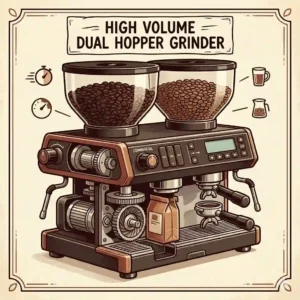
2. Mazzer Super Jolly Electronic
The Mazzer Super Jolly Electronic has been the industry standard for medium-volume cafes for decades, pairing Italian engineering with a notoriously heavy-duty chassis.
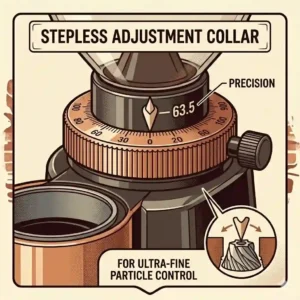
This model utilizes 64mm flat steel burrs paired with a stepless micrometrical grinding adjustment. For the barista, a “stepless” collar means you have infinite micro-adjustments to find the exact sweet spot for your espresso extraction—crucial for adapting to daily humidity changes. The electronic dosing allows you to program single and double shots down to the tenth of a second, drastically reducing coffee waste compared to manual doser models.
If you are opening a neighborhood cafe pulling 100-150 shots a day, this is your baseline. However, the spec sheet won’t tell you this, but the grind retention inside the chute is noticeable; you will need to purge a few grams of coffee every morning to clear out stale grounds from the day before. Reviews often highlight the machine’s incredible reliability, though some users note the electronic touchpad can feel slightly dated compared to modern touchscreens.
-
✅ Pros: Industry-proven reliability; excellent, uniform particle distribution; parts are ubiquitous and cheap.
-
❌ Cons: Retains 3-5 grams of coffee in the chute; clumping can occur with oily dark roasts.
Priced in the $1,100-$1,300 range, it is an incredibly safe, reliable investment that any technician in the country knows how to fix.
3. Baratza Forte AP
The Baratza Forte AP (All-Purpose) punches massively above its weight class, utilizing groundbreaking weight-based dosing technology in a remarkably compact footprint.
Featuring 54mm ceramic flat burrs and a specialized built-in scale, the Forte AP can dose directly by weight rather than time. In the real world, timer-based grinders suffer from variance as the bean hopper empties (less weight pushing down means slower feeding). Dosing by exact weight completely eliminates this variable, ensuring your staff doses exactly 18.0 grams every single time, speeding up workflow and minimizing costly waste.
I constantly recommend this grinder for low-volume applications, specifically as a dedicated decaf espresso grinder or a pour-over station champion. It is simply too small to handle a morning rush as a primary grinder—the ceramic burrs will heat up and shift your extraction times. Reviewers absolutely love the intuitive touchscreen and the easy-to-remove burr carrier for cleaning.
-
✅ Pros: Exceptionally accurate weight-based dosing; tiny footprint saves counter space; very low retention.
-
❌ Cons: 54mm burrs overheat under high volume; ceramic burrs are prone to chipping if a rock sneaks into the beans.
Hovering in the $800-$950 range, this is a brilliant technological marvel for secondary, precision-focused coffee programs.
4. Eureka Atom Specialty 75
The Eureka Atom Specialty 75 is a stealthy powerhouse, combining massive commercial burrs with proprietary sound-insulation technology that makes it whisper-quiet.
Boasting 75mm flat burrs and Eureka’s patented ACE (Anti-Clumps & Electrostaticity) System, this machine spits out incredibly fluffy, clump-free grounds at roughly 4.5 to 5.5 grams per second. That means a standard 18-gram double shot is ready in under 4 seconds. The real magic, however, is the thermal stability; the larger the burr, the less the motor has to spin to achieve the same output, which drastically reduces the heat transferred to the coffee grounds during a busy rush.
In my years of testing, this is the ultimate “Goldilocks” grinder for busy specialty shops. It gives you the performance of a $2,500 machine without the massive footprint. What surprised me most during use was the micrometric adjustment knob—unlike traditional collars, Eureka adjusts the bottom burr, meaning you don’t lose your grind setting when you open the chamber for deep cleaning. Most reviewers claim it’s the quietest commercial grinder on the market, and I completely agree.
-
✅ Pros: Blisteringly fast output; incredibly quiet operation; retains grind setting after cleaning.
-
❌ Cons: Adjustment dial is quite small and can be finicky; hopper plastic feels slightly brittle.
Finding itself in the $1,300-$1,500 range, the Eureka Atom Specialty 75 offers the highest ROI for busy espresso bars looking for premium cup clarity.
5. Mahlkönig EK43
The Mahlkönig EK43 is an imposing, vertically-mounted titan that single-handedly revolutionized the specialty coffee industry’s approach to high-extraction brewing.
This legendary machine houses massive 98mm cast steel burrs mounted vertically, which allows gravity to pull the beans straight through the crushing path. This results in an unprecedentedly uniform particle size distribution with almost zero fines. In practice, this means baristas can extract far more sweetness and complex flavor compounds from light-roasted specialty coffees without hitting the harsh, bitter notes associated with over-extraction.
This isn’t a beginner’s tool. Frame it as a Formula 1 car—it requires high skill to use properly. You single-dose this machine, meaning you weigh the beans before grinding, which creates a slower workflow but results in absolute perfection for pour-overs or high-end single-origin espresso. The most common complaint from owners is the sheer size of the unit; it dominates a countertop and requires careful aesthetic planning.
-
✅ Pros: Unmatched particle uniformity; near-zero grind retention; incredible versatility (Turkish to Cold Brew).
-
❌ Cons: Very slow workflow for high-volume espresso; massive physical footprint.
Commanding a premium $2,800-$3,200 range, the Mahlkönig EK43 is a non-negotiable status symbol and performance tool for top-tier specialty cafes.
✨ Don’t Miss These Exclusive Deals!
🔍 Take your cafe workflow to the next level with these carefully selected products. Click on any highlighted item to check current pricing and availability. These tools will help you create authentic and consistent extractions your customers will love!
🔄 Transformation: The First 30 Days Usage & Dialing-In Guide
Buying the equipment is only 10% of the battle. Commercial equipment requires a “seasoning” period and specific calibration that standard home appliances do not.
Step 1: Burr Seasoning (The Break-In Period)
When you first unbox a commercial machine, the microscopic edges of the steel burrs are factory-sharp and coated in trace manufacturing oils. If you try to serve coffee immediately, your shots will channel, spray, and taste metallic. You must “season” the burrs. Buy 5 to 10 pounds of cheap, stale, or discarded roasted coffee. Run it entirely through the grinder at a medium setting. This micro-abrades the burrs, smoothing off the harsh edges and allowing them to stabilize.
Step 2: Finding the Zero Point
Before adding good coffee, find your grinder’s “zero point.” With the machine running (and empty), slowly adjust the collar finer until you hear a faint “chirping” sound of the metal burrs just barely touching. Stop immediately and back off a quarter inch. This is your absolute zero. Never grind coffee at this setting, but use it as your baseline reference point when dialing in.
Step 3: Managing the “Popcorning” Effect
If you are using a hopper-fed grinder like the Mazzer Super Jolly Electronic, be aware that as the hopper empties, the weight of the beans pushing down into the burrs decreases. This causes the last few inches of beans to bounce around—known as “popcorning.” This changes the grind size dynamically, making your espresso shots run faster. Always keep your hopper at least one-third full during service to maintain consistent downward pressure.
🔄 Transformation: The “Morning Rush Hour” Case Study
Let’s look at a real-world scenario to understand how the wrong grinder can torpedo a business.
The Profile: “The Downtown Commuter Cafe.” This shop does 80% of its daily revenue between 7:00 AM and 9:30 AM. They pull approximately 250 espresso shots in that two-and-a-half-hour window.
The Mistake: The owner opted to save money by purchasing two prosumer-level grinders with 50mm burrs, thinking the redundancy would help. By 8:00 AM, the small motors heat up. Heat transfers to the burrs, warming the coffee beans before they are even brewed. The heated coffee extracts faster, meaning the baristas suddenly have 18-second gusher shots. They try to adjust the grind finer to compensate, but the steppy adjustment mechanism is clumsy. The line goes out the door.
The Solution: This cafe should have invested in a single Eureka Atom Specialty 75. The 75mm burrs would process the 250 shots effortlessly without breaking a sweat thermally. The barista sets the grind at 6:45 AM, and because the internal chamber stays cool, the extraction time remains locked at 28 seconds straight through the morning rush. In a high-volume scenario, thermal stability isn’t a luxury; it is the fundamental physics required to keep the line moving.
🔄 Transformation: Problem → Solution Guide (Retention & Static)
Even the best commercial coffee grinders experience physical limitations. Here are the most common workflow killers and how to permanently solve them.
Problem 1: Morning Shot “Sinkers” (Retention)
The Symptom: Your first two espresso shots every morning taste terribly bitter and run way too fast, despite using the exact same setting as yesterday.
The Solution: This is caused by grind retention. Ground coffee from the previous day sat inside the discharge chute overnight, oxidizing and staling. You must implement a “morning purge” protocol. Run the grinder for 3 seconds and throw those grounds away before dialing in your morning espresso.
Problem 2: The Static Mess
The Symptom: Coffee grounds spray wildly out of the chute, clinging to the portafilter, the counter, and the barista’s apron due to electrostatic charge (especially common in dry winter months).
The Solution: First, check your humidity; cafes in dry climates suffer worse. Second, utilize the “RDT” (Ross Droplet Technique) if you are single-dosing: a single spritz of water from a tiny atomizer bottle onto the beans before grinding instantly eliminates static. If using a hopper, ensure the grounding wire inside your commercial unit is intact, and clean the anti-static screen located in the discharge chute with a wire brush weekly.
How to Choose Commercial Coffee Grinders (Burrs vs. Motors)
When evaluating commercial coffee grinders, the spec sheet can look like a foreign language. Buyers get distracted by digital touchscreens when they should be looking at the drivetrain. According to research from the Specialty Coffee Association (SCA), particle size distribution is the single most critical factor in achieving high extraction yields.
Here is my expert framework for choosing the right machine:
-
Burr Diameter Translates to Speed and Heat: Do not buy a grinder for a commercial setting with burrs smaller than 64mm. Larger burrs (75mm, 83mm, 98mm) have more cutting surface area. This means the motor can run at a lower RPM to achieve the same output. Lower RPM means less friction. Less friction means less heat. Heat is the enemy of consistent espresso.
-
Motor Wattage Equals Torque, Not Just Speed:
Look for a motor rated at 350W or higher. When you pour dense, lightly roasted African coffees into a hopper, a weak motor will bog down and stall. You need high torque to crush dense cellular structures without stuttering.
-
Adjustment Mechanisms (Stepped vs. Stepless):
If the grinder is for espresso, it must be stepless. Espresso requires micro-millimeter changes. If it is for drip coffee, French press, or retail bags, a stepped grinder is actually preferred, as it allows your staff to quickly jump between drastically different brew methods without losing their place.
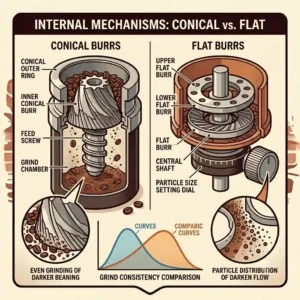
Flat Burrs vs. Conical Burrs (The Real-World Impact)
The debate between flat and conical burrs is endless, but the real-world application is highly practical.
| Burr Type | Physical Geometry | Flavor Profile Output | Best Application |
| Flat Burrs | Two parallel rings | High clarity, distinct flavor notes | Light roasts, modern espresso, pour-over |
| Conical Burrs | A cone inside a ring | High body, syrupy texture, blended notes | Dark roasts, traditional Italian espresso |
Looking at the table above, flat burrs dominate the modern specialty coffee scene because they produce a “unimodal” grind distribution—meaning all the coffee particles are exactly the same size. This allows water to extract flavors evenly, resulting in bright, clear fruit notes. Conical burrs produce a “bimodal” distribution (two distinct sizes of particles). This creates a thicker, more syrupy mouthfeel, but muddies individual flavor notes. If you serve traditional, chocolatey dark roasts and milk-heavy lattes, a conical grinder might actually serve your menu better than a high-end flat burr.
Common Mistakes When Buying High-Volume Grinders
The most expensive mistake I see owners make is purchasing based on aesthetics rather than workflow geometry. A sleek, low-profile grinder looks beautiful on the counter, but if the portafilter forks are positioned too close to the drip tray, your baristas will struggle to fit a digital scale underneath. In 2026, weighing your espresso output is non-negotiable for quality control. If the grinder’s physical geometry prevents scale usage, it is practically useless for a modern cafe.
Another massive pitfall is ignoring ventilation capability. High-end grinders like the Victoria Arduino Mythos series feature built-in cooling fans. If you buy a heavy-duty grinder without active cooling and place it directly next to your espresso machine’s boiler, it will absorb ambient heat all day. I always advise leaving at least a 4-inch air gap between the side of your espresso machine and your grinder.
Lastly, never underestimate the cost of replacement parts. The spec sheet won’t tell you this, but while European imports are fantastic, shipping a proprietary circuit board from Italy during a supply chain hiccup can leave your cafe crippled for weeks. Machines like the Mazzer Super Jolly Electronic are beloved specifically because every espresso technician in North America keeps spare parts in their van.
Long-Term Cost & Maintenance Cycles
Let’s discuss the Total Cost of Ownership (TCO). A commercial grinder is not a one-time purchase; it is an ongoing mechanical commitment.
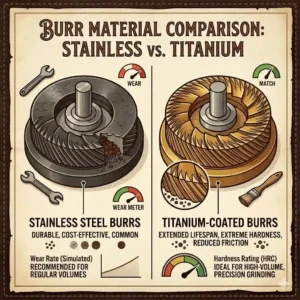
Understanding the metallurgy of your burrs is vital. Standard steel burrs typically need replacing after grinding 800 to 1,000 pounds of coffee. Titanium-coated or “Red Speed” burrs can last up to 3,000 pounds. If your cafe does 50 pounds of coffee a week, standard burrs will go dull in about four to five months. Dull burrs don’t cut beans; they shatter and crush them, creating microscopic dust (“fines”) that clog your espresso machine and make your coffee taste terribly bitter.
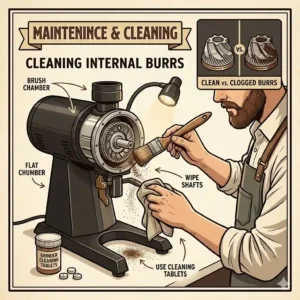
Furthermore, you must account for the daily labor cost of maintenance. Grinders with complex, hard-to-reach internal chambers require an extra 15 minutes of labor every night to vacuum and brush out. Over a year, that is 90 hours of paid labor just to clean one piece of equipment. Choosing a grinder with an easily accessible burr carrier (like the Eureka Atom Specialty 75) drastically reduces your hidden labor costs.
For a deep dive into the physics of how dull burrs impact coffee solubles, the University of California, Davis Coffee Center (.edu) has published extensive studies on extraction yields that are well worth reading.
✨ Don’t Miss These Exclusive Deals!
🔍 Ready to make an investment that pays for itself? Click on any highlighted item to check current pricing and availability. Your baristas (and your customers) will thank you!
Conclusion
Equipping your cafe or roastery with the right commercial coffee grinders is arguably the most impactful financial decision you will make for your business. You aren’t just buying a motor and blades; you are purchasing consistency, workflow speed, and thermal stability.
Whether you opt for the blistering bulk speed of the Bunn G1 HD for your retail bags, the whisper-quiet precision of the Eureka Atom Specialty 75 for your morning espresso rush, or the sheer unimodal perfection of the Mahlkönig EK43 for your pour-over bar, remember that the grinder dictates the ceiling of your coffee’s potential. Treat these machines with respect, adhere to a strict burr replacement schedule, and your extraction yields—and customer retention—will skyrocket.
❓ FAQs
❓ How long do commercial coffee grinder burrs last?
✅ Standard steel burrs process roughly 800-1,000 lbs of coffee before degrading. Titanium-coated burrs can handle up to 3,000 lbs. You should monitor your espresso shot times; when you have to constantly adjust finer to maintain pressure, it’s time to replace them…
❓ Is a flat burr or conical burr better for espresso?
✅ Neither is objectively better. Flat burrs provide high flavor clarity and highlight acidity, ideal for light roasts. Conical burrs produce a heavier, syrupy body, which is excellent for traditional dark roasts and milk-based drinks…
❓ Why does my commercial coffee grinder retain so much coffee?
✅ Retention happens because of the physical distance between the burrs and the exit chute, combined with static electricity. Using a grinder with a shorter, vertical chute path and managing cafe humidity can significantly reduce daily retention issues…
❓ Can I use a commercial espresso grinder for drip coffee?
✅ It is highly discouraged. Espresso grinders are optimized for micro-adjustments in a very fine range. Dialing back and forth from coarse drip to fine espresso daily wears out the adjustment threads and makes consistency nearly impossible…
❓ How often should I deep clean my commercial coffee grinders?
✅ In a high-volume setting, daily vacuuming of the hopper and chute is required. A chemical deep clean using food-safe grinder cleaning pellets (which absorb rancid coffee oils from the burrs) should be performed once a week…
Recommended for You
- 7 Powerful commercial automatic Solutions Transforming Business Efficiency in 2025
- 5 Best Pour Over Coffee Beans (2026) – Unlocking Pro Flavor
- 5 Best 220v coffee maker Models for Stress-Free Brewing in 2026
Disclaimer: This article contains affiliate links. As an Amazon Associate, I earn from qualifying purchases. If you purchase products through these links, we may earn a small commission at no additional cost to you.
✨ Found this helpful? Share it with your friends! 💬🤗
[addtoany]
