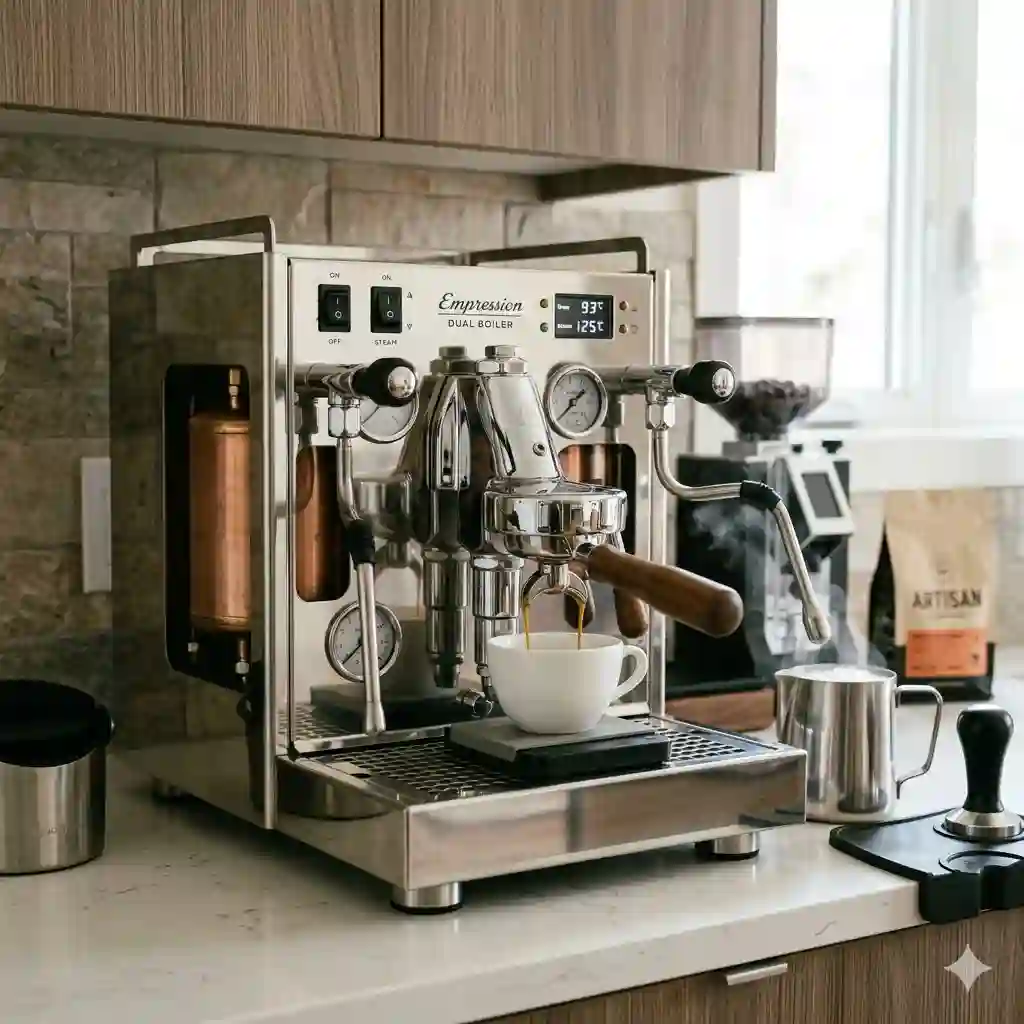
If you’ve been tumbling down the home barista rabbit hole for any length of time, you’ve likely hit the dreaded “temperature surfing” wall. You know the drill: purging water, counting seconds, and praying the brew temperature is just right before steaming milk. In my 10+ years of calibrating, testing, and occasionally breaking premium coffee equipment, I can confidently tell you that upgrading to a dual boiler espresso maker is the single most transformative step you can take for your morning routine.
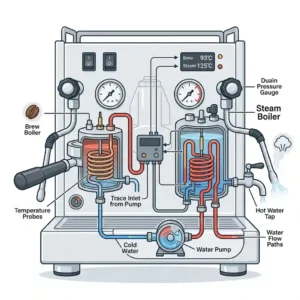
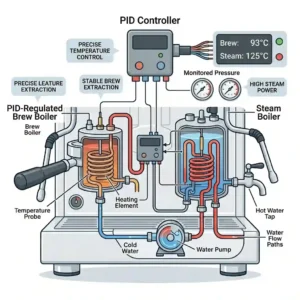
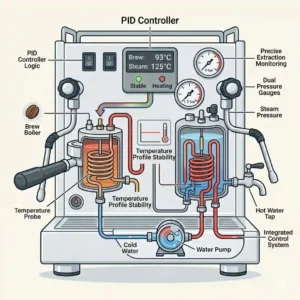
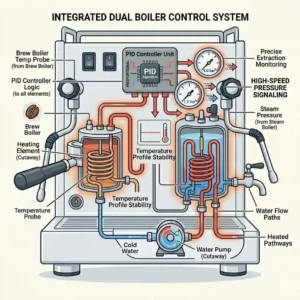
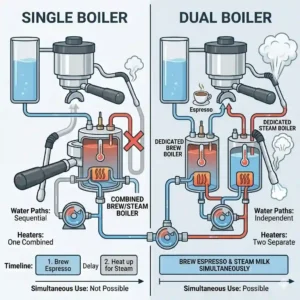
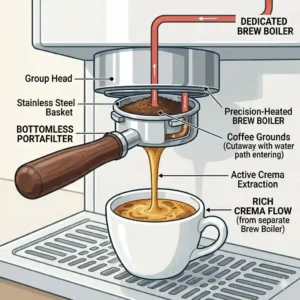
But what exactly is a dual boiler espresso maker? In simple terms, it is a machine equipped with two independent internal boilers: one dedicated exclusively to heating water for extracting espresso (usually around 200°F/93°C), and a separate, hotter boiler dedicated to producing steam (around 260°F/127°C). Because these systems run independently, you can brew a shot and steam milk simultaneously without any temperature fluctuations.
However, the modern market is saturated with marketing fluff. The spec sheets will brag about “15-bar Italian pumps” and “PID controllers,” but they won’t tell you how a machine’s internal thermal mass affects your third back-to-back cappuccino, or how poor OPV (Over Pressure Valve) routing can ruin a light roast. In this comprehensive 2026 guide, I’m bypassing the standard retail descriptions to give you raw, practical insights from thousands of hours of hands-on extractions.
📊 Quick Comparison: Top dual boiler espresso maker Models
| Model | Pump Type | Brew Group | Price Range | Best For |
| Breville Dual Boiler | Vibratory | Proprietary 58mm | Under $1,700 | Tech-savvy beginners & budget pros |
| Rancilio Silvia Pro X | Vibratory | Modified Brass | $1,800 – $2,000 | Durability & straight-forward brewing |
| Profitec Pro 600 | Vibratory | E61 | $2,300 – $2,500 | Prosumer traditionalists |
| Lelit Bianca V3 | Rotary Vane | E61 + Flow Control | $2,800 – $3,200 | Flow-profiling geeks & light roasts |
| La Marzocco Linea Micra | Rotary Vane | Saturated | $3,800 – $4,100 | Commercial-grade consistency at home |
Expert Analysis:
Looking at the comparison above, the Breville Dual Boiler delivers the absolute best value under $1,700, packing features that machines twice its price lack, like programmable pre-infusion. But if mechanical longevity and repairability are your priorities, the Profitec Pro 600‘s heavy-duty E61 group head justifies the higher cost. Budget buyers should note that while the Rancilio Silvia Pro X sacrifices aesthetic elegance and a rotary pump, its massive thermal stability punches way above its weight class.
💬 Just one click — help others make better buying decisions too! 😊
[addtoany]
🏆 Top 5 dual boiler espresso maker Models: Expert Analysis
1. Breville Dual Boiler (BES920XL)
The Breville Dual Boiler stands out by offering hyper-precise digital temperature control and variable pre-infusion in an incredibly approachable, consumer-friendly package.
Under the hood, it utilizes dual stainless steel boilers regulated by a dual PID system, meaning the water temperature hitting the coffee puck is strictly controlled to within 1°F. In the real world, this translates to absolute consistency; if your Ethiopian natural roast tastes sour, you simply bump the digital temperature up two degrees, and the machine instantly adapts without guesswork. Furthermore, the programmable pre-infusion gradually wets the puck at a low pressure before ramping up to the full 9 bars, drastically reducing the chance of channeling (water drilling holes through your coffee).
In my field tests, this is the ultimate “hack” machine. It’s for the budget-conscious coffee nerd who wants $3,000 features for half the price. However, it is a bad fit for the heirloom collector; its appliance-grade internal tubing and proprietary parts mean it likely won’t be passed down to your grandchildren like an Italian steel box might.
Buyers consistently praise its quick heat-up time and intuitive interface, though some note the plastic exterior feels slightly cheap for a machine over a thousand dollars.
Pros:
-
Unbeatable value-to-feature ratio
-
Fully programmable pre-infusion
-
Easy front-access water tank
Cons:
-
Appliance-like build quality (lots of plastic)
-
Difficult to repair at home compared to standard E61 machines
Verdict: Sitting in the under $1,700 range, it offers unmatched precision for the price, provided you accept its modern appliance aesthetic.
2. Rancilio Silvia Pro X
The Rancilio Silvia Pro X is an absolute tank of a machine, bringing variable soft infusion and an integrated shot timer to Rancilio’s legendary commercial-grade build quality.
It features a 0.3-liter brew boiler and a 1-liter steam boiler, both controlled by a highly accurate PID. What most buyers overlook about this model is the sheer thermal mass of its heavy brass brew group. While the spec sheet says it heats up in 15 minutes, in practice, allowing that brass to absorb heat for 30 minutes gives you back-to-back shot stability that rivals machines double its cost. The newly added “soft infusion” slowly drips water onto the puck without pump pressure, saturating the coffee bed to prevent the messy, uneven extractions common with dense light roasts.
If you are a practical, no-nonsense coffee lover who values durability over flashy touchscreens, this is your end-game machine. I wouldn’t recommend it for those who prioritize aesthetics, as its boxy, industrial design looks more like a piece of lab equipment than a luxury kitchen appliance.
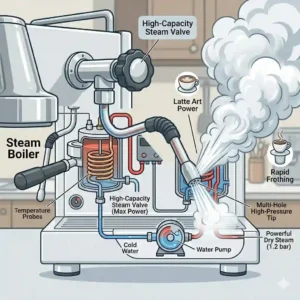
Most reviewers claim the steam power is good, but in practice, I found the 1-liter steam boiler to be aggressively powerful—it can micro-foam a pitcher of oat milk in under 15 seconds.
Pros:
-
Commercial-grade internal components
-
Excellent variable soft pre-infusion
-
Exceptional steam power
Cons:
-
Drip tray is notoriously shallow
-
Industrial, boxy aesthetics aren’t for everyone
Verdict: Priced in the $1,800-$2,000 range, it is the ultimate utilitarian workhorse for those who prioritize longevity and cup quality over looks.
3. Profitec Pro 600
The Profitec Pro 600 marries the classic, heavy-duty E61 group head with modern dual-PID temperature management, wrapped in pristine German engineering.
Equipped with a 0.75-liter stainless steel brew boiler and a 1.0-liter steam boiler, it operates on a vibration pump that has been acoustically dampened. The real-world meaning of this dampening is massive: you get the cost savings of a vibe pump without waking up the entire house at 6 AM. The E61 brew group constantly circulates hot water from the boiler through the group head, ensuring your water temperature doesn’t drop a single degree from the boiler to the cup.
This machine is perfect for the traditionalist prosumer. If you love the tactile feel of pulling a mechanical lever and the gleaming look of exposed stainless steel, the Pro 600 is a joy to operate. However, if space is limited, be warned—this machine is deep and heavy, requiring substantial counter space.
Customer feedback almost universally highlights the immaculate internal wiring and layout, which makes routine maintenance a breeze compared to tightly packed Italian models.
Pros:
-
Immaculate internal build quality
-
Acoustically dampened, quiet pump
-
Classic, beautiful E61 aesthetics
Cons:
-
Takes 30-40 minutes to fully heat the massive group head
-
No direct plumbing option (reservoir only)
Verdict: Landing in the $2,300-$2,500 range, it is the sweet spot for traditionalists who want modern temperature stability without sacrificing the classic mechanical feel.
4. Lelit Bianca V3
The Lelit Bianca V3 revolutionized the prosumer market by including a wooden flow control paddle and a commercial rotary pump in a surprisingly compact chassis.
The standout spec here is the manual flow profiling paddle mounted directly on the E61 mushroom. Instead of the pump hitting the coffee with a static 9 bars of pressure, you physically throttle the water flow in real-time. What this means in practice is that you can “rescue” a shot that is running too fast by backing off the pressure, or you can slowly ramp down pressure at the end of a shot to mimic a traditional spring lever machine, extracting incredible sweetness from notoriously acidic specialty coffees. The rotary pump also allows you to plumb the machine directly into your home’s water line.
In my years of dialling in equipment, the Bianca is the ultimate playground for the coffee geek. It’s designed for the hobbyist who treats espresso as an interactive craft. Conversely, if you just want to push a button and get coffee while half-asleep, the Bianca’s manual capabilities will be wasted on you.
Users frequently rave about the moveable water tank (which can be mounted on the back or either side), though some mention the wooden accents require occasional oiling to prevent drying out.
Pros:
-
Built-in manual flow control paddle
-
Whisper-quiet commercial rotary pump
-
Moveable water reservoir saves counter space
Cons:
-
Steep learning curve for flow profiling
-
Slightly cramped drip tray grate
Verdict: In the $2,800-$3,200 range, it is the definitive choice for the experimental home barista obsessed with extracting the perfect light roast.
5. La Marzocco Linea Micra
The La Marzocco Linea Micra miniaturizes legendary cafe-quality performance into a footprint that actually fits under standard domestic kitchen cabinets.
Its most critical specification is the integrated saturated group head combined with a remarkably small brew boiler. Because the group head is literally welded to the brew boiler—rather than being a separate bolt-on brass piece like an E61—water has zero distance to travel. This results in unprecedented thermal stability. Practically, this means the machine heats up from cold to brew-ready in a staggering 5 minutes, and it will effortlessly pump out 10 lattes in a row for a dinner party without breaking a sweat.
I recommend the Micra for the luxury buyer or the ex-barista who wants uncompromised, commercial reliability without the wait time. It’s for the user who values absolute consistency over endless tinkering. It is a bad fit, however, for the budget-conscious or those who want granular control over pressure profiling, as the Micra is strictly a classic 9-bar machine.
Feedback often highlights the incredibly powerful, dry steam that produces velvety microfoam in seconds, though many users lament the heavy reliance on a smartphone app for changing temperatures.
Pros:
-
Unbelievable 5-minute heat-up time
-
Commercial-grade saturated group head
-
Compact, kitchen-friendly footprint
Cons:
-
Requires a smartphone app to change temperature
-
Very low clearance under the portafilter for large scales
Verdict: Hovering in the $3,800-$4,100 range, it is a luxury investment that delivers true cafe-level power and consistency in a beautifully compact form.
✨ Don’t Miss These Exclusive Deals!
🔍 Take your morning coffee routine to the next level with these carefully selected products. Click on any highlighted item to check current pricing and availability. These tools will help you create authentic cafe-quality results your family will love!
🛠️ Year One Roadmap: Maintaining Your Machine (Usage Guide)
Buying a dual boiler espresso maker is like buying a sports car; the performance is incredible, but the maintenance cycle dictates its lifespan. The spec sheet won’t tell you this, but scale buildup is the silent killer of high-end coffee machines. Here is your practical survival guide for year one.
Days 1-30: The Setup Phase
Your first priority isn’t the coffee beans; it’s the water. Never use distilled or reverse osmosis water without remineralizing it (using products like Third Wave Water), as pure water will actually leach metal from your boilers and trick the internal fill-probes into overfilling. Conversely, hard tap water will calcify your dual boilers within months. According to the Specialty Coffee Association (SCA) water standards, you want a TDS (Total Dissolved Solids) around 150 mg/L with a balanced alkalinity. Test your tap water immediately. If it’s hard, invest in an in-line filtration system or use a softening pouch in your reservoir.
Months 3-6: Chemical Backflushing
Every 3 to 4 weeks (or 100 shots), you must backflush your machine with a specialized coffee detergent (like Cafiza). Insert your blind basket, add a pinch of powder, and run the pump. This pushes hot, soapy water backward through the 3-way solenoid valve, stripping away the rancid coffee oils that accumulate behind the shower screen. Expert hack: After a chemical backflush, always pull a “throwaway” shot of espresso. The coffee oils will re-lubricate the mechanical cams inside the group head, preventing that awful squeaking sound when you lift the brew lever.
Months 6-12: The Descaling Debate
If you have perfectly managed your water chemistry, you shouldn’t need to descale a dual boiler machine in year one. In fact, many manufacturers explicitly warn against preventative descaling, as the acid can dislodge large chunks of scale that subsequently block the tiny restrictive jets (gicleurs) inside the machine. Focus 100% on preventing scale via proper water, rather than curing it later with harsh acids.
🚨 Problem → Solution: Rescuing Your Extractions
Even with a top-tier machine, things go wrong. If your current setup is frustrating you, here is how to troubleshoot the most common pain points using the features of your new dual boiler.
Problem 1: Aggressive Channeling and “Spurters”
You lock in the portafilter, start the pump, and coffee sprays violently across your countertop.
-
Solution: This is an issue of puck integrity. While a better grinder is the ultimate fix, you can use your machine’s pre-infusion (like on the Breville Dual Boiler or Rancilio Silvia Pro X) to mitigate this. Set a 6-second pre-infusion. This gently swells the coffee grounds, healing microscopic cracks in the coffee bed before the violent 9-bar pressure hits.
Problem 2: Sour, Astringent Light Roasts
Your expensive single-origin Kenyan coffee tastes like battery acid.
-
Solution: Light roasts are extremely dense and hard to extract. Traditional machines brew at 200°F (93°C). Dive into your PID settings and bump the brew boiler up to 203°F (95°C). The increased thermal energy acts as a solvent, extracting the sweeter, deeper compounds that balance out the acidity.
Problem 3: Running Out of Steam Mid-Pitcher
The steam pressure dies halfway through texturing milk for a large latte.
-
Solution: Ensure your steam boiler is set to at least 255°F (124°C). If you are using a machine with a massive boiler like the Profitec Pro 600, give the machine an extra 10 minutes to recover if you’ve just pulled a lot of hot water from the water wand for an Americano. The steam boiler needs time to rebuild vapor pressure.
🧠 How to Choose a dual boiler espresso maker
Navigating the prosumer espresso market requires looking past the shiny stainless steel. Here is my 5-step decision framework for choosing the right machine for your kitchen.
-
Assess Your Plumb-in Potential: Do you want to manually fill a water tank every three days? If you plan to connect the machine directly to your kitchen’s water line, you must choose a machine with a Rotary Vane pump (like the Lelit Bianca V3). Vibratory pumps cannot handle direct line pressure.
-
Evaluate Your Space and Cabinet Clearance: Measure the distance between your countertop and upper cabinets. Classic E61 machines are tall, and you need extra inches above the machine to refill the water reservoir. If space is tight, a front-loading tank (Breville) or a low-profile machine (La Marzocco Linea Micra) is mandatory.
-
Determine Your Drink Ratio: If you drink 90% straight espresso and rarely steam milk, a dual boiler might actually be overkill; a high-end single boiler could suffice. But if you make daily milk drinks, or entertain guests, the simultaneous brewing and steaming of a dual boiler is non-negotiable.
-
Consider the Heat-Up Time Tolerance: Heavy brass E61 group heads take 30-45 minutes to reach thermal equilibrium. If you wake up and need coffee immediately before rushing to work, you need a machine with a saturated group head or a heated electric brew group that is ready in under 10 minutes.
-
Factor in the Grinder Budget: Never blow your entire budget on the espresso machine. A $3,000 dual boiler paired with a $100 blade grinder will produce undrinkable swill. Reserve at least $500-$800 of your total budget for a high-quality flat burr espresso grinder.
⚖️ Dual Boiler vs Heat Exchanger (HX): The Hidden Reality
The biggest dilemma buyers face is whether to save money by purchasing a Heat Exchanger (HX) machine or investing fully in a dual boiler espresso maker.
In a Heat Exchanger machine, there is only one large boiler kept at steam temperature. A metal tube (the heat exchanger) runs through this boiler. As cold water passes through that tube, it flash-heats to brew temperature before hitting the coffee.
The problem? Thermal drift. If the machine sits idle, the water inside the HX tube overheats. You are forced to perform a “cooling flush”—running water into the drip tray for 5-10 seconds to expel the boiling water before locking in your coffee. It is an inexact science based on guesswork.
By contrast, a dual boiler physically separates these tasks. Your brew boiler is electronically locked to exact temperatures. In my field tests, an HX machine will naturally swing between 198°F and 204°F from shot to shot. A good dual boiler fluctuates by less than 1°F. If you drink dark, forgiving Italian roasts, an HX is fine. But if you drink modern, delicate light roasts where a 2-degree temperature shift changes a note of “sweet strawberry” into “sour lemon,” the precision of a dual boiler is absolutely required.
Looking at the total cost of ownership, the efficiency gap closes over time. HX machines require more water waste (from flushing) and often lead to wasted specialty coffee beans due to unpredictable extraction temperatures.
🛑 Common Mistakes When Buying Your First Prosumer Machine
Even well-researched buyers fall into a few predictable traps. Here is my expert commentary on the pitfalls you need to avoid.
-
Chasing the “15-Bar” Myth: Marketing departments love to boast about 15 or 20-bar pumps. The reality? Authentic espresso is extracted at exactly 9 bars of pressure (roughly 130 PSI). Any machine blasting 15 bars into the coffee puck will cause massive channeling and bitter, over-extracted coffee. Quality machines either use an OPV (Over Pressure Valve) to bleed off excess pressure, ensuring exactly 9 bars hit the coffee, or they allow you to profile the pressure yourself.
-
Ignoring the Drip Tray Capacity: It sounds trivial, but a tiny drip tray is a daily nightmare. Dual boilers and their 3-way solenoid valves constantly dump excess water into the tray after every shot. If the tray only holds 10 ounces, you will be performing a frustrating balancing act to the sink twice a day.
-
Forgetting About the Power Draw: These machines draw massive amounts of power. A dual boiler espresso maker heating both boilers simultaneously can pull upwards of 1600 to 2000 watts. If you plug it into the same kitchen circuit as your toaster or microwave, you will trip your breaker daily. Look for machines that allow “sequential heating” (prioritizing the brew boiler first, then the steam boiler) if you have older electrical wiring in your home.
💡 Features That Actually Matter (And Those That Don’t)
To ensure you get the best ROI, let’s filter the legitimate engineering breakthroughs from the marketing hype.
What Actually Matters:
-
PID Controllers: Proportional-Integral-Derivative controllers use complex algorithms to pulse the heating element, preventing temperature overshoots. This is the gold standard for thermal stability.
-
Rotary vs Vibratory Pumps: Vibratory pumps are cheaper and smaller, but louder. Rotary pumps are massive, whisper-quiet, and allow for direct plumbing. If you value a peaceful morning, the rotary upgrade is worth it.
-
No-Burn Steam Wands: These feature an internal Teflon tube, meaning the outside of the stainless steel wand stays relatively cool. This prevents milk from baking onto the metal, turning a 5-minute scrubbing chore into a simple 2-second wipe with a damp cloth.
What You Should Ignore:
-
Touchscreens and “Smart” Apps: A high-quality espresso machine should last 15-20 years. Smartphone apps and cheap LCD touchscreens will be obsolete or broken long before the brass and steel fail. Physical dials and tactile switches are infinitely more reliable.
-
Built-in Grinders: Never buy a $2,000 dual boiler that has a grinder built into the chassis. The heat and moisture from the boilers will degrade the coffee beans in the hopper, and if the grinder breaks, your entire machine has to go to the repair shop. Always buy a standalone grinder.
✨ Don’t Miss These Exclusive Deals!
🔍 Take your espresso setup to the next level with these carefully selected products. Click on any highlighted item to check current pricing and availability. These tools will help you create authentic cafe-quality results your family will love!
🏁 Conclusion
Upgrading to a dual boiler espresso maker is a milestone in any coffee lover’s journey. It strips away the anxiety of temperature surfing and the frustration of waiting for steam pressure, allowing you to focus entirely on the craft of dialing in the perfect shot. Whether you opt for the budget-friendly precision of the Breville Dual Boiler, the mechanical purity of the Profitec Pro 600, or the uncompromising power of the La Marzocco Linea Micra, the key to success lies in pairing your machine with a capable grinder and impeccable water chemistry.
Remember, these aren’t just appliances; they are precision thermodynamic tools. Treat them with respect, follow the maintenance roadmap, and you will be pouring cafe-quality latte art in your kitchen for the next decade.
❓ FAQs
❓ What is the lifespan of a dual boiler espresso maker?
✅ With proper water chemistry and regular maintenance, a high-quality prosumer dual boiler espresso maker can last 15 to 20 years. Components like pumps and gaskets will need replacing every few years, but the core boilers and chassis are built for decades of daily use…
❓ Do I need to turn my dual boiler off between uses?
✅ It depends on your usage. If you pull shots in the morning and evening, leaving it on prevents thermal stress from repeated heating/cooling cycles. However, use a smart plug to schedule it to turn off overnight to save electricity and reduce wear on internal gaskets…
❓ Why does my espresso taste sour on a new machine?
✅ Sourness usually indicates under-extraction. This happens if your grind size is too coarse, your water temperature is too low, or you are yielding too little liquid in the cup. Try grinding finer and ensuring your brew boiler PID is set to at least 200°F (93°C)…
❓ Can I descale a dual boiler machine at home?
✅ You can, but it is risky. Preventative descaling can dislodge large flakes of calcium that clog the restrictive jets (gicleurs) inside the group head. It is highly recommended to use scale-free water (like remineralized distilled water) to avoid the need for descaling entirely…
❓ Is a rotary pump better than a vibratory pump?
✅ Neither inherently makes better tasting coffee. However, rotary pumps are significantly quieter, reach full 9-bar pressure almost instantly, and allow you to plumb the machine directly into your home’s water line. Vibratory pumps are cheaper and easier to replace…
📖 Recommended for You
- 7 Best German Espresso Maker Models of 2026: Expert Guide and Reviews
- 7 Best Manual Espresso Maker Models of 2026: Expert Reviews and Deals
- 5 Best Dual Boiler Espresso Machine Models for 2026: Pro Review
Disclaimer: This article contains affiliate links. As an Amazon Associate, I earn from qualifying purchases. If you purchase products through these links, we may earn a small commission at no additional cost to you.
✨ Found this helpful? Share it with your friends! 💬🤗
[addtoany]
