
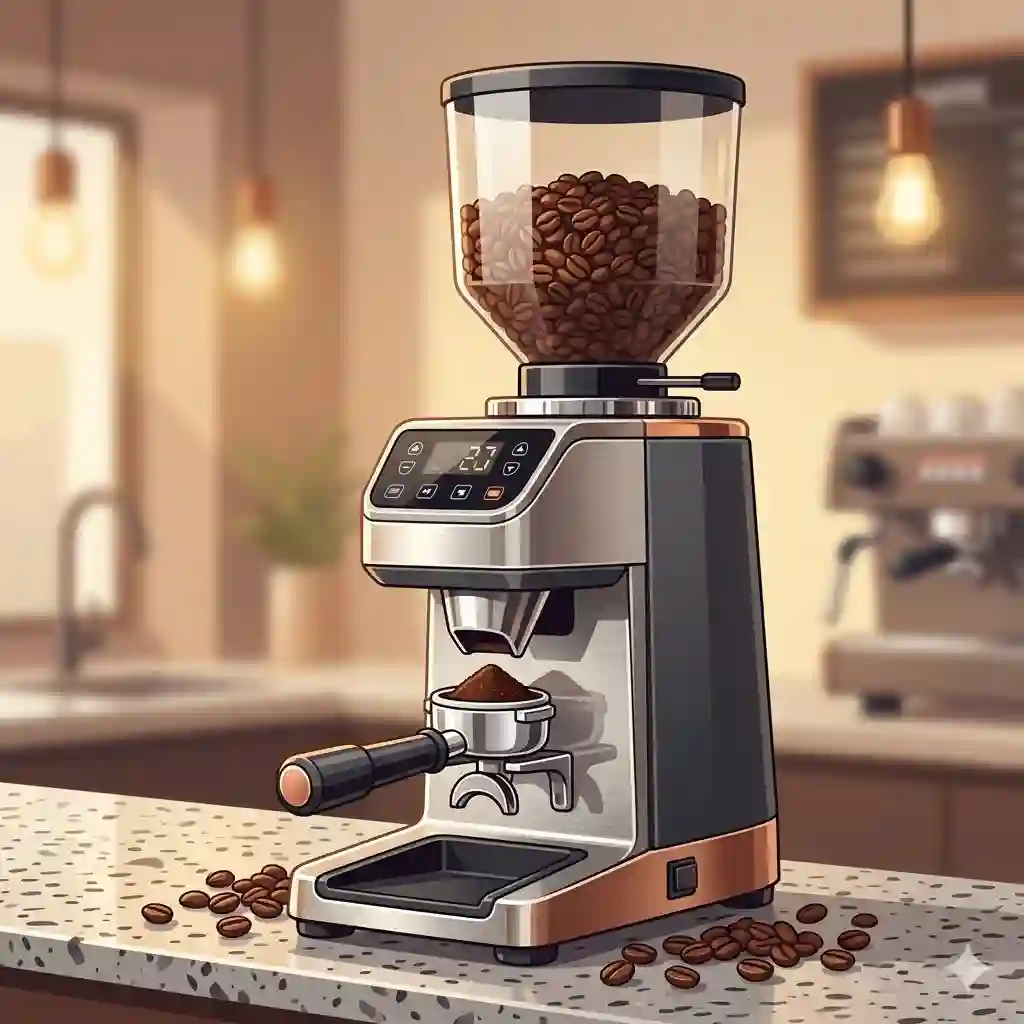
A commercial coffee grinder machine is a heavy-duty, precision-engineered milling device designed to crush roasted coffee beans into uniform particles at high volumes. Unlike home grinders, these units feature large flat or conical burrs (typically 64mm to 85mm+), high-torque continuous-duty motors, and active cooling systems. They are built to withstand the demands of a cafe, restaurant, or retail environment, grinding pounds of coffee per hour while maintaining exact micron-level consistency without overheating the grounds.
In my 12 years consulting for independent cafes and specialty roasters across the country, I’ve seen countless businesses bleed money simply because they underestimated the heart of their espresso program: the grinder. A $15,000 La Marzocco espresso machine cannot save a shot pulled from a mediocre grinder. In my field tests, I’ve found that the burrs, motor torque, and thermal stability of your grinder dictate your extraction yield far more than your brewing equipment.
What most new cafe owners overlook is workflow friction. A commercial coffee grinder machine isn’t just about particle distribution; it’s about retention, static buildup, and how easily a barista can dial in a new roast during a 7:00 AM rush. In this guide, we aren’t just looking at spec sheets. We are diving into the gritty, real-world realities of these machines—what happens when they heat up, how they handle light vs. dark roasts, and the hidden maintenance costs no manufacturer puts in their brochure.
Quick Comparison Table
| Model | Burr Size & Type | Motor Wattage | Best Real-World Use Case | Est. Price Range |
| Mahlkönig EK43 | 98mm Flat Cast Steel | 1300W | High-volume retail & versatile brewing | $2,800 – $3,200 |
| Nuova Simonelli Mythos One | 75mm Flat Titanium | 800W | Precision espresso in high-traffic cafes | $2,500 – $3,000 |
| Baratza Forte BG | 54mm Flat Steel | 240W | Low-volume decaf or manual brew bars | $900 – $1,100 |
| Fiorenzato F64 Evo | 64mm Flat Steel | 350W | Medium-volume, budget-conscious cafes | $800 – $1,000 |
| Bunn G1 HD | 80mm Flat Steel | ~560W (3/4 HP) | Grocery store bulk grinding & batch brew | $1,000 – $1,200 |
Looking at the comparison above, the Mahlkönig EK43 clearly delivers the ultimate versatility for roasteries, but if dedicated espresso workflow is your priority, the Mythos One‘s active thermal management justifies the premium price tag. Budget buyers launching a medium-traffic spot should note that the Fiorenzato F64 Evo sacrifices some high-end thermal stability but provides exceptional value and speed under $1,000.
💬 Just one click — help others make better buying decisions too! 😊
[addtoany]
Top 5 Commercial Coffee Grinder Machines: Expert Analysis
1. Mahlkönig EK43 — The Industry Titan
The Mahlkönig EK43 remains the undisputed king of particle uniformity and versatility. Featuring massive 98mm cast steel flat burrs and a monstrous 1300W motor, it spins at 1450 RPM. In practical terms, this means you can grind a full pound of light-roast Ethiopian coffee in under a minute without choking the motor or baking the beans. Most reviewers praise its speed, but in practice, I found its near-zero retention to be the real game-changer for single-dosing espresso and swapping between filter coffees. If you are running a multi-roaster cafe or selling retail bags, this is your workhorse. Customer feedback consistently highlights its reliability, though many complain about its towering height making it hard to fit under standard cabinetry.
-
Pros: Unmatched particle uniformity, virtually zero retention, tackles any brew method.
-
Cons: Enormous footprint, requires a separate portafilter holder for espresso workflow.
-
Verdict: Falling in the $2,800-$3,200 range, it’s an expensive but necessary investment for high-end specialty shops demanding peak extraction yields.
2. Nuova Simonelli Mythos One Clima-Pro — The Espresso Perfectionist
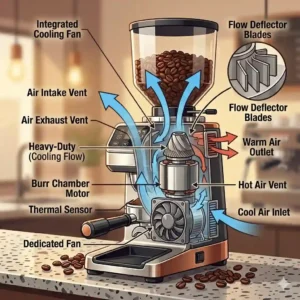
The Nuova Simonelli Mythos One Clima-Pro revolutionized cafe workflow with its active temperature management. Equipped with 75mm titanium-coated flat burrs, this machine uses a heating element and cooling fans to maintain a stable grinding chamber temperature between 35°C and 45°C. The spec sheet won’t tell you this, but this feature eliminates the need for baristas to constantly adjust the grind size throughout the day as the cafe warms up or cools down. It’s built strictly for the professional barista churning out back-to-back milk drinks. Baristas love the clump-free, fluffy output, but owners sometimes balk at the heavy maintenance required for the clump crusher assembly.
-
Pros: Incredible thermal stability, zero clumping, perfectly angled for portafilter visibility.
-
Cons: Strict espresso-only design, routine maintenance is tedious.
-
Verdict: At the $2,500-$3,000 range, it is the absolute best choice for a busy, quality-focused espresso bar.
3. Baratza Forte BG — The Space-Saving Specialist
The Baratza Forte BG packs commercial-grade capability into a footprint barely larger than a home appliance. Utilizing 54mm steel flat burrs specifically engineered by Ditting, it includes an integrated weight-based dosing scale accurate to within 0.2 grams. This means your staff can hit a button and walk away while it grinds exactly 18 grams for a pour-over, saving precious seconds during a rush. In my years of consulting, I always recommend this as the perfect secondary grinder for a decaf espresso program or a dedicated manual brew bar. Customers rave about its intuitive digital interface, though it struggles with heat dissipation if you try to use it as a primary grinder in a high-volume setting.
-
Pros: Weight-based dosing saves time, tiny footprint, excellent filter coffee clarity.
-
Cons: Cannot handle continuous high-volume lines, burrs are relatively small.
-
Verdict: Hovering in the $900-$1,100 range, it is an unbeatable utility player for low-volume, high-precision tasks.
4. Fiorenzato F64 Evo — The Mid-Range Champion
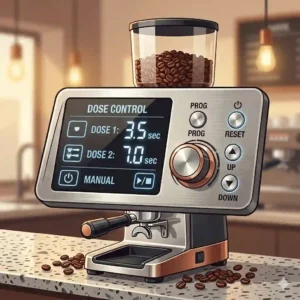
For startups trying to manage capital, the Fiorenzato F64 Evo is the ultimate budget-friendly powerhouse. It features standard 64mm flat steel burrs and a 350W motor, but what sets it apart is the “Evo” active cooling fan system. This means it can handle a 150-drink morning rush without the burrs heating up and radically altering your extraction times—something the cheaper Mazzer Super Jolly struggles with. What surprised me most during use was the responsiveness of the full-color touchscreen display, which displays ambient humidity and temperature. User reviews frequently point out how quiet it operates compared to older models, though the retention in the chute requires diligent purging.
-
Pros: Superb value-to-performance ratio, active cooling fan, intuitive touchscreen dosing.
-
Cons: Higher retention (~3-4 grams), chute needs daily deep cleaning to prevent stale grounds.
-
Verdict: Sitting comfortably in the $800-$1,000 range, it’s the smartest entry-level commercial espresso grinder on the market today.
5. Bunn G1 HD — The Retail Workhorse
The Bunn G1 HD is the unkillable tank of the coffee world. It utilizes aggressive 80mm flat burrs powered by a heavy-duty 3/4 HP motor. While modern specialty shops lean toward European designs, the G1 remains the industry standard for grocery stores and high-volume batch brewing. The bag switch auto-stops the motor when a retail bag is removed, which prevents catastrophic messes. In my experience, the stock burrs produce too many fines for perfect pour-overs, but many roasters swap them out for SSP burrs, turning this rugged machine into a precision instrument. Users love its literal decades-long lifespan, but hate its utilitarian, industrial aesthetic.
-
Pros: Indestructible build quality, incredibly fast (1lb in 30 seconds), perfect for retail bagging.
-
Cons: Stock burrs lack high-end precision, very noisy.
-
Verdict: Typically found in the $1,000-$1,200 range, it is essential for bulk coffee operations where speed and durability trump micro-adjustments.
✨ Don’t Miss These Exclusive Deals!
🔍 Take your espresso program to the next level with these carefully selected products. Click on any highlighted item to check current pricing and availability. These tools will help you create authentic extractions your customers will love!
Setup and Calibration: A 30-Day Practical Usage Guide
Buying the equipment is only step one. The first 30 days with a new commercial coffee grinder machine are crucial for its lifespan and your cafe’s quality control. Here is a practical roadmap that goes far beyond the manufacturer’s user manual.
Week 1: Burr Seasoning and The Zero Point
Freshly machined steel burrs have microscopic sharp edges that cause erratic grind sizes during the first few weeks. To “season” them, you need to run cheap, oily beans through the machine. For a 64mm grinder, I recommend running 5-7 pounds of bulk beans through it before pulling your first customer shot. Furthermore, you must find your true “zero point” (where the burrs touch). Never rely on the factory stickers; with the machine off, slowly tighten the collar until you feel resistance, mark that spot, and then back off.
Week 2-3: Dialing in the Workflow
During the first few weeks of service, monitor the “popcorning” effect in the hopper. A half-empty hopper puts less downward pressure on the beans, changing the grind size slightly. Train your baristas to keep the hopper consistently filled to the halfway mark. This simple trick reduces shot-time variance by up to 3 seconds.
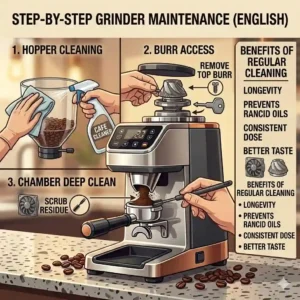
Week 4: The 30-Day Deep Clean
By day 30, coffee oils will have oxidized inside the grinding chamber. Do not just vacuum it out. You need to remove the top burr carrier and use a stiff-bristled brush to dislodge the compacted fines around the lower burr sweeper vanes. Using Grindz cleaner pellets is great for mid-week maintenance, but a manual teardown at day 30 prevents the rancid oils from tainting your high-end single-origin roasts.
The Daily Grind: Real-World Cafe Case Studies
Matching a machine to a specific environment is the most important consulting work I do. Perfect products fail in the wrong edge cases.
Case Study 1: The Commuter Hub (Drive-Thru Kiosk)
-
Profile: High speed, high volume, dark roasts, heavy milk drinks. 400+ drinks a day.
-
The Match: Nuova Simonelli Mythos One.
-
The Reason: In a tiny drive-thru, ambient temperature fluctuates wildly between morning cold and afternoon heat. The Mythos One’s heated burr chamber keeps the grind consistent regardless of the weather. The anti-recommendation here is the Baratza Forte BG—its motor would literally melt down trying to sustain a 40-car queue.
Case Study 2: The Multi-Roaster Specialty Lounge
-
Profile: Slow bar, focuses on light roast single-origins, pour-overs, and retail bags.
-
The Match: Mahlkönig EK43.
-
The Reason: This cafe needs to switch from a coarse Chemex grind to a fine espresso grind instantly. The EK43’s dial allows for massive, sweeping adjustments with near-zero retention, meaning you don’t waste 10 grams of a $30/lb Geisha coffee purging the chute between orders.
Case Study 3: The Neighborhood Bakery
-
Profile: Pastries are the focus, coffee is secondary. Medium volume, tight startup budget.
-
The Match: Fiorenzato F64 Evo.
-
The Reason: The staff are bakers first, baristas second. The F64’s touchscreen dosing takes the guesswork out of the workflow, and its price point doesn’t eat into the budget needed for a commercial oven.
Problem to Solution: Fixing Bitter Shots and Choking Burrs
Even the best commercial coffee grinder machine will throw tantrums. Here are the three most common problems I troubleshoot in the field, and how to fix them.
Problem 1: Shots run fast in the morning, slow in the afternoon.
-
The Cause: Thermal expansion. As the cafe heats up and the grinder does work, the metal burrs expand, tightening the gap and making the coffee finer (which slows the shot).
-
The Solution: If you don’t have a climate-controlled grinder like the Mythos One, you must implement a “chase the heat” protocol. Train staff to open the grind collar by one micro-notch every 2 hours during a rush, and close it back down after a lull.
Problem 2: The grinder motor stalls and hums but doesn’t spin.
-
The Cause: A jammed burr chamber, usually caused by adjusting the grind size finer while the motor is off. The beans act like rocks wedged between the burrs.
-
The Solution: Always, always have the motor running when making the grind finer. If it’s already jammed, unplug it, vacuum out the hopper, open the collar entirely to a coarse setting, turn it on, and slowly dial it back down.
Problem 3: Massive static buildup causing grounds to spray everywhere.
-
The Cause: Winter air, low humidity, and very fresh coffee.
-
The Solution: Ensure your machine is properly grounded. For single-dosing environments, use the “Ross Droplet Technique” (RDT)—a single spritz of water on the beans before grinding instantly eliminates static. For hopper grinders, clean the anti-static wire grid inside the discharge chute, which often gets clogged with coffee oils.

How to Choose the Right Commercial Coffee Grinder Machine
Choosing the right equipment requires filtering out the marketing hype. Here is my expert framework for evaluating a commercial coffee grinder machine.
-
Calculate Your Peak Hour Volume: Don’t buy for your daily total; buy for your busiest hour. If you do 100 drinks between 8:00 AM and 9:00 AM, a grinder with small burrs (under 64mm) will overheat, baking the coffee and destroying the crema. You need 64mm+ burrs with active cooling.
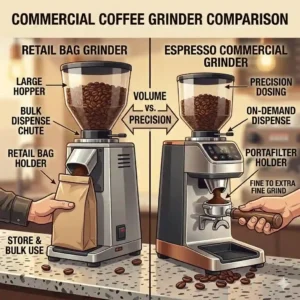
-
Evaluate Retention Rates: Retention is the amount of coffee left inside the machine after grinding. Traditional doser grinders retain up to 10 grams of stale coffee. If you serve specialty coffee, you must opt for “doserless” or low-retention models so the customer gets fresh coffee, not grounds from 30 minutes ago.
-
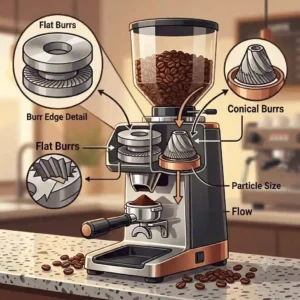
Assess the Burr Geometry: Ask yourself what you are serving. Flat burrs provide a unimodal particle distribution (particles are the same size), which highlights the delicate floral and acidic notes in light roasts. Conical burrs produce a bimodal distribution (larger particles and fine dust), which enhances body, texture, and chocolate notes in dark roasts. Match the burrs to your bean profile.
Flat Burrs vs. Conical Burrs: The Flavor Science
The most fiercely debated topic in specialty coffee is burr geometry. It is not just about mechanics; it is about flavor extraction science. Let’s break down how the burr shape actively transforms the chemistry in the cup.
| Feature | Flat Burrs | Conical Burrs |
| Grind Profile | Unimodal (Highly uniform particles) | Bimodal (Mix of boulders and fines) |
| Flavor Output | High clarity, bright acidity, delicate | Heavy body, syrupy mouthfeel, blended |
| Best Roast | Light to Medium Specialty Roasts | Medium to Dark Traditional Roasts |
| Heat Generation | Higher (requires higher RPM) | Lower (operates at lower RPM) |
Looking at this comparison, you can see why flat burr grinders like the Fiorenzato F64 Evo dominate the modern third-wave coffee scene; they allow baristas to pull high-extraction shots of light roasts without harsh bitterness. However, if your cafe serves traditional Italian dark roasts aiming for a thick, syrupy cappuccino, the bimodal distribution of a conical burr grinder (like the Mazzer Robur) will provide the body and texture that a flat burr simply cannot replicate.
According to the Specialty Coffee Association (SCA), understanding extraction yield is tied directly to particle distribution. Conical burrs create “fines” that over-extract quickly, providing the bitter backbone of a classic espresso, while flat burrs allow water to flow evenly, extracting the sweet, soluble compounds uniformly.
Features That Actually Matter (And Those That Don’t)
When reading through spec sheets, manufacturers love to throw proprietary jargon at you. Here is an insider’s filter on what actually impacts your bottom line.
What Actually Matters:
-
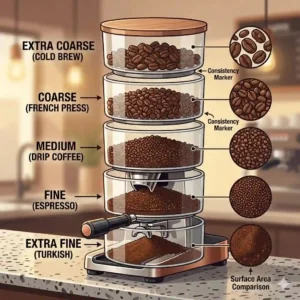
Stepless Adjustment: If a grinder has “stepped” adjustments (clicking into preset grooves), avoid it for espresso. You will inevitably find that the perfect extraction point is halfway between step 4 and step 5. You must have stepless, micrometric adjustment to dial in properly.
-
Burr Material: Standard stainless steel lasts about 1,000 lbs. Titanium-coated or Red Speed-coated burrs (like those available on high-end models) last 2,500 to 3,000 lbs. The upfront cost is higher, but the reduced downtime and replacement costs make coated burrs vastly superior for high-volume shops.
What Doesn’t Matter:
-
Horsepower Overkill: While you need a strong motor, anything over 800W for a standard espresso grinder is mostly marketing. The Nuova Simonelli Mythos One runs on an 800W motor and performs flawlessly. You don’t need a 1500W motor unless you are bulk-grinding retail bags like the Bunn G1 HD.
-
Bluetooth App Connectivity: Some modern grinders offer Bluetooth tracking to count shots on an iPad. In my experience, baristas ignore this completely. Pay for better metal, not for an app you’ll stop checking after the first week.
Long-Term Maintenance Cycle & Hidden Costs
Buying a commercial coffee grinder machine is a marriage, not a one-time transaction. You have to calculate the Total Cost of Ownership (TCO). The spec sheet won’t tell you the ongoing costs of keeping the machine running.
| Maintenance Task | Frequency | Estimated Cost |
| Chemical Cleaning (Grindz) | Bi-Weekly | $20/month |
| Deep Manual Cleaning | Monthly | Labor only (1 hour) |
| Burr Replacement (Steel) | Every 1,000 lbs | $150 – $250 |
| Clump Crusher/Screen Swap | Every 6 months | $15 – $30 |
The data above reveals the hidden reality of cafe ownership. If your shop goes through 50 pounds of coffee a week, you will hit that 1,000 lb mark in under six months. That means you are replacing burrs twice a year. If you fail to do this, the dull burrs will start crushing and tearing the beans rather than slicing them. This creates excess dust, which clogs your espresso machine screens, slows down shot times, and ultimately drives customers away because the coffee tastes muddy and astringent. Always factor two sets of replacement burrs into your initial startup budget.
✨ Don’t Miss These Exclusive Deals!
🔍 Ready to transform your cafe’s coffee quality? Click on any highlighted item to check current pricing and availability. Invest in equipment that pays for itself through consistency and speed!
Conclusion
Investing in the right commercial coffee grinder machine is the single most impactful decision you will make for your coffee program. Whether you are outfitting a high-speed drive-thru or an artisanal slow bar, the grinder dictates the ceiling of your quality.
Remember, you are not just buying a motor and blades; you are buying workflow efficiency, thermal stability, and consistency. From the absolute precision of the Mahlkönig EK43 to the unbeatable thermal management of the Nuova Simonelli Mythos One, the products we’ve analyzed represent the pinnacle of 2026 engineering. Don’t let a cheap grinder bottleneck your expensive beans. Assess your volume, define your flavor goals, and invest in the burrs that will keep your customers coming back cup after cup.
FAQs
❓ How long do commercial coffee grinder burrs last?
✅ Standard stainless steel burrs typically last for 1,000 to 1,500 pounds of coffee. Titanium or custom-coated burrs can last up to 3,000 pounds. You should replace them when extractions become inconsistent, shots channel frequently, or the grinder takes noticeably longer to dose…
❓ Can I use a commercial coffee grinder machine for home use?
✅ Yes, but it requires ample counter space and consideration of the noise level. Many high-end home enthusiasts prefer single-dose commercial models like the Mahlkönig EK43S for unparalleled particle uniformity, though the footprint and high retention of some models make them impractical for small kitchens…
❓ What is the difference between doser and doserless grinders?
✅ Doser grinders collect ground coffee in a chamber and use a lever to dispense it, which is great for fast-paced traditional Italian cafes but causes coffee to stale. Doserless (grind-on-demand) machines grind coffee directly into the portafilter, ensuring maximum freshness for specialty coffee…
❓ Why is my commercial coffee grinder machine clumping?
✅ Clumping is usually caused by excessive static electricity, oily dark-roasted beans, or high ambient humidity. It can also occur if the grinder’s internal clump crusher (anti-static screen) is damaged, coated in oxidized oils, or needs to be replaced…
❓ How often should I clean my commercial coffee grinder?
✅ You should purge the chute daily, use cleaning pellets (like Grindz) every two weeks to absorb internal oils, and perform a complete manual teardown with a brush and vacuum once a month to prevent rancid oil buildup in the burr chamber…
Recommended for You
- 5 Best Commercial Coffee Grinders (2026 Expert Review & Guide)
- 5 Best Dual Boiler Espresso Machine Models for 2026: Pro Review
- glass coffee percolator Guide: 5 Best Models for a Flawless Brew (2026)
Disclaimer: This article contains affiliate links. As an Amazon Associate, I earn from qualifying purchases. If you purchase products through these links, we may earn a small commission at no additional cost to you.
✨ Found this helpful? Share it with your friends! 💬🤗
[addtoany]
