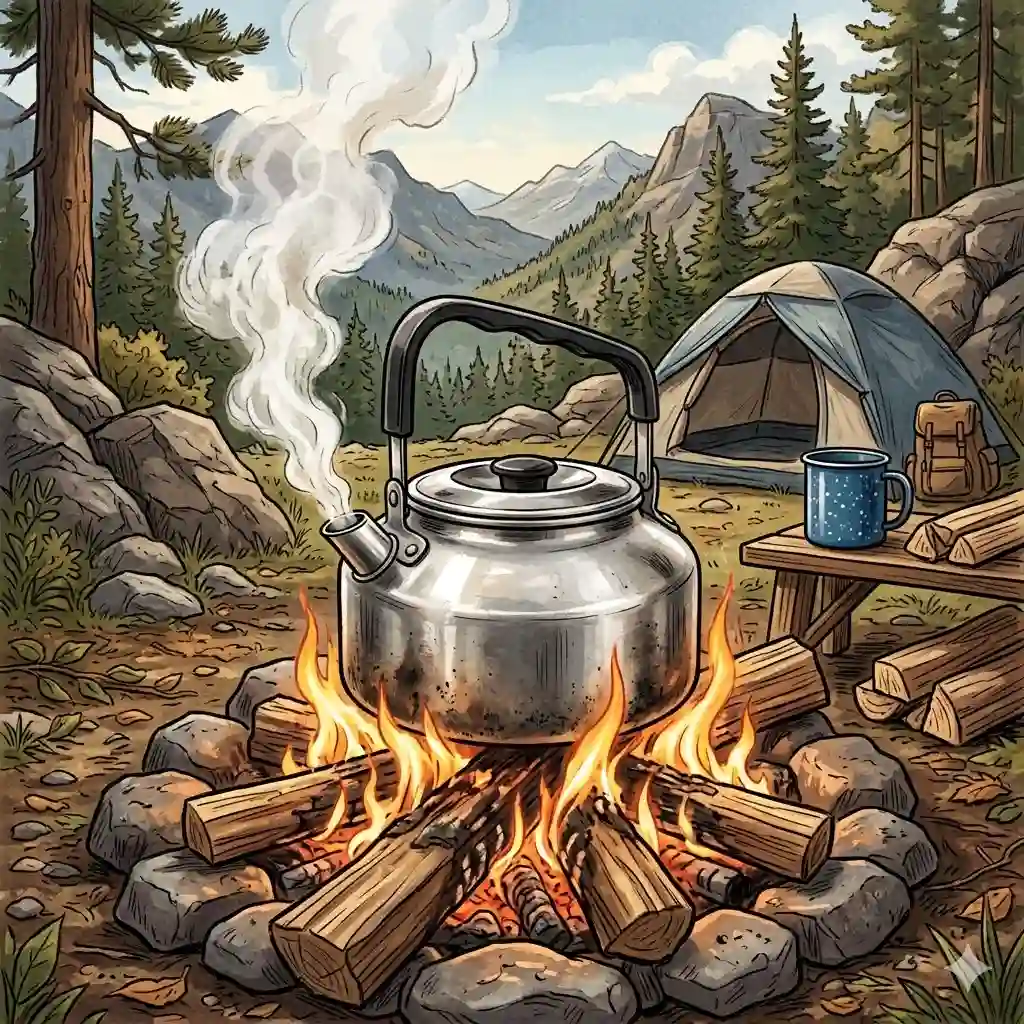
In my 10+ years of leading backcountry expeditions and gear testing, I’ve watched countless novice campers try to boil water in a standard open pot. They inevitably end up with lukewarm, ash-filled coffee and scorched fingers. The truth is, a dedicated camping tea kettle isn’t a luxury item—it’s an efficiency tool that dictates the tempo of your morning and the safety of your hydration.
What is a camping tea kettle?
A camping tea kettle is a specialized piece of outdoor cookware designed with a sealed lid and a directional spout, specifically engineered to boil water rapidly over a camp stove or open flame while preventing heat loss and keeping out environmental debris like ash and insects.
Over the past decade, I’ve field-tested over 40 different boiling vessels. I’ve watched cheap plastic handles melt onto $150 stoves, and I’ve seen “premium” titanium models warp out of shape after three uses. The outdoor industry in 2026 is flooded with marketing hype, but the physical laws of thermal dynamics remain unchanged. You need a vessel that transfers heat efficiently, pours without dribbling boiling water onto your boots, and survives the inevitable drop onto granite.
In this comprehensive guide, I’m pulling back the curtain on the industry. We won’t just look at spec sheets; we’ll dive into thermal bridging, galvanic corrosion, and the ergonomic realities of pouring 100°C water when you can barely feel your fingers. Let’s find the exact kettle that matches your specific wilderness style.
📊 Quick Comparison: Top Contenders at a Glance
| Product Name | Best For | Material | Practical Capacity | Estimated Price Range |
| GSI Outdoors Halulite Ketalist | Backpackers & Solo Campers | Hard-Anodized Aluminum | 1.0 Liter | Under $40 |
| Snow Peak Kettle No. 1 | Ultralight Purists | Titanium | 0.9 Liter | $25 – $35 |
| Sea to Summit X-Pot Kettle | Space-Starved Travelers | Silicone / Aluminum base | 1.3 Liters | $45 – $55 |
| Kelly Kettle Trekker | Survivalists & Bushcrafters | Stainless Steel | 0.6 Liter | $80 – $95 |
| Stanley Adventure Boil + Brew | Car Campers & Coffee Snobs | 18/8 Stainless Steel | 0.9 Liter | $20 – $30 |
Expert Analysis:
Looking at the comparison above, the GSI Outdoors Halulite delivers the best overall thermal efficiency for budget buyers, largely due to aluminum’s superior heat conductivity compared to titanium. However, if space is your absolute priority, the collapsible Sea to Summit X-Pot justifies its higher price tag by practically disappearing in your pack. Survivalists should note that the Kelly Kettle Trekker sacrifices weight and packing volume, but its ability to boil water using twigs completely eliminates the need to carry liquid fuel.
💬 Just one click — help others make better buying decisions too! 😊
[addtoany]
🔥 Top 5 Camping Tea Kettles: Expert Analysis
1. GSI Outdoors Halulite Ketalist: The Backpacker’s Workhorse
The GSI Outdoors Halulite is a masterclass in functional minimalism, featuring a low-profile design that nests a nesting bowl and mug inside.
Its hard-anodized aluminum construction boasts a thermal conductivity rate roughly 50% higher than titanium. In the real world, this means you save precious Isobutane fuel—I consistently brought 1 liter of water to a rolling boil 45 seconds faster in this than in my titanium pots. The low center of gravity prevents tipping on small canister stoves, a crucial safety factor when cooking on uneven ground.
In my experience, this is the perfect camping tea kettle for solo backpackers or couples who rely on dehydrated meals and quick coffee. What most buyers overlook is the locking handle mechanism; unlike cheaper knockoffs, the Halulite’s handle locks upright, keeping the silicone grip away from the burner’s convective heat plume.
Customer feedback generally praises its rapid boil time and nesting capabilities, though some note the plastic lid knob can loosen over time.
-
Pros: Exceptional fuel efficiency; low, stable profile; handle locks securely upright.
-
Cons: Lid knob requires occasional tightening; aluminum dents if dropped heavily.
-
Price Range & Value: Sitting comfortably under $40, it offers the best return on investment for weight-conscious hikers who don’t want to pay the titanium tax.
2. Snow Peak Kettle No. 1: The Ultralight Purist’s Dream
Snow Peak’s Kettle No. 1 is practically an industry heirloom, offering a minimalist, multi-functional design that doubles as a standard cooking pot.
Weighing in at a mere 9 ounces, it utilizes premium Japanese titanium. The spec sheet won’t tell you this, but titanium’s primary advantage here isn’t just weight—it’s chemical inertness. It will never impart a metallic taste to your water, and it resists the biofilm buildup that plagues scratched aluminum pots. The folding handles and top bail handle give you options: suspend it over a fire or set it directly on coals.
This kettle is strictly for the ultralight purist who counts every gram and understands heat management. Because titanium is actually a poor conductor of heat, you must use a stove with a focused flame, otherwise, the heat deflects up the sides, wasting fuel and risking burned handles.
Reviews consistently highlight its bulletproof durability and feather-light feel, though some complain about the lack of a dedicated pour spout.
-
Pros: Indestructible titanium build; zero metallic taste transfer; extremely lightweight.
-
Cons: Pouring requires practice (no spout); poor heat distribution compared to aluminum.
-
Price Range & Value: Typically found in the $25-$35 range, it is an absolute steal for genuine Japanese titanium, lasting literal decades if treated right.
3. Sea to Summit X-Pot Kettle: The Space-Saving Innovator
The Sea to Summit X-Pot shatters traditional cookware molds by combining a hard-anodized aluminum base with food-grade, heat-resistant silicone walls.
The primary specification here is the collapsed height: it flattens down to just 1.38 inches. When you’re packing a 40L bag for a multi-day trek, finding room for a rigid sphere is a nightmare. The X-Pot solves this. The aluminum base handles the direct heat, while the silicone walls safely hold the boiling water.
This is the ultimate camping tea kettle for bikepackers, kayakers, and anyone whose storage space is severely restricted. However, my field tests revealed a critical caveat: you must ensure the flames of your stove do not extend past the aluminum base. If a wide-flame burner licks up the sides, you will permanently damage the silicone. It requires mindful cooking.
Most user feedback is overwhelmingly positive regarding the space-saving aspect, but beginners occasionally report melting the silicone due to user error with oversized stoves.
-
Pros: Flattens to under 1.5 inches; transparent lid lets you see the boil; dual glass-reinforced nylon handles.
-
Cons: Vulnerable to wide flames; holds residual odors if used for food instead of water.
-
Price Range & Value: Ranging from $45-$55, you are paying a premium for the engineering, but the space saved is worth every penny for strict packers.
4. Kelly Kettle Trekker: The Off-Grid Survival Engine
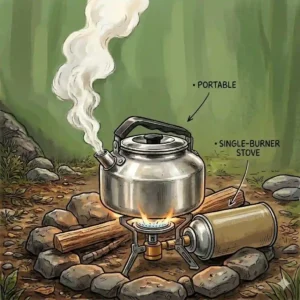
The Kelly Kettle Trekker isn’t just a kettle; it’s a centuries-old Irish design that uses a central chimney to boil water using nothing but handfuls of combustible debris.
Constructed from laser-welded stainless steel, it holds 0.6 liters in a hollow water jacket surrounding a central fire chamber. Because the fire drafts up through the middle, the surface area exposed to heat is massive. In practical terms, this means you can boil water in under 3 minutes during a freezing downpour using wet pine needles and a single firestarter.
I strongly recommend this system for overlanders, bushcrafters, and disaster-prep kits. The “Anti-Recommendation” here is for high-alpine climbers—above the treeline where biomass is scarce, this system becomes useless dead weight. It requires active foraging.
Customer reviews rave about its reliability in severe weather, though the learning curve for pouring using the chain and handle system takes a few tries to master.
-
Pros: Zero reliance on liquid/gas fuel; boils incredibly fast in high winds; bombproof stainless construction.
-
Cons: Bulky and heavy (1.6 lbs); completely useless without burnable biomass.
-
Price Range & Value: In the $80-$95 bracket, it’s an expensive initial outlay that pays for itself over time by eliminating the need to ever buy fuel canisters again.
5. Stanley Adventure Camp Boil + Brew: The Car Camper’s Caffeinator
Stanley brings their legendary thermos durability to the campsite with this hybrid French press and boiling vessel.
Featuring 18/8 stainless steel and a BPA-free nylon press, it holds 32oz of liquid. The magic here isn’t just the steel—it’s the thermal mass. While it takes longer to boil than aluminum, the thick steel walls retain heat significantly longer. You can boil your water, press your coffee, and let it sit on the frosty picnic table while you cook eggs without it going ice-cold in five minutes.
This is my go-to recommendation for car campers, van-lifers, and basecamp setups where weight isn’t an issue but morning comfort is paramount. What most users don’t realize is that the press mechanism can be completely removed, leaving you with an incredibly durable, standard tall kettle for boiling pasta or making soup.
Reviews consistently praise the coffee quality and ruggedness, but correctly note that the lack of a true spout makes pouring into small thermoses slightly messy.
-
Pros: Superior heat retention; integrated coffee press; indestructible steel build.
-
Cons: Heavy for backpacking; pouring precision is lacking.
-
Price Range & Value: Sitting in the $20-$30 range, it offers unmatched versatility and durability for weekend warriors on a budget.
✨ Don’t Miss These Exclusive Deals!
🔍 Take your backcountry barista setup to the next level with these carefully selected products. Click on any highlighted item to check current pricing and availability. These tools will help you create authentic, morale-boosting morning brews your campmates will love!
🧭 Real-World Scenario: Matching the Kettle to Your Trip
Even a “perfect” product will fail if mismatched with the user’s environment. Here is my exact decision matrix for pairing gear with reality.
Profile A: The 15-Mile-a-Day Thru-Hiker
If you are hiking the Appalachian Trail, your biggest enemy is fatigue, and your second biggest is pack volume. You need a camping tea kettle that acts as a nesting doll for your stove and fuel.
-
The Match: The GSI Outdoors Halulite. You can fit an MSR PocketRocket stove and a 110g fuel canister inside the kettle. This keeps your kitchen kit contained to a single, lightweight cylinder, drastically reducing morning pack-up times.
Profile B: The Family Car-Camping Coordinator
You’re managing three kids, a dog, and a massive two-burner Coleman stove at a state park. You don’t care about ounces; you care about durability and keeping coffee hot while flipping pancakes.
-
The Match: The Stanley Adventure Boil + Brew. The high thermal mass of the thick steel keeps liquids warmer longer in the brisk morning air, and if it gets knocked off the picnic table onto gravel, it won’t dent or shatter.
Profile C: The High-Desert Bikepacker
You are strapping gear to a bicycle frame. You have zero room for rigid, bulky items, but you need reliable hydration in an arid environment.
-
The Match: The Sea to Summit X-Pot. Folded flat, it slides into a frame bag alongside a hydration bladder, completely eliminating the awkward bulges that rigid metal kettles create against your knees while pedaling.
🔧 The Year-One Longevity & Maintenance Cycle
The spec sheet stops mattering exactly 30 days into your trip. Here is the unvarnished “Year One” roadmap for outdoor cookware, and the maintenance required to keep your gear out of the landfill.
Months 1-3: The Honeymoon Phase
Everything works perfectly. However, this is when you must establish the habit of wiping the exterior bottom of the kettle before placing it on the stove. A single grain of sand between a titanium kettle and a red-hot stove grate can cause localized micro-pitting.
Months 4-6: Biofilm and Oxidation
If you use your kettle to melt snow or boil water from creeks, you will notice a slippery film developing on the interior walls. This is biofilm. Plain water rinses won’t touch it.
-
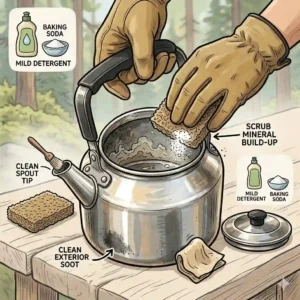
The Fix: Once a month, boil a mixture of 1 part white vinegar to 3 parts water. This strips the biofilm and dissolves hard water scaling (calcium deposits) that acts as an insulator and increases your boil times.
Months 7-12: Handle Fatigue & Galvanic Corrosion
By the end of year one, the rivets holding the handle brackets will undergo thermal fatigue from expanding and contracting hundreds of times. If your kettle uses steel rivets on an aluminum body, you may see white, powdery oxidation. This is galvanic corrosion, a reaction between dissimilar metals.
-
The Fix: Clean rivet points with a soft brush and avoid leaving the kettle soaking in soapy water for extended periods. Check the tightness of all screws and rivets; a loose handle over boiling water is a severe trip-ending hazard.

🔬 How to Choose a Camping Tea Kettle: Beyond the Marketing Fluff
When evaluating a camping tea kettle, novice buyers obsess over weight. As an expert, I look at structural geometry and thermodynamics.
-
The Aspect Ratio (Width vs. Height): A wide, squat kettle captures more BTUs from the stove’s flame than a tall, narrow one. The wider the base, the faster the boil, and the more fuel you save. Tall kettles allow flames to escape up the sides, wasting energy.
-
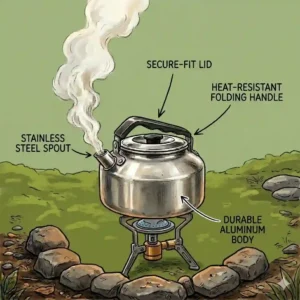
Spout Dynamics: A poorly designed spout will dribble 100°C water down the side of the pot rather than shooting it forward. Look for a spout that has a sharp, defined “lip.” A rolled edge often creates surface tension that pulls the water back.
-
Handle Insulation: Bare metal handles require you to use a bandana or multi-tool to lift them. Silicone or rubberized handles are vastly superior, provided the handle locks in an upright position. If the handle flops down against the hot metal body during boiling, the silicone will melt, ruining the kettle and releasing toxic fumes.
🚫 Common Mistakes When Buying Outdoor Cookware
The outdoor gear graveyard is filled with the results of bad purchasing logic. Here are the pitfalls to avoid:
The “Do-It-All” Illusion
Many campers buy a massive 2-liter pot thinking it can serve as a skillet, a kettle, and a washbasin. In reality, pouring coffee from a 2-liter wide-mouth pot usually results in second-degree burns. A dedicated kettle controls the flow of dangerous, boiling liquids safely.
Ignoring Stove Compatibility
If you own an ultra-compact stove (like a BRS-3000T), buying a large kettle with a wide base creates a dangerous cantilever effect. A slight bump to the camp table will send the heavy kettle toppling off the tiny stove arms. Always match the diameter of the kettle’s base to the span of your stove’s pot supports.
The Altitude Oversight
According to wilderness safety guidelines from Princeton Environmental Health and Safety, water boils at lower temperatures at high altitudes. At 10,000 feet, water boils at roughly 90°C (194°F), which takes longer to kill certain pathogens. If you frequently camp at altitude, you need a kettle with a tight-fitting lid to trap steam and build micro-pressure, ensuring a vigorous, pathogen-killing boil.
⚖️ Titanium vs. Hard-Anodized Aluminum vs. Stainless Steel
Let’s cut through the metallurgical marketing jargon and interpret what these materials actually mean for your trip.
Hard-Anodized Aluminum (The Pragmatist’s Choice)
Through an electrochemical process, raw aluminum is given a hardened, non-porous outer layer.
-
Practical Meaning: It conducts heat beautifully, saving you fuel. It is cheap and lightweight. However, acidic foods (like tomato sauce or heavily acidic coffee) can slowly degrade the anodized layer over years of misuse. It’s perfect for boiling water and quick meals.
Titanium (The Ultralight Specialist)
-
Practical Meaning: Titanium is exceptionally strong and light, but it has terrible thermal conductivity. You will use more fuel to boil the same amount of water compared to aluminum. It is prone to “hot spots,” meaning if you try to cook oatmeal in a titanium kettle, it will likely burn onto the bottom while the top remains cold. Keep titanium strictly for boiling water, not cooking complex meals.
Stainless Steel (The Indestructible Tank)
-
Practical Meaning: Steel can take a beating. You can drop it on rocks, scrub it with sand, and set it directly in the glowing coals of a campfire—something that would melt aluminum. The trade-off is massive weight. It’s strictly for vehicle-supported camping.
⏱️ What to Expect: Boil Times in Real-World Conditions
Laboratory boil times printed on a box are fiction. They are tested indoors, at sea level, with room-temperature water.
In the real world, thermal dynamics change everything. If you are using a standard 1-liter aluminum camping tea kettle with a 10,000 BTU canister stove, here is what actually happens:
-
Ideal Conditions (Summer, 70°F, no wind): Expect a rolling boil in about 3.5 to 4 minutes.
-
The Wind Factor: A mere 5 mph breeze can blow the convective heat away from the bottom of your kettle. Without a windscreen, that 4-minute boil time can easily stretch to 8-10 minutes, consuming double the fuel.
-
The Cold Water Penalty: Drawing water from a glacial stream (35°F) requires significantly more thermal energy to reach 212°F than water drawn from a sun-warmed jug in your trunk. Expect boil times to increase by 30-40% when melting snow or using icy water.
Insider Tip: Never fill a kettle to the absolute brim. Boiling water expands and will surge out of the spout, extinguishing your stove flame and potentially causing gas to pool around your cooking area—a severe fire hazard recognized by agencies like the U.S. Forest Service. Leave at least an inch of headspace.
✨ Don’t Miss These Exclusive Deals!
🔍 Ready to upgrade your camp kitchen? Check out these highly-rated gear options. Click on any highlighted item to verify current pricing and read more user reviews. Your future self will thank you when the wind is howling and you need hot coffee now.
🏁 Conclusion
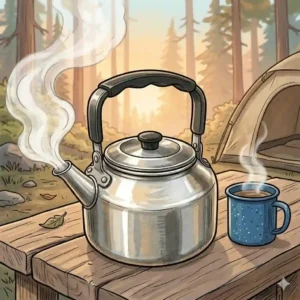
Choosing the right camping tea kettle isn’t about buying the most expensive item on the shelf; it’s about matching metallurgical properties and design geometry to the harsh realities of your specific wilderness environment.
Whether you are shaving grams off your base weight with the titanium Snow Peak Kettle No. 1, maximizing pack space with the collapsible Sea to Summit X-Pot, or surviving off-grid with the biofuel-driven Kelly Kettle Trekker, the goal remains the same: safe, rapid, and reliable boiling water. Stop settling for ash-covered coffee and dangerous, wobbly pots. Invest in a dedicated, high-quality kettle, master your stove system, and take control of your backcountry kitchen.
❓ FAQs
❓ Can you put a camping tea kettle directly on a campfire?
✅ Yes, but material matters. Stainless steel and titanium kettles can handle direct coals safely. Avoid putting silicone-hybrid kettles or standard aluminum kettles with plastic/rubberized handles into a fire, as the extreme heat will melt the components and compromise the metal…
❓ How do you clean a scorched camping tea kettle?
✅ For steel or titanium, make a paste of baking soda and water, let it sit on the scorch mark for 30 minutes, and scrub with a nylon brush. Avoid using steel wool on hard-anodized aluminum, as it will strip the protective coating…
❓ What size kettle do I need for two people?
✅ A 1.0 to 1.3-liter kettle is ideal for two people. It provides exactly enough boiling water for two large mugs of coffee or tea, plus enough leftover to rehydrate two standard freeze-dried backpacking meals simultaneously…
❓ Does boiling water in a titanium kettle taste like metal?
✅ No. Titanium is highly inert and biocompatible, meaning it does not leach metallic flavors or chemicals into your water, even when exposed to high heat or acidic liquids like coffee. This makes it superior for flavor purity…
❓ Why do some kettles have a whistle and others don’t?
✅ Most modern camping kettles omit the whistle to save weight and reduce moving parts that can break in the backcountry. Instead, campers rely on the visible steam venting from the lid holes or the audible rumbling of the water to know it’s boiling…
📚 Recommended for You
- Hand Brew Coffee Guide: 5 Pro Secrets for Perfect 2026 Pour-Overs
- Best 5 cup coffee machine in 2026: A Barista’s Top Expert Picks
- Camping Kettle Guide: 5 Best Picks Tested for 2026
Disclaimer: This article contains affiliate links. As an Amazon Associate, I earn from qualifying purchases. If you purchase products through these links, we may earn a small commission at no additional cost to you.
✨ Found this helpful? Share it with your friends! 💬🤗
[addtoany]
