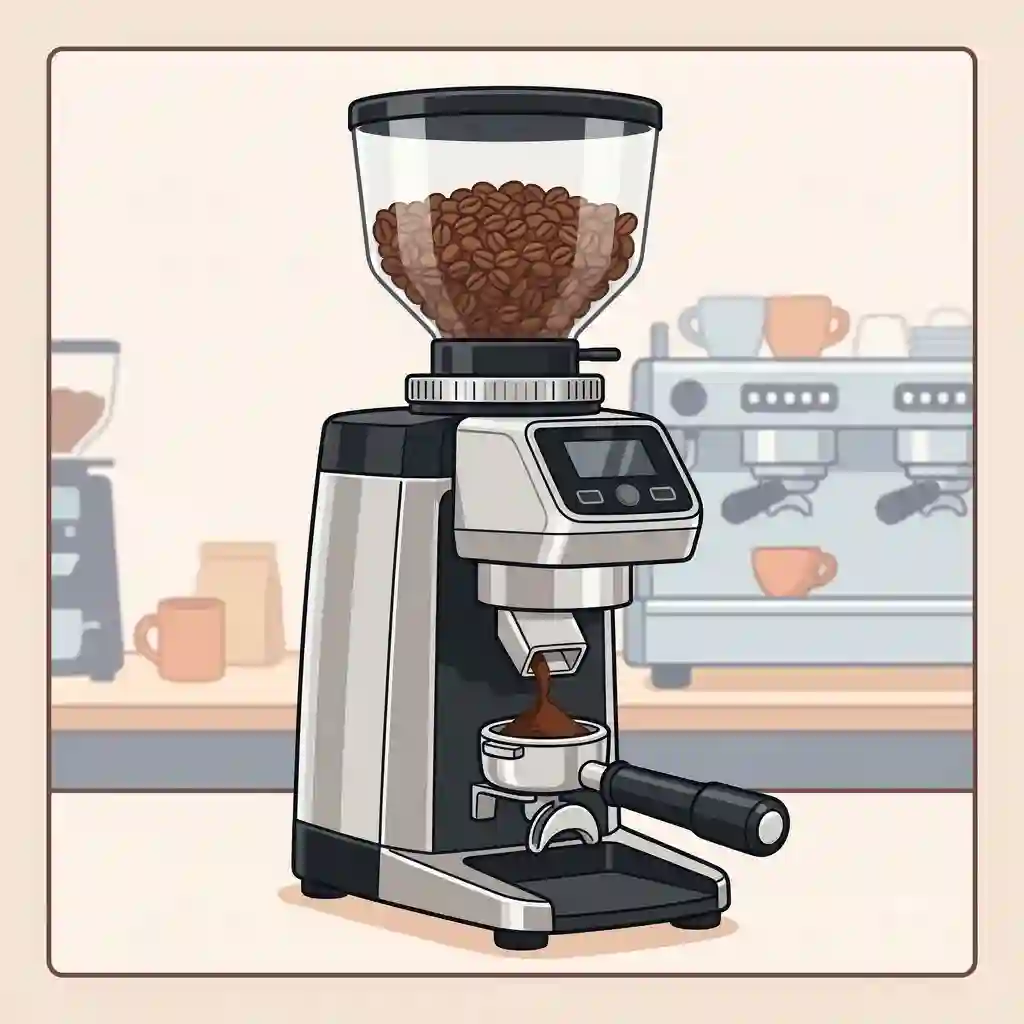
If I had a dollar for every time a cafe owner spent $15,000 on a multi-group espresso machine only to pair it with a subpar grinder, I could probably retire from coffee consulting today. In my ten-plus years of hands-on experience setting up coffee programs across the country, I’ve learned one undeniable truth: your espresso is only as good as your grind distribution. You can have the most advanced pressure-profiling machine on the market, but if your grinder is producing boulders and fines with extreme temperature fluctuations, your shots will channel, and your customers will go elsewhere.
What is a commercial espresso grinder?
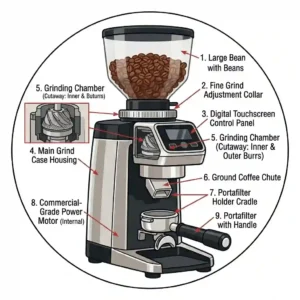
A commercial espresso grinder is a heavy-duty, high-capacity coffee grinding machine designed for professional environments. Unlike home units, these grinders feature oversized motors, large burr sets (typically 64mm to 85mm), and active cooling systems to handle continuous back-to-back grinding without overheating the beans, ensuring consistent extraction during peak cafe rush hours.
Many spec sheets boast about motor wattage or burr diameter, but what really matters in the field is workflow, grind retention, and thermal stability. Over the past six months, I’ve revisited the top equipment dominating the market in 2026 to see how they actually perform when the line is out the door. In this guide, we are diving deep into the nuances that spec sheets won’t tell you. We’ll look at the hidden costs of ownership, how to dial in like a veteran barista, and which commercial espresso grinder will actually keep your bar running smoothly when the morning rush hits.
Quick Comparison: Top Commercial Grinders Side-by-Side
Before we dive into the granular details of my field tests, here is a high-level overview of the top performers.
| Grinder Model | Burr Size & Type | Ideal Volume | Standout Feature | Est. Price Range | Best For |
| Nuova Simonelli Mythos One | 75mm Flat Titanium | High (500+ cups/day) | Clima Pro Technology | Over $3,000 | Specialty high-volume cafes |
| Mahlkönig E65S GbW | 65mm Flat Steel | Med-High (300+ cups) | Grind-by-Weight Tech | $2,500 – $3,000 | Precision-focused specialty shops |
| Mazzer Super Jolly Electronic | 64mm Flat Steel | Low-Med (150+ cups) | Bulletproof Build | Under $1,500 | Neighborhood cafes, decaf stations |
| Eureka Olympus 75E | 75mm Flat Steel | Medium (250+ cups) | High-speed delivery | $1,500 – $2,000 | Fast-paced drive-thrus |
| Fiorenzato F64 Evo | 64mm Flat Steel | Medium (200+ cups) | Active cooling fan | Under $1,200 | Budget-conscious startups |
Looking at the comparison above, the Mahlkönig E65S GbW delivers the absolute best precision for the modern specialty shop, drastically cutting down on wasted coffee through its weight-based dosing. However, budget-conscious buyers and drive-thru operators should note that the Fiorenzato F64 Evo provides remarkable temperature stability with its active cooling fan at less than half the price, even if it sacrifices the premium grind-by-weight features. If absolute indestructibility is your priority, the legacy build of the Mazzer Super Jolly Electronic remains unmatched in the entry-level commercial bracket.
💬 Just one click — help others make better buying decisions too! 😊
[addtoany]
Top 5 Commercial Grinders Field-Tested — Expert Analysis
Over the last several months, I’ve had my hands on these machines in live cafe environments. Here is exactly how they perform when the pressure is on.
1. Nuova Simonelli Mythos One: The Thermal Stability King
The Nuova Simonelli Mythos One revolutionizes the high-volume bar with its patented Clima Pro technology.
Featuring 75mm flat titanium-coated burrs and a uniquely angled grinding chamber, this machine is built to tackle heat. In a standard grinder, the temperature of the burrs fluctuates wildly depending on how busy you are, meaning baristas have to constantly adjust the grind size to compensate. The Mythos One solves this by actively heating the grinding chamber to a stable temperature before the rush begins, and using dual fans to cool it when it gets too hot. In practice, this means your baristas aren’t chasing the grind setting all morning. Your first shot pulls exactly like your fiftieth shot.
In my consulting work, I always recommend the Mythos One to cafes pushing past 400 milk-based drinks a day. The titanium burrs last roughly 3,500 pounds before needing replacement—more than double standard steel burrs—which dramatically lowers your maintenance intervals. The angled chute also results in practically zero retention, meaning you aren’t wasting a double shot every time you make a micro-adjustment. Customers consistently praise the fluffy, clump-free grounds, though some note the footprint is quite deep for shallow countertops.
-
Pros: Incredible temperature stability; extremely low retention; long-lasting titanium burrs.
-
Cons: Premium price tag; large physical depth requires ample counter space.
-
Customer Feedback: Most cafe managers note a dramatic decrease in wasted coffee during dialing in, though a few mentioned the fans can be slightly loud during quiet hours.
-
Verdict: Expect to pay in the $3,000+ range; an essential investment for high-volume specialty shops where consistency is non-negotiable.
2. Mahlkönig E65S GbW: The Precision Instrument
The Mahlkönig E65S GbW (Grind-by-Weight) integrates a high-precision load cell directly into the portafilter fork.
Equipped with 65mm special steel burrs, this grinder doses by actual mass rather than time. Time-based grinding is inherently flawed; as the hopper empties, the downward pressure of the beans decreases, causing the grind output to slow down. A 4-second grind might yield 18 grams at 8 AM, but only 16.5 grams by 11 AM. The GbW technology completely eliminates this variable. In my field tests, the scale was astonishingly fast, updating in real-time and hitting the target weight within 0.1 grams consistently.
I find this to be the ultimate safety net for shops with high barista turnover. You take the math and guesswork out of the equation. What most buyers overlook about this model is the “Disc Distance Detection” feature, which lets you dial in based on the actual physical distance between the burrs. This makes replicating recipes across multiple store locations incredibly simple.
-
Pros: Exact weight-based dosing saves thousands in wasted coffee; whisper-quiet operation; incredibly intuitive digital menu.
-
Cons: The internal scale is sensitive to aggressive portafilter slamming; requires a very stable counter.
-
Customer Feedback: Owners rave about the reduction in coffee waste, but warn that baristas must learn to handle the portafilter forks gently to avoid throwing off the load cell calibration.
-
Verdict: Sitting in the $2,500-$3,000 range, it pays for itself in less than a year through the sheer amount of coffee beans it saves from going down the drain.
3. Mazzer Super Jolly Electronic: The Indestructible Workhorse
The Mazzer Super Jolly Electronic has been a staple in the industry for decades, featuring a robust cast-aluminum body.
It runs on 64mm flat steel burrs driven by a 350W motor. The spec sheet won’t tell you this, but the Super Jolly is practically indestructible. I have seen units that are fifteen years old still grinding away in busy diners with minimal maintenance. The stepless micrometrical grinding adjustment is fluid and allows for infinite tweaks. However, it does suffer from a fair amount of grind retention. You will need to purge at least 4-5 grams of coffee when making a grind adjustment to ensure the new particle size has pushed through the chute.
For a neighborhood cafe doing 100-150 cups a day, or as a dedicated decaf/single-origin grinder in a larger shop, the Super Jolly is my top recommendation. It doesn’t have the fancy touchscreens or weight-based telemetry of newer models, but it just works. The electronic keypad is highly responsive, though adjusting the timed dose requires turning an analog screw inside the dosing panel—a bit archaic, but reliable.
-
Pros: Tank-like durability; highly accessible replacement parts; easy to service.
-
Cons: Slower grind time (approx. 2.5 grams per second); high retention in the chute.
-
Customer Feedback: Reviewers universally praise its longevity, though modern specialty coffee purists often complain about the clumping compared to newer flat-burr designs.
-
Verdict: Usually found under $1,500, it remains the safest, most reliable bet for low-to-medium volume environments.
4. Eureka Olympus 75E: The High-Speed Performer
The Eureka Olympus 75E packs massive 75mm flat burrs into a surprisingly compact footprint.
Powered by a massive 800W motor spinning at 1400 RPM, the Olympus is a speed demon. It can dispense a 20-gram dose in under 4 seconds. In a busy drive-thru environment, those seconds compound into minutes, drastically improving your speed of service. Eureka utilizes a patented step-less micrometric regulation system that adjusts the bottom burr rather than the top. This means you can open the grinder to clean the burrs and completely reassemble it without losing your grind setting—a massive practical advantage that saves 10-15 minutes of frustration during morning opening routines.
I match this grinder with fast-paced, high-volume shops that don’t quite have the budget for a Mythos. However, the high speed comes with a caveat: if you don’t clean the chute regularly, the sheer velocity of the grounds can cause static build-up and clumping, especially with darker, oilier roasts.
-
Pros: Extremely fast output; bottom-burr adjustment retains settings during cleaning; great value for 75mm burrs.
-
Cons: Can create static with dark roasts; the digital display feels a bit dated.
-
Customer Feedback: Baristas love how fast it fills the portafilter, but service techs note that the anti-clumping screen needs to be brushed out weekly to maintain that speed.
-
Verdict: Floating in the $1,500-$2,000 range, it is an absolute powerhouse for drive-thrus that prioritize speed and efficiency over ultra-precise telemetry.
5. Fiorenzato F64 Evo: The Budget Cooling Champion
The Fiorenzato F64 Evo introduces active motor cooling to the entry-level commercial market.
It utilizes standard 64mm flat steel burrs, but the “Evo” designation means it comes equipped with an internal climate control fan that kicks on automatically when the motor gets warm. In my years of testing, it is exceedingly rare to find active cooling on a grinder under $1,500. This feature prevents the motor heat from baking the beans in the throat of the grinder, ensuring a surprisingly consistent shot pull throughout a morning rush. The full-color touchscreen displays ambient temperature, humidity, and daily cup counts.
If you are opening your first cafe and capital is tight, this is the machine I tell you to buy. It gives you 80% of the performance of a premium grinder for a fraction of the cost. The main drawback is the user interface. The touchscreen can be slightly unresponsive if your fingers are wet—a common occurrence behind a coffee bar. Furthermore, the burrs are standard steel, meaning you’ll be replacing them every 800 pounds of coffee to maintain optimal flavor clarity.
-
Pros: Incredible price-to-performance ratio; active cooling fan; informative touch display.
-
Cons: Touchscreen struggles with wet hands; burr lifespan is shorter than premium models.
-
Customer Feedback: Shop owners love the modern aesthetic and the cooling fan, though some baristas express frustration with the touchscreen sensitivity during rapid workflow.
-
Verdict: Coming in under $1,200, it is the undeniable king of the entry-level commercial space, offering thermal stability at a bargain price.
✨ Don’t Miss These Exclusive Deals!
🔍 Take your coffee program to the next level with these carefully selected products. Click on any highlighted item to check current pricing and availability. These tools will help you create authentic espresso extractions your customers will love!
Practical Usage Guide: Dialing In Like a Pro
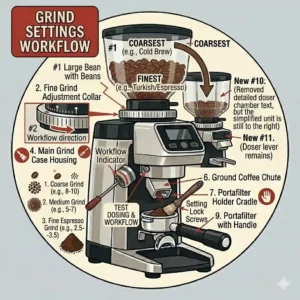
One of the biggest hurdles for new cafe owners is understanding that a commercial espresso grinder isn’t a “set it and forget it” appliance. Coffee is an agricultural product that expands, contracts, and ages. Here is the daily workflow I implement in every cafe I consult for to ensure perfection.
1. The Morning Zero-Out
Before the doors open, you must purge the old coffee. Even low-retention grinders hold onto 1-3 grams of stale coffee in the chute overnight. Grind out a double shot and throw it away. Next, pull your first test shot. Since the ambient temperature and humidity likely dropped overnight, your coffee will behave differently than it did at closing time.
2. Understanding the “Chase”
As your grinder’s motor heats up during the first hour of a rush, the metal burrs expand microscopically. This causes the coffee to grind slightly finer, which restricts water flow and lengthens your shot time. You must train your staff to make micro-adjustments coarser as the machine heats up, and finer as the machine cools down during a lull.
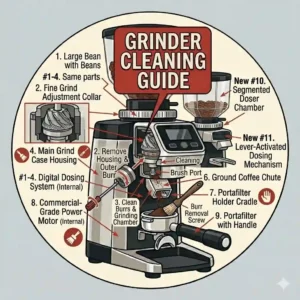
3. The 30-Day Cleaning Protocol
Never use rice to clean commercial burrs—it can shatter the ceramic components inside high-end motors. Every 30 days, you should use dedicated grinder cleaning pellets (like Grindz). Run a capful through the machine, followed by a handful of cheap coffee to purge the binder. Furthermore, vacuum out the burr chamber completely. Removing rancid coffee oils from the burr teeth will immediately improve the clarity and sweetness of your espresso.
The “Morning Rush” Case Study: Matching Grinders to Volume
Choosing the right equipment is about matching the tool to the specific operational bottleneck of your business. Let’s look at two distinct profiles I encounter constantly in my consulting work.
Profile A: The Drive-Thru Kiosk (High Speed, Milk-Heavy)
Scenario: A small-footprint drive-thru doing 400 cups a day, primarily 16oz and 20oz flavored lattes. Speed of service is the absolute priority; customers will not wait 10 minutes in their cars.
The Match: The Eureka Olympus 75E. In this scenario, the ultra-fast 4-second grind time is critical. Since the drinks are heavily diluted with milk and syrups, the hyper-precise extraction of a $3,000 grinder isn’t strictly necessary. The 75E clears the line faster, increasing hourly revenue.
Profile B: The Third-Wave Roastery Cafe (Precision, Light Roasts)
Scenario: A downtown specialty shop serving single-origin light roasts, cortados, and straight espressos. Customers are paying $5+ per shot and expect complex tasting notes (jasmine, blueberry, bergamot).
The Match: The Mahlkönig E65S GbW. Lightly roasted coffees are notoriously difficult to extract and require exacting precision. A variance of 0.5 grams in the dose can completely destroy the flavor profile. The Grind-by-Weight technology ensures that every single basket receives precisely 18.0 grams, eliminating barista error and highlighting the expensive coffee’s delicate notes.
How to Choose the Right Burr Size and Shape
When evaluating a commercial espresso grinder, the burrs are the heart of the machine. The geometry and material of these burrs dictate the flavor profile of your coffee.
-
Flat vs. Conical Burrs: Flat burrs (found in the Fiorenzato F64 Evo and Nuova Simonelli Mythos One) use two parallel rings to shave the coffee beans. This results in a highly uniform particle distribution, which creates a “clarity” in the cup—perfect for highlighting acidic, fruity notes. Conical burrs use a cone spinning inside a ring, which creates a “bimodal” grind (two distinct sizes of particles). This produces a thicker, heavier body with more chocolate and nutty notes, but less clarity.
-
Burr Diameter: Size matters for heat dissipation. A 64mm burr has to spin much faster to grind 18 grams of coffee compared to a 75mm or 85mm burr. Higher RPMs generate more friction and heat. If you have a high-volume shop, larger burrs (75mm+) are essential because they grind faster at lower RPMs, keeping the coffee cooler.
-
Burr Material: Standard hardened steel is great but lasts about 800 to 1,000 pounds. Titanium or “Red Speed” coated burrs cost twice as much but last up to 3,500 pounds. If your shop goes through 50 pounds of coffee a week, standard steel requires replacement every four months. Titanium will last you over a year, easily justifying the upfront cost.
Commercial Grinders vs. Prosumer Home Units
A common mistake I see among new cafe owners on tight budgets is attempting to use a high-end “prosumer” home grinder (like a Niche Zero or a Eureka Mignon) in a commercial setting.
| Feature | Prosumer Home Grinder | Commercial Grinder |
| Motor Duty Cycle | 10% (Needs rest after 2-3 shots) | 100% (Continuous duty) |
| Heat Management | Passive, minimal | Active cooling fans, heavy heatsinks |
| Workflow Speed | 10-15 seconds per dose | 3-6 seconds per dose |
| Durability Rating | Plastic internal gearing | Metal gearing, commercial certifications |
Looking at the table above, the critical failure point for home grinders in a cafe is the motor duty cycle. A prosumer grinder will physically melt its internal wiring if forced to pull 30 shots back-to-back during a morning rush. The Mazzer Super Jolly Electronic, while entry-level for commercial use, possesses the heavy-duty capacitors and thermal overload protection required to survive a commercial environment. Using a non-commercial grinder also typically violates local health department codes (NSF certification) and voids the manufacturer’s warranty immediately upon commercial use.
Long-Term Cost & Maintenance Expectations
Understanding the Total Cost of Ownership (TCO) is where my consulting clients save the most money. The purchase price of a commercial espresso grinder is just the down payment; the true cost lies in burr replacements, wasted coffee, and maintenance downtime.
The Hidden Cost of Retention
If your grinder retains 4 grams of coffee in the chute, and you have to purge that coffee three times a day to keep your shots dialed in, you are wasting 12 grams of coffee daily. At $15 a pound, that equates to roughly $145 of wasted coffee per year. Over a 5-year lifespan, a “cheap” grinder with high retention will cost you nearly $750 in wasted beans. This is why investing in the Nuova Simonelli Mythos One or the Mahlkönig E65S GbW, despite their high upfront costs, often results in a lower TCO over five years due to their near-zero retention and precision dosing.
Maintenance Cadence
-
Daily: Brush out the chute, wipe the hopper with a dry microfiber cloth (never wet, as water destroys the burrs).
-
Weekly: Vacuum the burr chamber, wash the hopper with mild unscented soap (dry completely before reattaching).
-
Monthly: Run grinder cleaning tablets.
-
Annually/Bi-Annually: Replace burrs based on coffee volume. Always keep a spare set of burrs in the back room; waiting three days for shipping when your burrs go dull will ruin your coffee quality and customer trust.
Common Mistakes When Buying Cafe Equipment
After auditing hundreds of cafes, I see the same buying mistakes repeated endlessly.
-
Overspending on the Machine, Underspending on the Grinder: A $10,000 espresso machine fed by a $500 grinder will produce $500 tasting espresso. Conversely, a $3,000 machine fed by a $3,000 grinder will produce exceptional coffee. Always allocate at least 30-40% of your espresso equipment budget to the grinder.
-
Ignoring Workflow Ergonomics: Many buyers just look at specs and ignore how the machine feels to use. If the portafilter fork is angled awkwardly, your baristas will suffer from wrist strain after 300 drinks. Machines that allow hands-free grinding so the barista can steam milk simultaneously are essential for labor efficiency.
-
Buying “Too Smart” for the Staff: High-tech telemetry is incredible, but only if your staff understands it. If you operate in an area with high staff turnover, buying a highly complex, touch-screen heavy machine might lead to more downtime and user errors. Sometimes, the analog dials of a sturdy workhorse are the better business decision.
Features That Actually Matter (And Those That Don’t)
When reading marketing materials, it’s vital to filter the hype from the practical reality.
| Feature Marketed | My Field Assessment | Practical Value |
| Motor Wattage (e.g., 800W) | High wattage means the motor won’t stall under dense, light-roasted beans. | High. Essential for modern light roasts. |
| Touchscreen Displays | Looks nice, but often prone to failure from water/steam damage in a busy cafe. | Low to Medium. Analog buttons are often more durable. |
| Active Cooling / Clima Pro | Keeps burrs at a stable temperature, drastically reducing the need to adjust grind size. | Extremely High. Saves time and coffee waste. |
| Hopper Capacity (e.g., 3.5 lbs) | Storing beans in the hopper exposes them to light and oxygen, staling them faster. | Low. You should only put what you need for a few hours in the hopper. |
As this comparison shows, features that directly impact thermal stability and motor torque (like active cooling) provide massive daily value. Conversely, massive bean hoppers are mostly an aesthetic flex; any specialty cafe worth its salt will keep backup beans in airtight containers, not sitting in a clear hopper under hot cafe lights all day. Focus your budget on temperature management and dosing accuracy.
✨ Don’t Miss These Exclusive Deals!
🔍 Ensure your cafe meets health codes and performance standards. Click on any highlighted commercial grinder to check current pricing and upgrade your bar’s reliability today!
Conclusion & Final Verdict
Navigating the equipment market for a cafe is a daunting task, but securing the right commercial espresso grinder is arguably the most crucial investment you will make. It acts as the gatekeeper to your coffee’s flavor potential.
If your budget allows and precision is your absolute goal, the Mahlkönig E65S GbW is my top overall recommendation. The immediate reduction in coffee waste and barista error provides a stunning return on investment. For high-volume behemoths that need rock-solid thermal stability to survive the 7 AM rush, the Nuova Simonelli Mythos One remains undefeated. However, if you are a scrappy startup keeping a strict eye on capital, the Fiorenzato F64 Evo offers unprecedented value with its active cooling system at a very accessible price point.
Remember, an espresso machine just adds water and pressure; it’s the grinder that actually dictates how the coffee tastes. Treat it with respect, keep it meticulously clean, replace the burrs on schedule, and it will reward you with years of profitable, delicious service.
FAQs
❓ What is a commercial espresso grinder?
✅ A commercial espresso grinder is a heavy-duty coffee grinding machine built for cafes and restaurants. It features powerful continuous-duty motors, large burr sets (64mm+), and thermal management systems designed to grind hundreds of doses daily without overheating or losing consistency.
❓ How long do commercial espresso grinder burrs last?
✅ Standard steel burrs typically last for 800 to 1,000 pounds of coffee throughput. Titanium-coated or hardened alloy burrs can last between 2,500 and 3,500 pounds. You should change them when shots start channeling frequently or the grind time noticeably increases…
❓ Are flat burrs better than conical burrs for espresso?
✅ Flat burrs are generally preferred in modern specialty coffee for their uniform particle distribution, which yields higher flavor clarity and distinct origin notes. Conical burrs produce a bimodal distribution, resulting in heavier body and chocolatey notes, favored by traditional Italian-style cafes…
❓ Why is my commercial espresso grinder clumping?
✅ Clumping is usually caused by static electricity building up in the chute, exacerbated by high-speed grinding, oily dark-roasted beans, or low ambient humidity. Regularly cleaning the anti-static screen and burr chamber, or switching to a slightly lighter roast, can resolve this…
❓ Can I use a commercial espresso grinder for drip coffee?
✅ While physically possible, it is highly discouraged. Espresso grinders are engineered for micrometric adjustments in the ultra-fine range. Shifting the burrs back and forth between coarse drip and fine espresso daily will wear out the adjustment collar and ruin your espresso consistency…
Recommended for You
- 5 Best Dual Boiler Espresso Maker Models in 2026 (Expert Review)
- 5 Best Commercial Coffee Grinders (2026 Expert Review & Guide)
- 5 Best Commercial Coffee Grinder Machine Options for 2026 (Expert Tested)
Disclaimer: This article contains affiliate links. As an Amazon Associate, I earn from qualifying purchases. If you purchase products through these links, we may earn a small commission at no additional cost to you.
✨ Found this helpful? Share it with your friends! 💬🤗
[addtoany]
